An IP68 LED strip can pass an immersion test and still fail outdoors, beside a swimming pool or in a food-processing facility.
That is not necessarily a contradiction.
An IP rating evaluates protection against solid-object and water ingress under defined test conditions. It does not automatically evaluate:
- UV degradation
- Chlorine resistance
- Saltwater corrosion
- Cleaning chemicals
- Solvents
- Oils
- Condensation
- Thermal cycling
- Material yellowing
- Long-term optical loss
- Cable-joint durability
- Adhesive failure
- Galvanic corrosion
- Electrical safety for pools or fountains
The correct question is not simply:
What IP rating does the LED strip have?
A professional buyer should ask:
Which complete assembly was tested, under what conditions, and what evidence proves resistance to the actual environment?
Quick Answer
IEC 60529 IP tests primarily classify protection against:
- Access to hazardous parts
- Ingress of solid foreign objects
- Harmful effects caused by water ingress
The scope of IEC 60529 does not itself establish protection against corrosion, corrosive solvents, fungus, solar radiation, icing or condensation. These limitations are visible in the published ANSI/IEC 60529 scope.
Therefore:
- IP65 does not mean UV-resistant
- IP67 does not mean chlorine-resistant
- IP68 does not mean saltwater-resistant
- IP68 does not automatically mean pool-safe
- IP ratings do not predict five years of outdoor service
- A waterproof encapsulant does not prove that cables, joints and adhesives are equally resistant
Environmental resistance must be specified and tested separately.
What an LED Strip IP Rating Actually Means
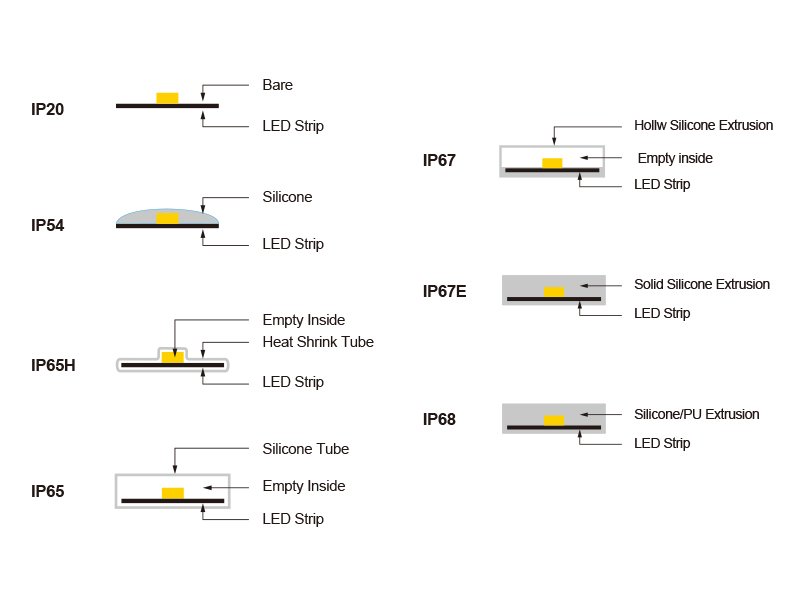
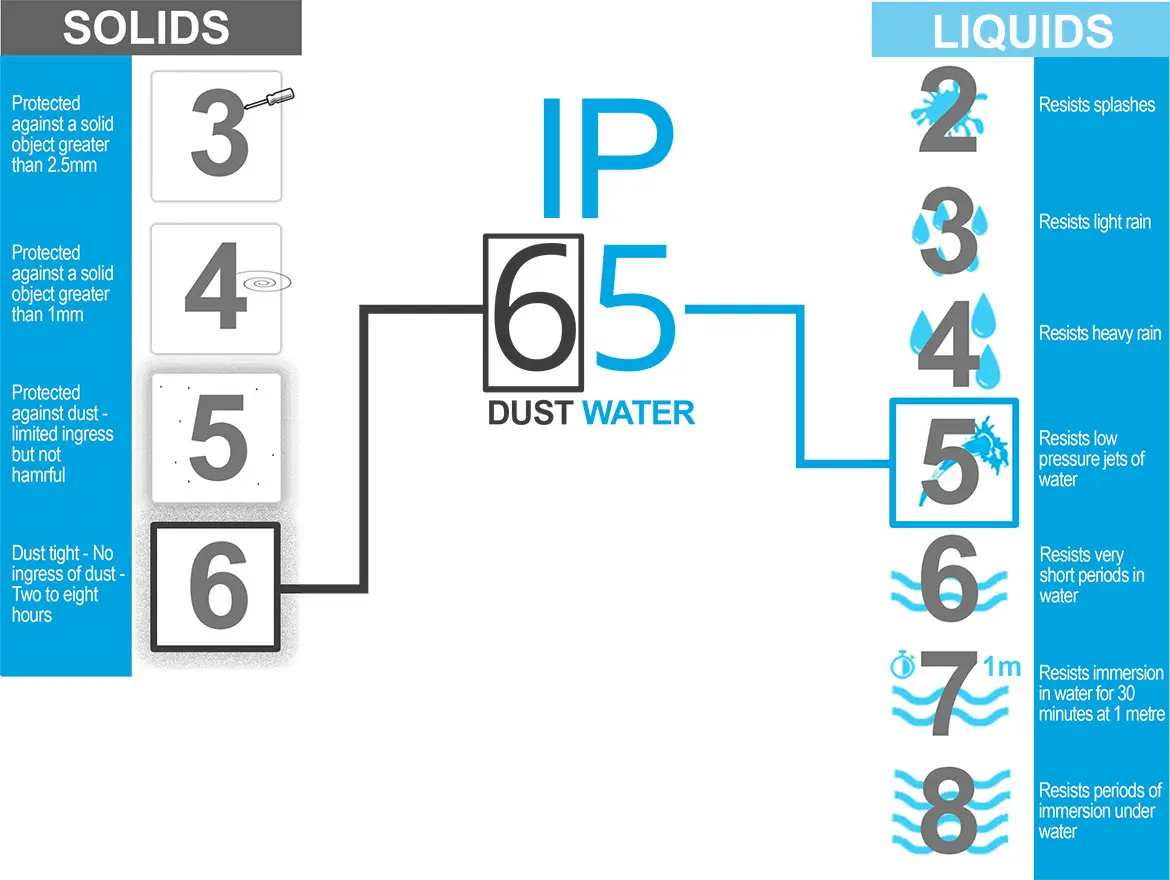
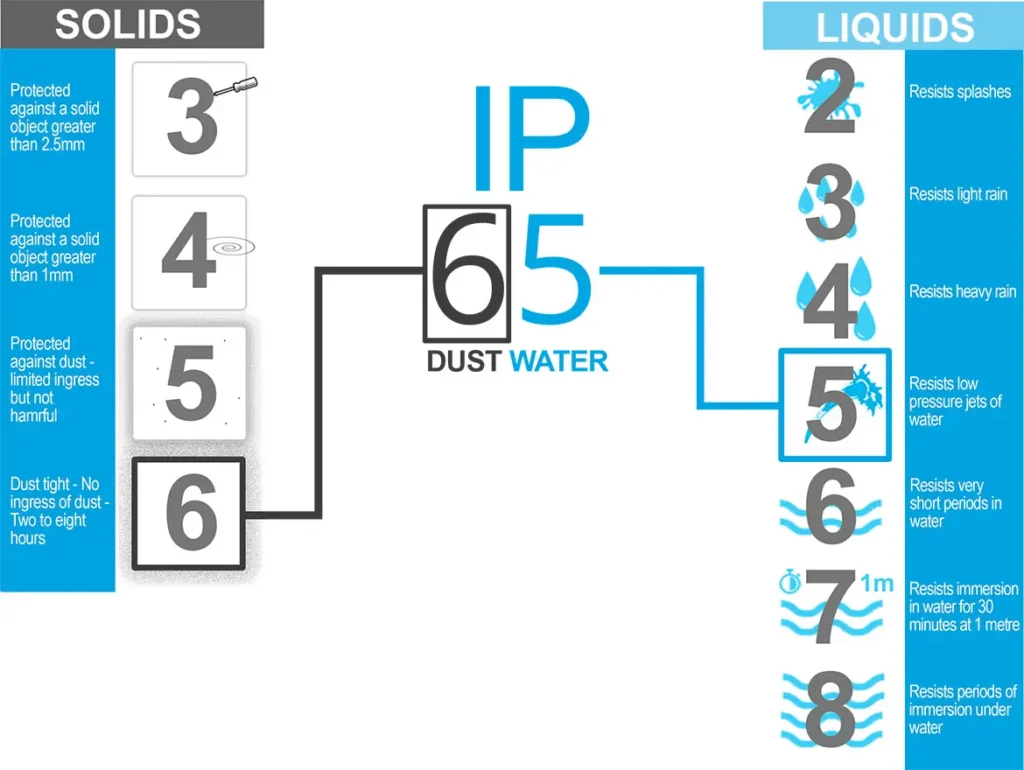
An IP code normally contains two characteristic numerals.
Using IP67 as an example:
- The first digit, 6, relates to protection against solid foreign objects and dust.
- The second digit, 7, relates to protection against the effects of temporary water immersion.
First Digit: Solid-Object Protection
| First digit | General meaning |
|---|---|
| 0 | No specified protection |
| 1–4 | Protection against progressively smaller solid objects |
| 5 | Dust-protected; limited ingress may be permitted if not harmful |
| 6 | Dust-tight |
Second Digit: Water Protection
| Second digit | General water exposure |
| 0 | No specified protection |
| 1–2 | Dripping water |
| 3 | Spraying water |
| 4 | Splashing water |
| 5 | Water jets |
| 6 | Powerful water jets |
| 7 | Temporary immersion |
| 8 | Continuous immersion under agreed conditions |
| 9 | High-pressure, high-temperature water jets under the applicable test method |
The precise test method, duration, sample arrangement and acceptance criteria should be obtained from the applicable standard and laboratory report.
IP65, IP67 and IP68 Are Not a Simple Waterproof Ladder
Many buyers assume:
IP65 < IP67 < IP68
That comparison is incomplete because jet tests and immersion tests represent different types of exposure.
- IPX5 evaluates water jets.
- IPX6 evaluates more powerful water jets.
- IPX7 evaluates temporary immersion.
- IPX8 evaluates continuous immersion under defined agreed conditions.
A construction designed to tolerate static immersion does not automatically resist a concentrated water jet aimed at a cable entry or end seal.
IEC 60529 provides for products that need protection against both water jets and immersion to be identified by the applicable dual classification—for example, an immersion rating together with a jet rating.
For an LED strip that will be pressure-washed, specifying only IP68 may therefore be insufficient.
Ask whether the exact product has passed:
- IPX5
- IPX6
- IPX7
- IPX8
- IPX9 where relevant
- A combination of jet and immersion tests
IPX8 Does Not Have One Universal Depth and Duration
IPX8 is frequently marketed as “completely waterproof” or “suitable for continuous underwater use.”
That description omits an important detail.
For IPX8, the immersion conditions are agreed between the manufacturer and user and must be more severe than the IPX7 conditions. The exact test depth and duration are not represented by the digit 8 alone.
An IP68 report should therefore state:
- Immersion depth or pressure
- Test duration
- Water temperature
- Sample configuration
- Cable and end-seal construction
- Whether the product was powered
- Preconditioning
- Number of samples
- Acceptance criteria
- Test laboratory
- Exact model and dimensions tested
Two products marked IP68 may have been tested under very different conditions.
What IP Tests Do Not Measure
| Exposure or property | Covered by a standard IP code? | Why separate validation is needed |
| Dust ingress | Yes, according to first digit | Exact protection depends on classification |
| Water splash, jet or immersion | Yes, according to second digit | Only the relevant defined water test is covered |
| UV radiation | No | Can yellow, crack or embrittle polymers |
| Solar heat | No | Raises material and LED operating temperature |
| Chlorine | No | Can attack polymers, metals, joints and adhesives |
| Saltwater | No | Promotes corrosion and ionic contamination |
| Salt fog | No | Requires a separate corrosion test |
| Cleaning chemicals | No | Chemical compatibility is formulation-specific |
| Oils and solvents | No | Can swell, soften or dissolve materials |
| Condensation | Not established by the basic IP code | Moisture can form internally without external water entry |
| Freeze-thaw cycling | No | Can stress seals and cable entries |
| Thermal cycling | No | Repeated expansion can open interfaces |
| Mechanical impact | No | Requires a separate mechanical classification or test |
| Cable flexing | No | Can damage the seal around the conductor |
| Long-term outdoor life | No | IP is not a service-life prediction |
| Pool electrical safety | No | Requires system and local regulatory evaluation |
| Optical clarity after aging | No | A strip may remain sealed while losing light |
| Adhesive durability | No | Mounting tape may fail independently |

Why an LED Strip Can Stay Sealed but Still Fail
Water ingress is only one possible failure mechanism.
An LED strip can retain its original seal while experiencing:
- Encapsulant yellowing
- Reduced lumen output
- Color shift
- Surface cracking
- Loss of flexibility
- Corroded external connectors
- Cable-jacket embrittlement
- Adhesive delamination
- Aluminum-profile corrosion
- End-cap separation
- Increased operating temperature
- Chemical swelling
- Loss of mechanical strength
A passed IP test therefore does not mean that the complete system will remain optically, electrically and mechanically acceptable.
UV Resistance: What Sunlight Can Do to an LED Strip
Outdoor LED strips are exposed to more than rain.
Sunlight contains UV radiation that can alter polymers, adhesives, pigments and cable materials. Solar exposure also heats dark profiles and surfaces above the surrounding air temperature.
Common UV-Related Failure Modes
UV exposure can cause:
- Yellowing
- Loss of optical transmission
- Surface chalking
- Cracking
- Embrittlement
- Loss of elasticity
- Adhesive degradation
- Fading of printed markings
- Cable-jacket deterioration
- Reduced impact resistance
- Changes in surface tack
The strip may continue operating electrically while producing less or differently colored light.
Why an IP Test Does Not Reveal UV Failure
An immersion or water-jet test does not reproduce months or years of:
- Solar radiation
- Day-night temperature changes
- Dry-wet cycles
- Thermal expansion
- Surface oxidation
- UV exposure combined with moisture
The enclosure may pass an IP test when new and become vulnerable later after its material has cracked or hardened.
How UV Resistance Should Be Tested
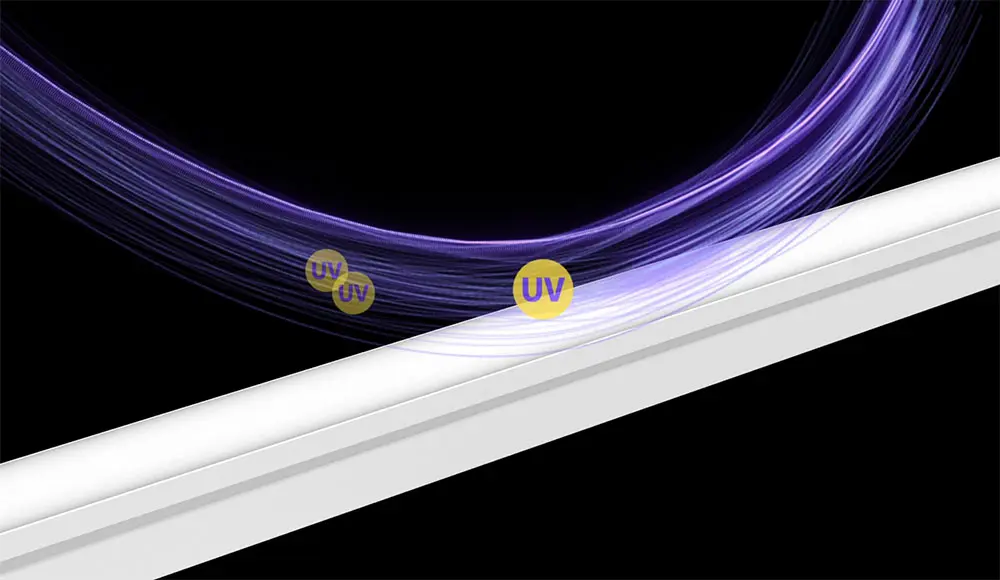
Laboratory weathering can use controlled light sources, moisture and temperature cycles.
The ISO 4892 series provides methods and guidance for exposing plastics to laboratory light sources and interpreting accelerated-weathering results.
A useful UV validation plan should define:
- Light source and test method
- Irradiance
- Wavelength range
- Black-panel or chamber temperature
- Moisture or condensation cycle
- Exposure duration
- Sample orientation
- Material thickness
- Pass/fail criteria
After exposure, evaluate:
- Yellowing
- Luminous-flux change
- CCT and chromaticity shift
- Cracks
- Hardness
- Flexibility
- Adhesion
- Seal integrity
- Electrical insulation
- Repeat IP performance where required
“UV-Resistant” Needs a Measurable Definition
A datasheet statement such as “UV-resistant silicone” is incomplete without defining:
- Material formulation
- Test method
- Exposure conditions
- Duration
- Permitted color change
- Permitted transmittance loss
- Mechanical acceptance criteria
Accelerated UV hours should not be converted directly into outdoor years using one universal ratio. Real exposure depends on geography, orientation, climate, pollution, temperature and installation geometry.
Chlorine Resistance: Why Pool Environments Are Different
A swimming-pool installation exposes materials to much more than clean water.
Potential exposure includes:
- Free available chlorine
- Combined chlorine compounds
- pH-control chemicals
- Salt from saltwater chlorination systems
- Cleaning products
- Warm water
- Continuous humidity
- Condensation
- Repeated wet-dry cycles
- Human-contact contaminants
Chlorine exposure is affected by:
- Concentration
- pH
- Water temperature
- Exposure time
- Water circulation
- Chemical dosing method
- Distance from dosing equipment
- Frequency of cleaning
- Whether the strip is immersed or only exposed to vapor
A material that survives occasional contact with a dilute chlorine solution may not survive continuous warm-water immersion.
Chlorine Can Affect More Than the Encapsulant
Potentially vulnerable parts include:
- Silicone or polyurethane encapsulation
- End caps
- Sealants
- Cable jackets
- Connector housings
- Adhesives
- Copper pads
- Solder joints
- Aluminum profiles
- Fasteners
- Printed labels
The complete assembly is only as resistant as its weakest exposed component.
Poolside and Underwater Are Different Applications
A poolside strip may experience:
- Chlorinated splash
- UV
- Cleaning chemicals
- Foot traffic
- Heat
- Dry-wet cycles
An underwater strip may experience:
- Continuous immersion
- Hydrostatic pressure
- Chlorine
- Warm water
- Cable-entry stress
- Difficult maintenance access
These applications should not share one generic “IP68 pool strip” specification.
IP68 Does Not Establish Pool Electrical Safety
An ingress rating does not determine:
- Permitted operating voltage
- Driver location
- Electrical isolation
- Equipotential bonding
- Circuit protection
- Installation zone
- Cable-routing requirements
- Local pool regulations
The strip, driver, controller, wiring and installation method must be evaluated as a complete electrical system.
For a deeper project-safety review, see Is an IP68 LED Strip Pool-Safe?.
Saltwater Resistance: Ingress Protection Is Not Corrosion Protection
Saltwater is more electrically conductive and more corrosive than clean water.
Even when liquid does not reach the internal LED circuit, salt can affect:
- External conductors
- Cut ends
- Cable entries
- Connectors
- Solder joints
- Aluminum profiles
- Screws and clips
- Mounting brackets
- Protective coatings
Why Salt Accelerates Problems
Salt deposits can:
- Retain moisture
- Increase ionic conductivity
- Promote electrochemical corrosion
- Enter small joints through capillary action
- Remain after water evaporates
- Create repeated wet-dry concentration cycles
A small amount of saltwater intrusion can be more damaging than the same amount of relatively clean water.
Galvanic Corrosion
Marine installations often combine different metals:
- Copper
- Tin
- Aluminum
- Stainless steel
- Carbon steel
- Brass
When dissimilar metals are electrically connected in the presence of an electrolyte such as saltwater, galvanic corrosion can occur.
This makes material selection important for:
- Profiles
- Fasteners
- Clips
- Connector contacts
- Cable conductors
- Grounding components
Salt-Fog Testing
IEC 60068-2-11 provides a salt-mist method for assessing the corrosion resistance of electrotechnical products, components and materials. See IEC 60068-2-11.
Cyclic salt-mist methods can be relevant where products experience alternating salt exposure and drying. IEC 60068-2-52 addresses cyclic salt-mist testing for components or equipment intended for salt-laden atmospheres.
ISO 9227 also defines neutral salt spray and other artificial-atmosphere corrosion methods. Importantly, ISO explains that salt-spray testing should not automatically be used to predict long-term corrosion life or rank unrelated materials. See ISO 9227.
Therefore, “500 hours of salt spray” does not automatically mean “five years by the sea.”
The test should be used with:
- Defined materials
- Defined coatings
- Agreed acceptance criteria
- Relevant comparison samples
- Project-specific field assumptions
Chemical Resistance: “Chemical-Proof” Is Not a Useful Specification
There is no single chemical-resistance rating comparable to IP65 or IP68.
A material may resist one cleaner and fail rapidly when exposed to another.
Potential LED strip exposures include:
- Isopropyl alcohol
- Ethanol
- Sodium hypochlorite
- Hydrogen peroxide
- Quaternary ammonium disinfectants
- Ammonia-based cleaners
- Acids
- Alkalis
- Degreasers
- Detergents
- Oils
- Fuels
- Solvents
- Lubricants
- Food residues
- Sunscreen or cosmetic products
Chemical compatibility depends on:
- Exact chemical
- Concentration
- Temperature
- Contact time
- Frequency
- Rinsing
- Mechanical stress
- Material formulation
- Combined exposure
“Resistant to cleaning chemicals” is therefore too vague for an RFQ.
How Chemicals Damage LED Strip Materials
Chemical exposure can cause:
- Swelling
- Softening
- Hardening
- Cracking
- Loss of transparency
- Discoloration
- Adhesive failure
- Sealant dissolution
- Cable-jacket damage
- Stress cracking
- Loss of tensile strength
- Corrosion
- Surface tackiness
A strip may still pass a quick electrical function check after exposure while its long-term seal has already been weakened.
Chemical Immersion Testing
ISO 175 specifies methods for exposing plastic test specimens to liquid chemicals and evaluating resulting property changes. See ISO 175.
For an LED strip project, material-coupon testing can be useful for screening, but it is not sufficient by itself.
The complete assembly should also be tested because:
- Joints behave differently from bulk material
- Cable entries create stress concentrations
- Different polymers contact each other
- Electrical conductors may be exposed at interfaces
- Thermal expansion affects the seal
- Adhesives can react differently from encapsulants
Silicone, Polyurethane and PVC: Which Is Most Resistant?
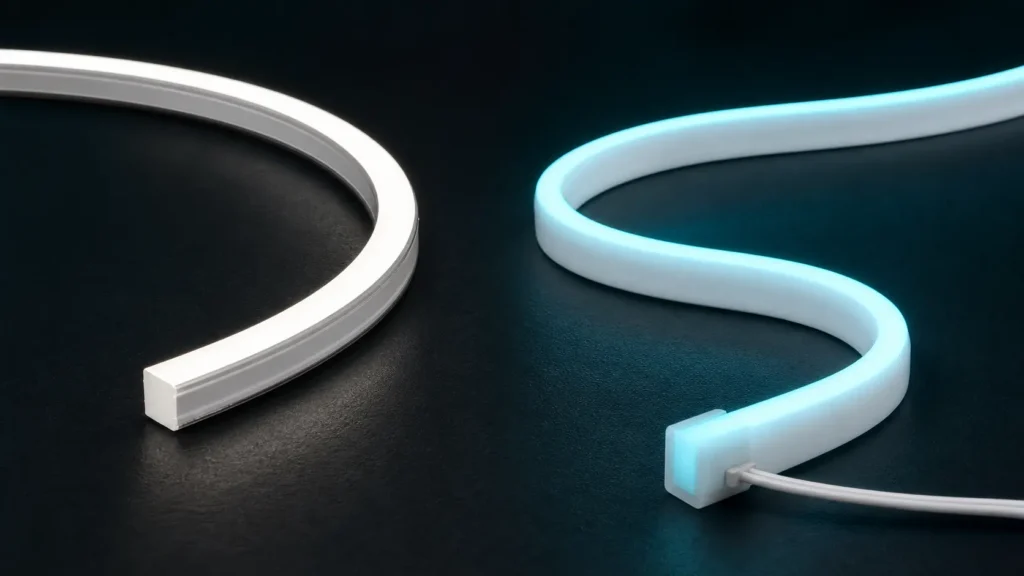
No encapsulation material is universally best.
Performance depends on the exact formulation, additives, curing, thickness and manufacturing process.
Silicone
Potential advantages:
- Wide operating-temperature capability
- Good flexibility
- Often good UV and weathering performance
- Suitable for extrusion and encapsulation
- Can maintain elasticity across temperature changes
Potential limitations:
- Chemical resistance varies by formulation
- Some oils and solvents can cause swelling
- Standard acrylic tapes may bond poorly to silicone
- High gas or moisture-vapor permeability may matter in some designs
- Poorly cured material can affect optical or mechanical performance
Polyurethane
Potential advantages:
- Good abrasion resistance in some formulations
- Strong encapsulation
- Good initial optical clarity in suitable grades
- Useful for fully potted constructions
Potential limitations:
- Some formulations yellow under UV
- Hydrolysis resistance varies
- Repair and field termination can be difficult
- Heat retention can affect strip temperature
- Hardness and flexibility can change with aging
PVC
Potential advantages:
- Economical
- Mechanically robust in suitable constructions
- Widely used for long-run and high-voltage strips
- Flexible formulations are available
Potential limitations:
- UV stability varies
- Plasticizer migration can affect adhesives and other materials
- Low-temperature flexibility varies
- Yellowing or embrittlement can occur
- Chemical performance is formulation-specific
Nano Coatings
Potential advantages:
- Minimal dimensional increase
- Limited optical impact
- Useful for condensation or light splash in appropriate designs
Potential limitations:
- Not equivalent to a fully sealed extrusion
- Cut pads and joints remain critical
- Coating coverage and production consistency matter
- Usually unsuitable for immersion unless specifically designed and tested
The material name is only the beginning of the specification.
The Weakest-Link Principle
An environmental claim should cover the complete supplied configuration.
For an LED strip system, inspect:
- Encapsulation
- PCB
- Cut end
- Factory end cap
- Cable entry
- Cable jacket
- Connector
- Solder joint
- Adhesive
- Aluminum profile
- Diffuser
- Fasteners
- Driver enclosure
- Controller enclosure
- Field junction box
A chemically resistant encapsulant does not protect an incompatible cable jacket.
A corrosion-resistant profile does not protect an unsealed copper joint.
An IP68 strip does not make an IP20 connector waterproof.
Factory-Finished Lengths vs Field Cutting
Field cutting is one of the most common reasons a tested waterproof construction becomes an untested installation.
Cutting can expose:
- Copper conductors
- PCB edges
- Capillary paths
- Encapsulation interfaces
- Solder pads
Rebuilding the seal in the field depends on:
- Surface preparation
- Sealant chemistry
- Mixing and curing
- Temperature
- Humidity
- Technician skill
- Cable movement
- End-cap fit
For demanding UV, chlorine, salt or chemical environments, factory-finished lengths are usually preferable.
The factory should define:
- Cut length
- Cable type
- Cable direction
- End-cap construction
- Sealant
- Cure process
- Pull-test requirement
- Leak-test procedure
- Batch inspection
Any field termination should follow a validated, documented method.
Why Real Outdoor Exposure Is a Combined Stress Test
Environmental failures rarely involve only one stress.
An outdoor LED strip may experience this sequence:
- Solar radiation heats the strip and profile.
- Heat expands the encapsulant, PCB and cable at different rates.
- Night cooling contracts the materials.
- Condensation forms inside or around the profile.
- Salt or pollutants remain after evaporation.
- Freeze-thaw or repeated thermal cycling stresses the seal.
- UV gradually changes the polymer.
- A cable entry or end cap eventually opens.
- Moisture reaches the conductors.
- Corrosion begins.
A new sample may pass its original immersion test but fail after environmental aging.
For critical projects, consider a sequential test such as:
- UV or weathering exposure
- Thermal cycling
- Chemical, chlorine or salt exposure
- Cable flex or pull
- Repeat ingress test
- Electrical and photometric inspection
This is more representative than performing unrelated tests on separate pristine samples only.
How to Build an Environmental Test Plan
Step 1: Define the Real Exposure
Record:
- Indoor or outdoor
- Direct or indirect sunlight
- Maximum ambient temperature
- Minimum ambient temperature
- Water source
- Immersion depth
- Immersion duration
- Water-jet pressure or cleaning process
- Chemical names
- Chemical concentrations
- pH
- Salinity
- Chlorine level
- Exposure frequency
- Cleaning method
- Rinse procedure
- Expected service life
Step 2: Identify Every Exposed Material
Request a material list covering:
- Encapsulant
- End cap
- Sealant
- Cable
- Connector
- Adhesive
- Profile
- Diffuser
- Fasteners
Trade names may be commercially sensitive, but the supplier should still provide enough information to support compatibility and testing.
Step 3: Define Baseline Measurements
Before exposure, record:
- Visual appearance
- Mass where relevant
- Dimensions
- Hardness or flexibility
- Adhesion
- Light output
- Power
- CCT and chromaticity
- Insulation performance
- Seal integrity
- Cable pull strength
Step 4: Apply Relevant Environmental Exposure
Choose tests based on the project—not on whichever report the supplier already has.
Possible tests include:
- IP water-jet test
- IP immersion test
- UV weathering
- Salt mist
- Cyclic salt mist
- Chemical immersion
- Chemical splash or wipe cycles
- Thermal cycling
- Damp heat
- Freeze-thaw
- Cable flexing
- Cable pull
- Operating thermal test
Step 5: Define Post-Exposure Acceptance
A useful pass/fail requirement can include:
- No harmful water ingress
- No exposed conductor
- No cracking
- No unacceptable swelling or softening
- No seal separation
- No significant corrosion
- Cable entry remains secure
- Insulation remains acceptable
- Power remains within tolerance
- Lumen loss remains within the project limit
- Color shift remains within the project limit
- Adhesion remains acceptable
- The sample passes a repeat IP test
“Still lights up” is not an adequate environmental acceptance criterion.
Application-Based Specification Matrix
| Application | IP requirement | Additional resistance to evaluate |
| Indoor bathroom | Splash or damp exposure as applicable | Condensation, cleaners, local electrical rules |
| Outdoor cove | Rain and possibly jets | UV, thermal cycling, condensation, pollution |
| Building façade | Rain and wind-driven water | UV, heat, mechanical retention, corrosion |
| Landscape lighting | Rain, splash and possible temporary flooding | Soil chemicals, fertilizers, UV, freeze-thaw |
| Coastal architecture | Rain or jets | Salt mist, galvanic corrosion, UV |
| Marine vessel | Splash, jets or immersion as applicable | Saltwater, vibration, fuel/oil, marine regulations |
| Poolside | Splash or jets | Chlorine, UV, cleaning chemicals, slip/impact conditions |
| Pool immersion | Defined immersion | Chlorine/salt, electrical safety, cable and joint validation |
| Fountain | Immersion and jets may both apply | Water treatment, turbulence, service access |
| Food-processing plant | Washdown | Detergents, disinfectants, heat, pressure |
| Commercial kitchen | Splash | Grease, steam, degreasers, heat |
| Car wash | Powerful jets | Detergents, waxes, pressure and temperature |
| Sauna or spa | Moisture exposure | Heat, steam, chemicals, thermal cycling |
| Industrial machinery | Fluid exposure as applicable | Oils, coolants, solvents, vibration |
| Refrigerated display | Condensation | Cleaners, low temperature, thermal cycling |
Environmental Requirements for an LED Strip RFQ
Instead of writing:
IP68, UV-resistant and chemical-proof LED strip required.
Use a structured specification.
Ingress Requirements
- Required IP classification
- Applicable standard and edition
- Jet, splash or immersion exposure
- IPX8 depth and duration
- Powered or unpowered test
- Complete sample configuration
- Required dual rating where applicable
UV Requirements
- Test method
- Light source
- Exposure duration
- Temperature and moisture cycle
- Maximum permitted yellowing
- Maximum lumen loss
- Maximum color shift
- Mechanical acceptance
Chlorine Requirements
- Chemical name
- Concentration
- pH
- Water temperature
- Immersion or splash
- Exposure duration
- Replenishment method
- Rinse cycle
- Acceptance criteria
Salt Requirements
- Salt concentration or real-water specification
- Salt-mist or cyclic test method
- Exposure duration
- Wet-dry cycle
- Metal and coating requirements
- Maximum corrosion allowance
- Post-test electrical requirements
Cleaning-Chemical Requirements
- Exact product or active chemical
- Dilution
- Contact time
- Application method
- Wipe or immersion frequency
- Rinse method
- Temperature
- Required number of cycles
Construction Requirements
- Encapsulation material
- Cable-jacket material
- End-seal method
- Factory-finished lengths
- Connector type
- Profile and fastener material
- Field-cut restrictions
- Mechanical retention
Ten Questions to Ask an LED Strip Supplier
- Which exact product configuration was IP tested?
- Can you provide the complete IP test report?
- What were the IPX8 depth and duration?
- Was the cable entry included in the tested sample?
- Has the product also passed a water-jet test?
- Which materials are exposed to UV or chemicals?
- Is there test data for the exact encapsulation formulation?
- Were UV, salt or chemical tests performed on material coupons or complete assemblies?
- What changes were measured after exposure?
- Are custom cable, cut-length or connector versions still covered by the report?
A report for one construction should not automatically be applied to:
- A different cable
- A different sealant
- A different encapsulant
- A different strip width
- A field-cut version
- A different connector
- A different production site
- A custom long-length version
Common Myths
“IP68 Is the Highest Rating, So It Covers Everything”
No. IP68 addresses dust protection and a defined immersion condition. It does not automatically cover jets, UV, salt, chlorine or chemical resistance.
“If Water Cannot Enter, Salt Cannot Cause Damage”
Salt can attack external metal components, cable entries, connectors, profiles and fasteners without reaching the internal PCB.
“Silicone Is Always UV- and Chlorine-Proof”
Silicone properties vary by formulation. UV, chlorine, oils, solvents, curing and mechanical design must be evaluated.
“A Salt-Spray Test Predicts Outdoor Life”
Salt-spray testing is useful for detecting coating defects and comparing controlled constructions. It does not provide a universal conversion from test hours to field years.
“Outdoor-Rated Means Suitable for Any Outdoor Location”
A shaded building cove, desert façade, coastal pier and chlorinated pool deck are four different environments.
“If the Strip Still Lights, It Passed”
Environmental degradation can begin before complete electrical failure. Optical, mechanical, insulation and seal performance must also be evaluated.
Frequently Asked Questions
Does IP65 mean an LED strip is UV-resistant?
No. IP65 addresses dust and water-jet protection under the applicable test conditions. UV resistance requires separate material or assembly testing.
Is an IP67 LED strip resistant to chlorine?
Not automatically. IP67 does not evaluate chlorine concentration, pH, temperature or long-term chemical compatibility.
Does IP68 mean an LED strip can be used in saltwater?
No. The product needs separate validation for saltwater, corrosion, cable entries, connectors and exposed metals.
Is IP68 better than IP66?
They address different water exposure. IP66 evaluates powerful water jets; IP68 evaluates immersion under specified conditions. A project requiring both should verify both.
Can an IP68 strip be pressure-washed?
Only if it also has appropriate water-jet resistance for the cleaning process. Immersion resistance alone does not prove resistance to a concentrated jet.
Can IP68 LED strips be installed in swimming pools?
An IP68 rating alone is insufficient. Chlorine resistance, immersion conditions, electrical safety, driver location, joints, cables and local regulations must also be addressed.
What is the best encapsulation for coastal projects?
There is no universal material. Evaluate the exact silicone, polyurethane, PVC, cable, sealant, profile and fastener system under salt, UV and thermal cycling.
How do I verify chemical resistance?
Specify the exact chemical, concentration, temperature, contact time, application method and acceptance criteria. Test both material coupons and the complete assembly where project risk justifies it.
Does a waterproof aluminum profile improve the strip’s IP rating?
Not automatically. The strip, profile, diffuser, end caps, cable entries and field assembly create a new system that needs its own evaluation.
How long should an accelerated UV or salt test run?
The duration should be selected from the project requirement, material system and applicable test method. There is no universal test-hour-to-service-year conversion.
Specify the Environment, Not Just the IP Number
The most reliable LED strip selection process begins with the exposure:
- Fresh water or saltwater?
- Splash, jet or immersion?
- Direct sun or shaded installation?
- Pool chlorine or general humidity?
- Which cleaning chemical?
- Which concentration?
- Which temperature?
- Continuous or intermittent exposure?
- Factory-finished or field-cut?
- How will the strip be mounted and serviced?
Xmart Lighting can develop LED strip configurations using different waterproof constructions, cable directions, factory-finished lengths and project-specific accessories. But an IP rating should never be used as a substitute for understanding the actual environment.

For outdoor projects, also review Why Outdoor LED Strips Fail After Passing an IP Test.
When requesting a project proposal, provide:
- Required IP test
- Installation drawing
- Water exposure
- UV exposure
- Chemical names and concentrations
- Salinity or chlorine conditions
- Operating temperature
- Segment lengths
- Cable-entry direction
- Profile and fastener materials
- Required test evidence
- Target service conditions
Submit these details through the Xmart Lighting quick quote form so the strip construction can be evaluated as part of the complete installation.
An IP rating answers one limited question:
How well did this enclosure protect against specified solids and water exposure during a defined test?
It does not answer the more important project question:
Will every material, joint, cable and optical surface remain functional in this exact environment over time?