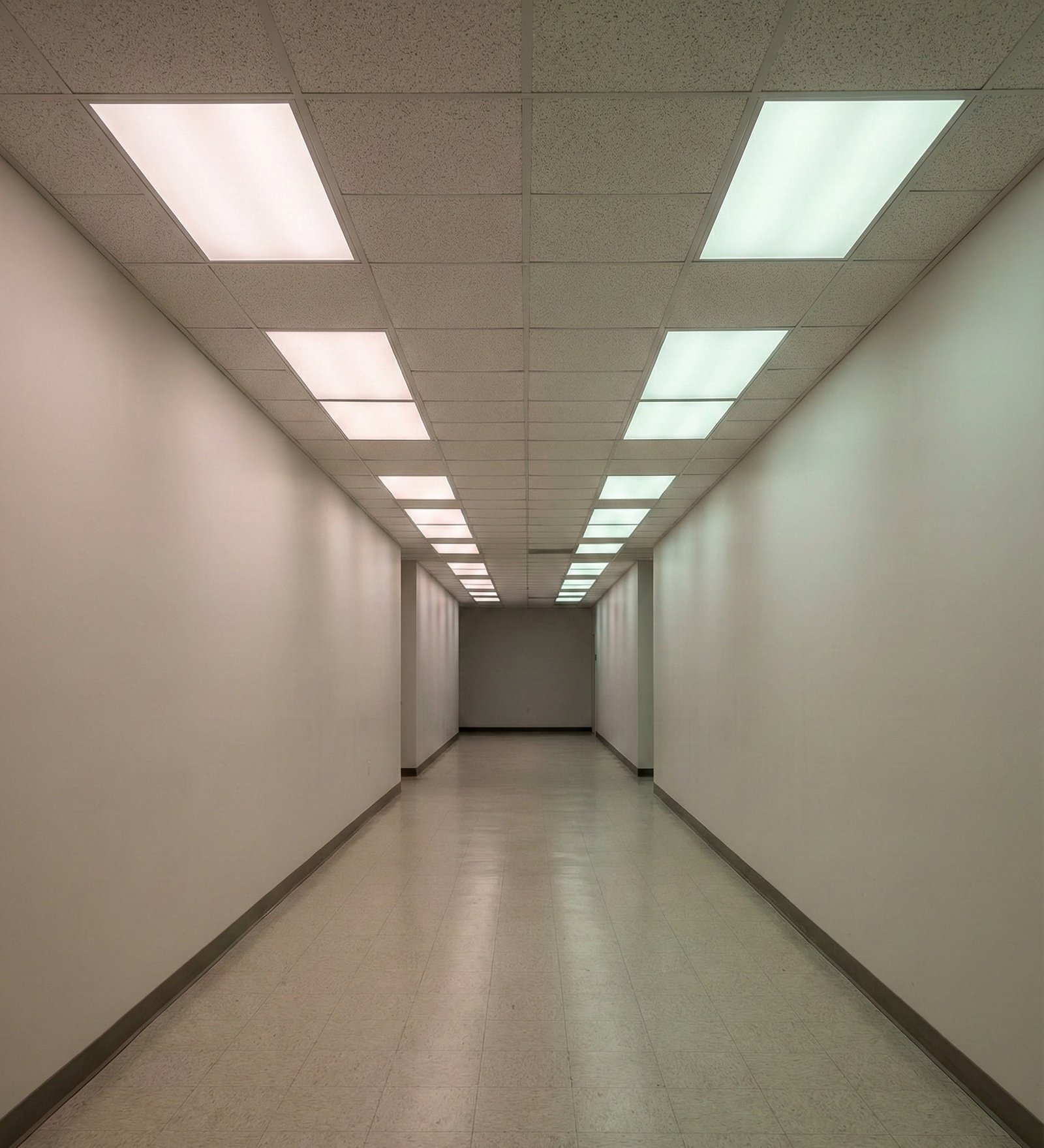
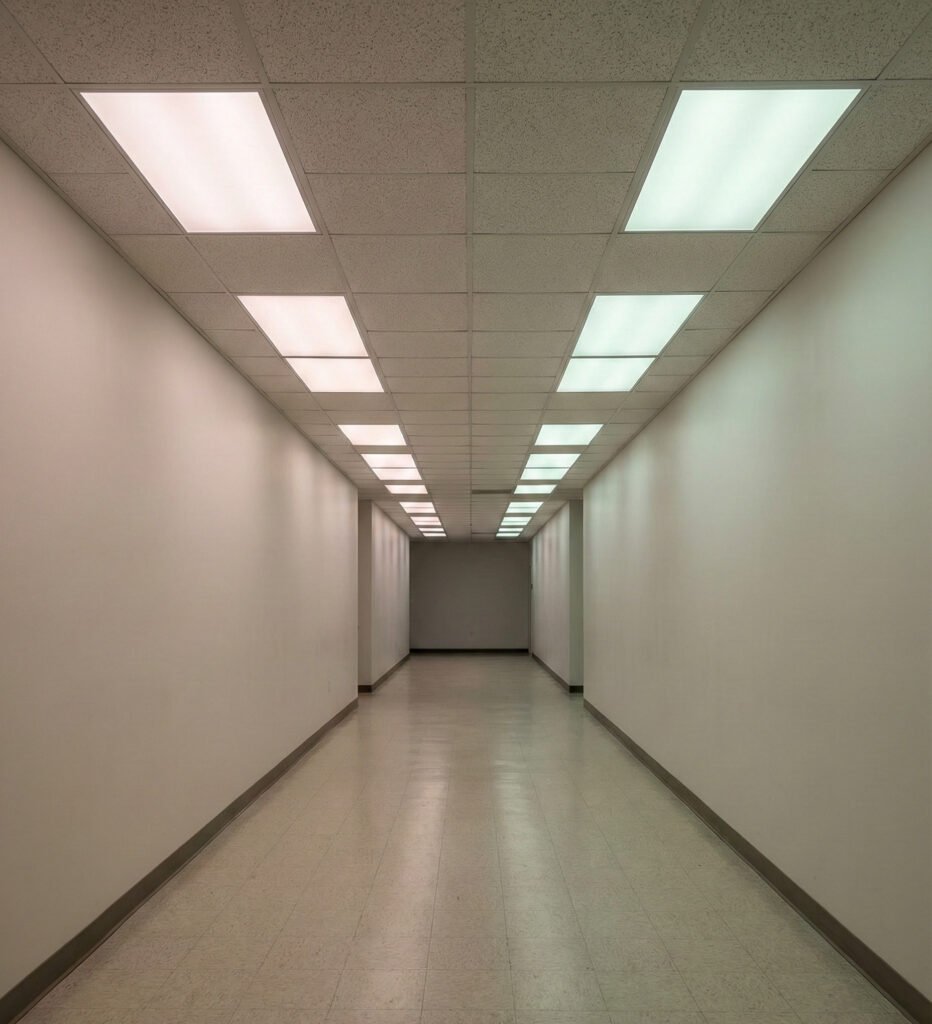
Two LED panels can both be correctly labeled 4000K and still look different when installed next to each other.
One may appear slightly green, pink, warm or cool. The difference may come from the LED bin, chromaticity target, Duv, operating temperature, drive current, diffuser or production-batch controls.
For distributors and project buyers, the key lesson is:
4000K is a nominal category—not one exact light color.
A purchasing specification that states only “4000K” cannot guarantee that the first order, repeat order and replacement panels will match.
Quick Answer
The most common causes of 4000K LED panel color mismatch are:
- Different LED chromaticity bins
- Different Duv values
- Different SDCM targets
- LED supplier or package substitutions
- Different operating temperatures
- Different driver output currents
- Diffuser material or thickness changes
- Inconsistent LED mixing
- Different measurement conditions
- Color shift during product aging
The problem is not solved by checking CCT alone. Buyers need control over the complete luminaire, production batch and repeat-order process.
4000K Is a Range, Not a Single Color Point
Correlated color temperature describes the approximate warm-to-cool appearance of white light.
However, a nominal 4000K designation covers a permitted chromaticity region. Products located at different points within that region may all be called 4000K.
ANSI C78.377-2024 specifies recommended chromaticity ranges for solid-state lighting products. Its purpose is to provide a standardized way to communicate nominal white-light chromaticity.
Compliance with the same nominal CCT category does not mean that two luminaires have identical chromaticity coordinates.
A simplified example:
| Panel | Label | Actual CCT | Duv | Possible Appearance |
|---|---|---|---|---|
| Batch A | 4000K | 3930K | Positive | Slightly green or yellow-green |
| Batch B | 4000K | 4070K | Negative | Slightly pink or magenta |
| Batch C | 4000K | 3990K | Near zero | More neutral |
All three can be described as approximately 4000K, but they may not look identical when installed together.
CCT Does Not Show the Green–Pink Direction
CCT primarily describes position along the warm-to-cool direction of white light. It does not fully describe how far the light is above or below the Planckian locus.
That second direction is commonly expressed using Duv.
- Positive Duv can produce a more greenish appearance.
- Negative Duv can produce a more pinkish or magenta appearance.
- A value closer to zero is nearer the Planckian locus.
The U.S. Department of Energy notes that CCT is most informative when considered together with Duv and chromaticity data.DOE color and spectrum guidance
This explains why two panels measured at almost the same CCT can still look different. Their Duv values may be moving in opposite directions.
For visually sensitive projects, a specification should not state only:
CCT: 4000K
It should also define an acceptable chromaticity or Duv range.
Why SDCM Does Not Automatically Solve the Problem
SDCM means Standard Deviation of Colour Matching. It is commonly used to describe the size of a chromaticity tolerance around a target.
A smaller SDCM value generally represents tighter chromaticity control.
However, a statement such as “≤3 SDCM” is incomplete unless the supplier also defines:
- The center of the tolerance
- The chromaticity coordinate system
- The measured product
- The operating conditions
- Whether the limit applies within one batch or between batches
- Whether it applies to repeat orders
- Whether the LED package or complete panel was measured
The CIE technical note on chromaticity difference specifications also cautions against treating MacAdam ellipses and “just noticeable difference” as universally interchangeable concepts. Actual perception depends on the visual conditions.
Two 3-SDCM Batches Can Still Look Different
This is one of the most important procurement points.
Suppose Batch A is controlled within three SDCM around one target. Six months later, Batch B is also controlled within three SDCM—but around a slightly different target.
Each batch may pass its own specification. Yet panels from the two batches can look different when installed side by side.
Therefore, “3 SDCM” does not automatically mean:
- Every carton will match.
- Every production lot will have the same center point.
- Repeat orders will match the first shipment.
- Replacement panels will match the original ceiling.
- Every selectable CCT setting has the same tolerance.
The target center and repeat-order rules must also be controlled.
LED Binning Is Only the Beginning
LED manufacturers sort components into groups, commonly called bins, according to characteristics such as:
- Chromaticity
- Luminous flux
- Forward voltage
- CCT
- Duv
A tighter LED bin can improve consistency, but the bin code alone does not completely define the finished panel.
The final appearance can still change because of:
- The number of LEDs mixed in each panel
- LED positions on the board
- Drive current
- Board temperature
- Diffuser properties
- Internal reflection
- Housing construction
- Test stabilization time
For this reason, a buyer should ask for finished-luminaire data—not only the LED package specification.
The Diffuser Can Change the Apparent Color
A flat panel’s diffuser does more than hide LED dots.
Its material, thickness, additives, surface texture and aging behavior can influence transmitted light. Two apparently similar diffusers may have different spectral transmission characteristics.
Production changes that can affect appearance include:
- Changing from one resin grade to another
- Changing diffuser suppliers
- Adjusting material thickness
- Changing anti-UV additives
- Using recycled material
- Changing surface texture
- Changing pigment concentration
- Using a different manufacturing process
A new diffuser may slightly shift the measured chromaticity even when the LED board remains unchanged.
The risk increases when a supplier treats the diffuser as a generic mechanical component rather than part of the optical system.
Temperature and Drive Current Matter
LED chromaticity can change with junction temperature and drive level.
If two panel batches use:
- Different driver output currents
- Different LED boards
- Different thermal contact
- Different housing materials
- Different internal spacing
their stabilized operating temperatures may differ.
A panel measured immediately after switch-on may also produce a different result from the same panel measured after reaching thermal stability.
For meaningful comparisons, the manufacturer should define:
- Input voltage
- Wattage setting
- CCT setting
- Ambient temperature
- Warm-up or stabilization method
- Measurement equipment
- Measurement time
Without consistent test conditions, a small reported batch difference may come from the measurement process rather than production.
Selectable-CCT Panels Need More Than One Color Check
A 5CCT LED panel can provide several nominal settings, such as:
- 3000K
- 3500K
- 4000K
- 5000K
- 6500K
Depending on the electrical and LED design, these settings may use different LED channels, combinations or drive conditions.
Therefore, a report at one setting should not automatically represent every selectable setting.
For a field-selectable product, buyers should ask:
- Was the complete panel measured at every CCT setting?
- What are the actual CCT and Duv values at each setting?
- Is the SDCM requirement applied to all settings?
- Which setting is the factory default?
- Are the LED part numbers and bins locked?
- Will repeat orders use the same chromaticity targets?
- Does changing the wattage setting affect the measured color?
A qualified LED flat panel light manufacturer should be able to connect the selectable settings to model-specific performance data and production controls.
Initial Color Consistency Is Not Maintained Color Consistency
Panels may match when new and still drift apart during operation.
Potential causes include:
- LED phosphor aging
- Encapsulant degradation
- Different LED junction temperatures
- Moisture exposure
- Optical material yellowing
- Driver-current change
- Uneven thermal stress
- Different operating hours
ANSI/IES LM-80-21 includes methods for measuring color maintenance of LED packages, arrays and modules under controlled conditions.
However, an LM-80 report applies to the LED source, not automatically to the complete panel. The diffuser, housing, driver and actual operating temperature can also influence maintained appearance.
Buyers should distinguish between:
- Initial chromaticity tolerance
- Batch-to-batch consistency
- Long-term color maintenance
- Replacement-product matching
They are related but not identical requirements.
Why Replacement Panels Often Look Different
A replacement panel may be ordered several years after the original project.
Even if the new product carries the same 4000K label, it may use:
- A newer LED generation
- A different LED package
- A different bin
- A revised driver
- A different diffuser
- A different chromaticity target
- A more efficient but spectrally different LED system
Meanwhile, the original installed panels may have experienced color shift.
The replacement is therefore being compared against an aged installation, not against the original new-product specification.
For larger projects, distributors should consider:
- Holding a small quantity of replacement stock
- Keeping the approved batch code
- Recording initial chromaticity values
- Retaining a golden sample
- Defining an approved replacement procedure
- Testing new and aged panels side by side
A model number alone may not be enough to guarantee a visual match years later.
Room Surfaces Can Exaggerate the Difference
Not every visible mismatch originates entirely from the luminaires.
Perceived color can also be affected by:
- Wall and ceiling paint
- Daylight
- Windows and blinds
- Carpet and furniture colors
- Reflections from glass or metal
- Different mounting positions
- Observer adaptation
- Nearby light sources
A white wall may make a green–pink difference more visible than a colored or textured surface. Daylight entering one side of a room can also make identical panels appear different.
Before rejecting a batch, compare the panels:
- In the same room position.
- After the same warm-up time.
- At the same power and CCT setting.
- Without daylight if possible.
- Using instrument measurements as well as visual inspection.
Phone photographs should not be used as the only evidence because camera exposure and automatic white balance can alter the apparent difference.
What Buyers Should Put in the Purchase Specification
A stronger 4000K panel specification may include the following requirements.
1. Nominal and Measured CCT
Specify the nominal CCT and acceptable measured range.
2. Target Chromaticity and Duv
Define the agreed target coordinates or Duv tolerance when appearance is critical.
3. SDCM Limit and Center
Do not state only “3 SDCM.” Identify the target center and the scope of the tolerance.
4. Production Scope
State whether the requirement applies:
- Within one panel
- Panel to panel
- Carton to carton
- Within one production lot
- Between production lots
- Across repeat orders
5. Complete-Luminaire Measurement
Require measurement after the LEDs, diffuser, driver and housing have been assembled.
6. Stabilized Test Conditions
Define the input voltage, operating time, ambient temperature, wattage setting and CCT setting.
7. Component Change Control
Require written approval before changing:
- LED supplier
- LED part number
- LED bin
- Driver
- Output current
- PCB layout
- Diffuser supplier
- Optical material
- Housing or thermal construction
8. Golden Sample and Data
Keep an approved physical sample together with its measured CCT, Duv, chromaticity coordinates and batch code.
9. Sampling Plan
Define how many finished panels are measured from each production batch and how failures are handled.
10. Repeat-Order Matching
State whether a repeat order must match the original approved target or only satisfy a broad nominal 4000K range.
Manufacturer Verification Checklist
Before approving a production batch, ask:
- What is the actual target chromaticity for 4000K?
- What Duv range is accepted?
- What SDCM limit is guaranteed?
- What is the center of that SDCM tolerance?
- Is the finished panel or only the LED package measured?
- How many samples are checked per production lot?
- Are all selectable CCT settings measured?
- Is the diffuser supplier locked?
- Are the LED part number and bin locked?
- Is driver output current controlled?
- Is a golden sample retained?
- How are repeat orders matched?
- What documentation accompanies each batch?
Buyers can also review Xmart’s available certification information and its broader explanation of SDCM, Duv and color-quality metrics when preparing a project specification.
Frequently Asked Questions
Can two LED panels both be 4000K and look different?
Yes. Nominal 4000K covers a chromaticity region. Different CCT, Duv and chromaticity coordinates within that region can produce visibly different appearances.
Does 3 SDCM guarantee that repeat orders will match?
Not by itself. The SDCM center, measurement conditions and repeat-order scope must also be defined.
Is LED binning enough to control panel color?
No. LED binning is important, but the finished color can also be affected by drive current, temperature, diffuser material and luminaire construction.
Does CRI explain why two white panels look different?
Not necessarily. CRI describes color rendering, while CCT, Duv and chromaticity describe the appearance of the emitted white light.
Can a diffuser change CCT?
It can alter the transmitted spectrum and measured chromaticity. Material, thickness, additives and aging should therefore be controlled.
Should every CCT setting of a selectable panel be measured?
For B2B approval, each available setting should have corresponding finished-product performance data or documented family coverage.
Why does a replacement 4000K panel not match the original installation?
The new panel may use different components or chromaticity targets, while the original panels may have shifted after years of operation.
Final Takeaway
“4000K” is not a complete color-consistency specification.
Reliable batch matching requires control of:
CCT + Duv + chromaticity target + SDCM center + LED bin + diffuser + temperature + measurement conditions + repeat-order rules
For distributors, importers and private-label brands, the objective is not simply to receive panels that individually pass a broad 4000K range. The objective is to receive panels that look consistent across cartons, production batches and future replacement orders.
To evaluate an OEM or commercial panel program, send Xmart the panel size, wattage settings, CCT settings, target SDCM, expected annual volume and repeat-order requirements through the commercial lighting quotation form.