Last reviewed: August 15, 2026
NICOR provides a clearer answer about government procurement eligibility than about factory location.
The company publicly lists its TGLS3 backlit troffer as TAA compliant. However, the reviewed NICOR pages do not identify the specific country where the fixture is manufactured.
That distinction matters. “TAA compliant” does not automatically mean “Made in USA,” and it does not tell an importer which tariff treatment applies.
The Short Answer
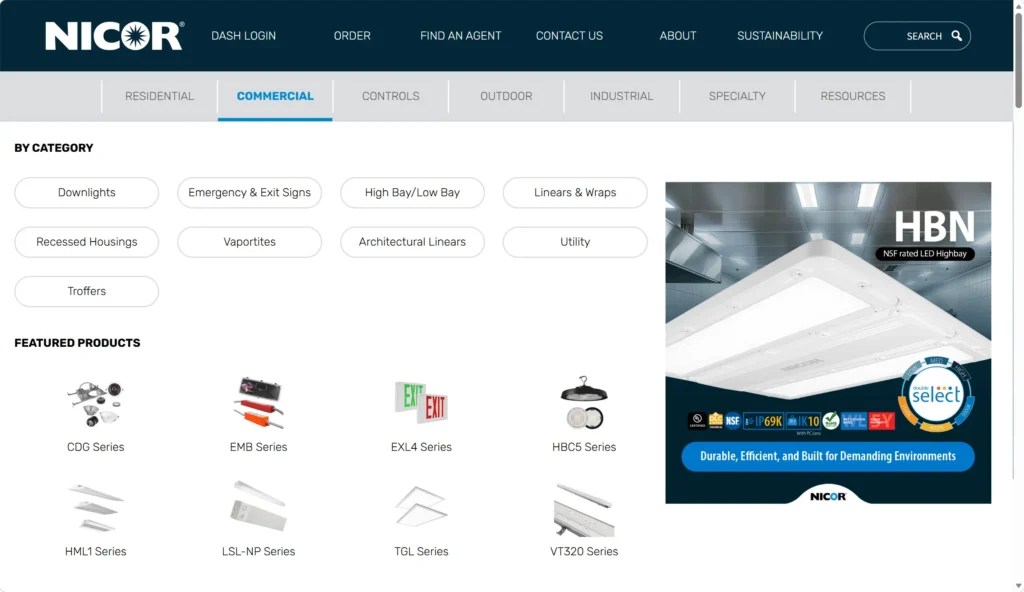
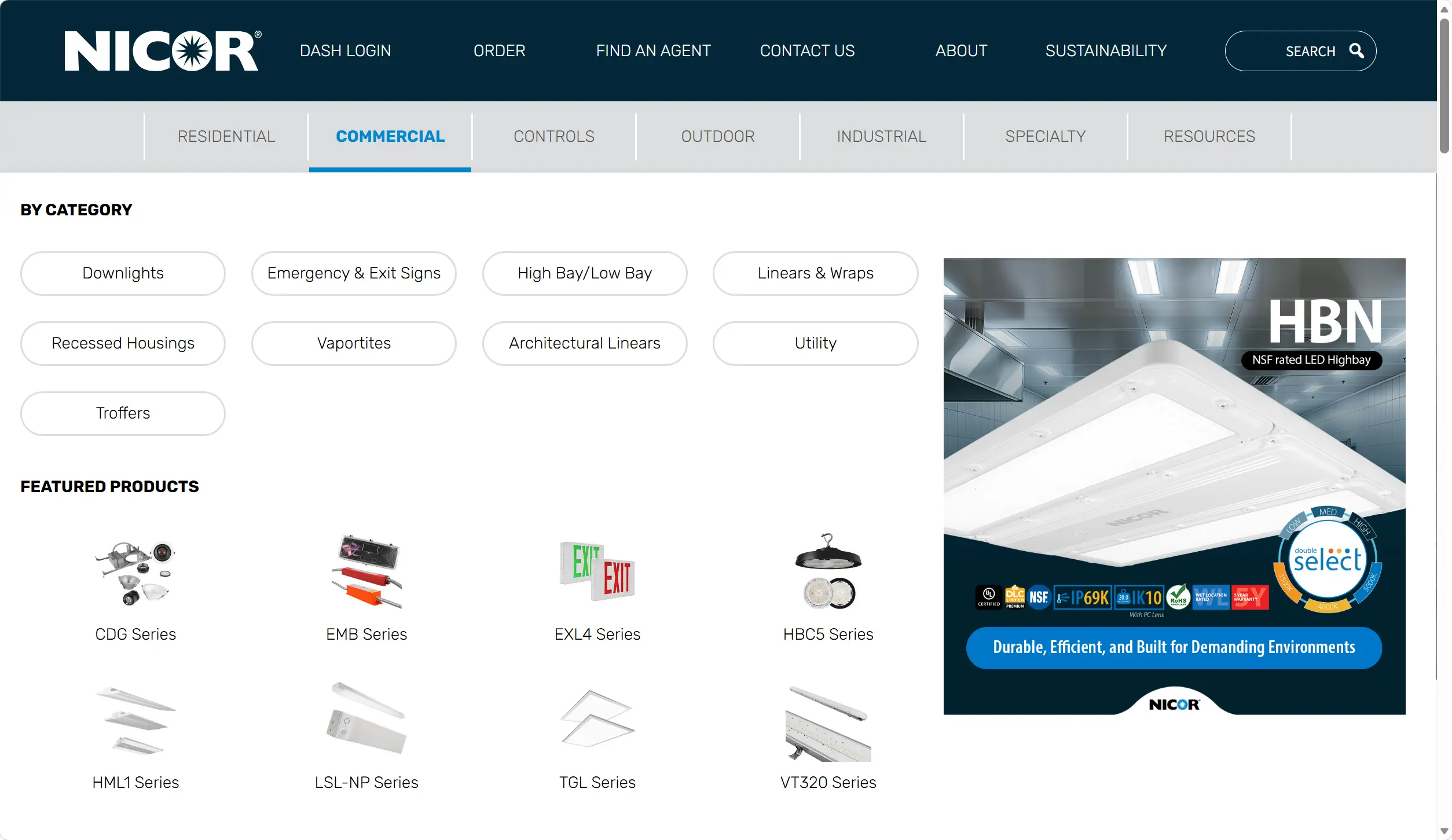
NICOR Lighting is headquartered in Albuquerque, New Mexico, with an additional customer support center in Georgia. These U.S. locations do not establish the country of origin of its LED fixtures.
Based on NICOR’s current public information:
- The TGLS3 is listed as a TAA-compliant backlit LED troffer.
- NICOR does not publicly name the designated country used for the TGLS3.
- The newer TGL4 is presented as a commercial backlit troffer, but it was not identified on the reviewed NICOR TAA product list.
- No reviewed source supports treating either series as unqualified “Made in USA” products.
Therefore, B2B buyers should verify the exact finished SKU—not only the NICOR brand or product family.
Why Buyers Search for a NICOR “Flat Panel” but Find a Troffer
NICOR markets the TGLS3 and TGL4 as backlit LED troffers. In commercial lighting searches, however, distributors and contractors may also describe this low-profile format as an LED flat panel.
The TGLS3 product page shows the characteristics normally associated with commercial backlit panels:
- 1×4, 2×2 and 2×4 configurations
- Selectable 3500K, 4000K and 5000K CCT
- Selectable wattage and lumen output
- 120–277V input
- 0–10V dim-to-off
- DLC 5.1 Standard
- Sealed backlit optical chamber
- Optional controls and emergency backup
For procurement purposes, the product name is less important than the construction, dimensions, certification record and exact ordering code.
What NICOR’s Public Record Confirms
NICOR includes the TGLS3 on its official TAA-compliance page. The company states that the listed products meet TAA procurement requirements and are eligible for applicable government contracts.
This is meaningful for buyers supplying certain federal or GSA-related projects. It indicates that NICOR has established a compliant sourcing route for the listed product.
But the statement still leaves several questions unanswered:
- Which designated country produces the TGLS3?
- Do all sizes use the same manufacturing location?
- Are emergency and control configurations covered by the same declaration?
- Can the declared origin change between production runs?
- Does the compliance statement cover the exact SKU being quoted?
A product-family page is useful during product discovery. It should not replace documentation tied to the final purchase order.
The TGLS3 and TGL4 Should Not Be Treated as the Same Product
The TGL4 is a newer backlit selectable troffer with sizes, electrical characteristics and applications similar to the TGLS3.
That does not allow buyers to transfer the TGLS3’s TAA status to the TGL4.
As of this review, NICOR’s TAA page identified the TGLS3, TGLS2 and TGL1 series, while the TGL4 was not displayed in the reviewed TAA category. This may reflect a certification update delay, a different supply chain or simply a product that has not been added to the list.
The correct response is not to assume noncompliance. It is to request a written statement for the exact TGL4 catalog number before including it in a government bid.
TAA Compliant vs Made in USA
This comparison is especially relevant because the two claims answer different procurement questions.
| Claim | What it generally establishes | What it does not establish |
|---|---|---|
| TAA compliant | The end product qualifies as U.S.-made or originates from an applicable designated country under the relevant procurement rules | That the fixture is manufactured in the United States |
| Made in USA | An unqualified claim generally requires the product to be “all or virtually all” made in the United States | That the product automatically meets every government solicitation |
| U.S. headquarters | The brand has U.S. business operations | The factory location or finished-product origin |
| Ships from the USA | Inventory is distributed from a U.S. location | Where the fixture was manufactured |
The Federal Acquisition Regulation defines a designated-country end product as a qualifying product from a WTO GPA, free-trade-agreement, least-developed or Caribbean Basin country, subject to the applicable definitions.
By contrast, the FTC’s Made in USA guidance says an unqualified claim generally requires final assembly, significant processing and all or virtually all components to be of U.S. origin.
A TAA-compliant fixture can therefore be manufactured outside the United States.
The Hidden Risk Is the Final Configuration
The base housing is not always the final product being delivered.
NICOR’s TGLS3 ordering structure includes different sizes, control options and emergency configurations. The product page also identifies optional networked lighting controls and emergency battery backup equipment.
For a normal commercial project, these options are mainly technical choices. For a regulated bid, they can become origin and compliance questions.
For example:
- Is the standard TGLS3 covered?
- Is the sensor-ready or NLC version covered?
- Is the emergency configuration covered?
- Does installing a separately sourced battery pack change the declared final SKU?
- Is the compliance declaration valid for the current production lot?
Buyers should request documentation matching the complete configuration shown on the quotation and purchase order.
A statement covering “TGLS3 Series” is weaker than one identifying the exact ordered part number.
TAA Status Does Not Determine the Import Duty
Another common mistake is using TAA eligibility as evidence that a fixture is tariff-free.
TAA governs specific government procurement treatment. Customs duty depends on separate factors, including:
- The finished product’s country of origin
- Its HTS classification
- Current trade-remedy measures
- Any applicable exclusions or special programs
- Whether the declared manufacturing process establishes substantial transformation
CBP generally determines origin by examining where the article was manufactured or substantially transformed. Simple relabeling, repacking or minor assembly in another country may not change origin.
Therefore, a distributor importing a TAA-compliant fixture still needs the actual country of origin to calculate landed cost. “TAA compliant” is not a usable substitute for “Made in [country].”
What Procurement Teams Should Request
Before approving a NICOR panel or troffer for a regulated project, request the following:
- Complete catalog number
- Written country-of-origin declaration
- Current TAA compliance statement
- Factory or final-assembly country
- Product and carton marking photos
- Applicable DLC product ID
- Safety listing file or certification reference
- Confirmation covering emergency and control options
- Statement that the supplied production lot matches the approved documentation
The declaration should appear in the vendor file before the purchase order is released.
Suggested RFQ Language
Please confirm the finished-product country of origin and TAA eligibility for the exact NICOR catalog number quoted. The declaration must cover the selected size, control package, emergency option and current production lot. Please also provide label photographs and the applicable safety and DLC listing references.
This wording prevents a supplier from answering only at brand or family level.
Can Trade Data Reveal the Factory?
Import records may show that a lighting company works with suppliers in several countries. They can help identify possible sourcing patterns, but they rarely prove the origin of one LED panel model.
A shipment associated with NICOR could involve downlights, outdoor fixtures, components, packaging or another product category. Even a shipment containing “lighting fixtures” may not establish that it contains TGLS3 or TGL4 units.
Trade data should be treated as a lead for further verification—not as a model-level country-of-origin certificate.
When Buyers Need a More Transparent OEM Supply Route
A branded catalog product and a factory-direct OEM program solve different purchasing problems.
NICOR may be appropriate when a project needs an established U.S. brand, local distribution and a listed TAA product. A factory-direct program may be more suitable when a distributor needs control over:
- Private-label packaging
- Selectable wattage and CCT combinations
- Carton and pallet configuration
- Batch-level color consistency
- Driver and control specifications
- Country-of-origin documentation
- MOQ and model consolidation
Buyers assessing alternative Asian production locations can review this list of top commercial lighting manufacturers in Vietnam.
Vietnam Xmart also provides a Made-in-Vietnam commercial backlit panel program for distributors, lighting brands and project suppliers. Available program features include 1×4, 2×2 and 2×4 sizes, 0–10V dimming, selectable output, UL and DLC 6.0 positioning, channel-specific packaging and certificate-of-origin support.
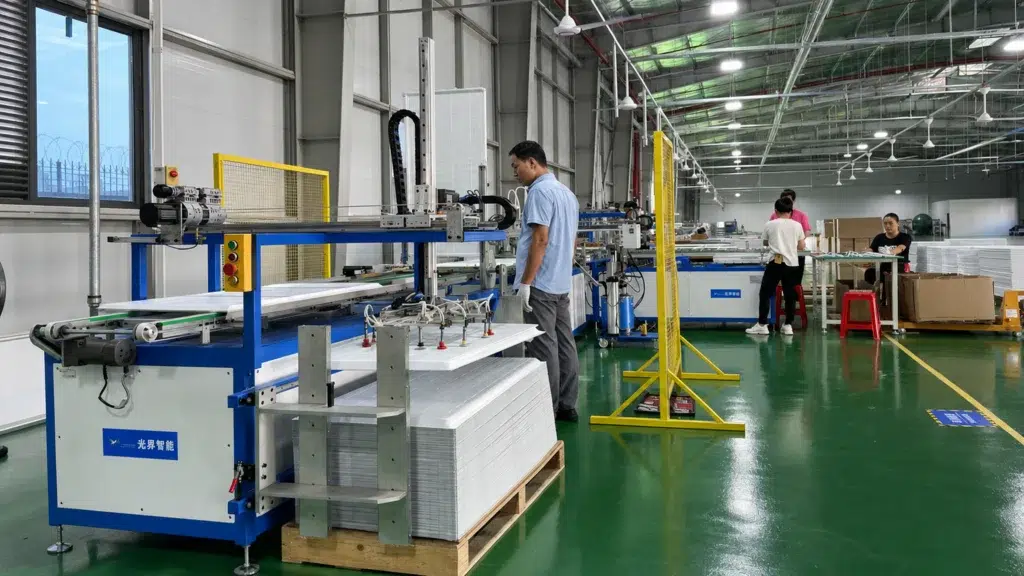
For product-specific approval, buyers should review the relevant certification documentation and confirm that the final model meets the requirements of the intended market or solicitation.
A Vietnam origin by itself does not guarantee TAA eligibility or a particular tariff result. Both must be verified against the finished product, manufacturing process and applicable procurement rules.
Frequently Asked Questions
Is NICOR Lighting an American company?
NICOR Lighting operates from U.S. locations, including its headquarters in Albuquerque, New Mexico. A U.S. headquarters does not establish that every NICOR fixture is manufactured in the United States.
Where is the NICOR TGLS3 manufactured?
NICOR publicly lists the TGLS3 as TAA compliant, but the reviewed public pages do not name the specific manufacturing country. Buyers should request a current declaration for the exact catalog number.
Is the NICOR TGLS3 TAA compliant?
NICOR currently includes the TGLS3 on its official TAA-compliant product list. Eligibility should still be confirmed for the exact configuration and solicitation.
Is the NICOR TGLS3 made in the USA?
The reviewed NICOR pages do not make an unqualified Made in USA claim for the TGLS3. TAA compliance should not be interpreted as proof of U.S. manufacture.
Is the newer NICOR TGL4 TAA compliant?
The TGL4 was not identified on the reviewed NICOR TAA product page as of August 15, 2026. Buyers should obtain written confirmation rather than transferring the TGLS3 status to the newer series.
Does TAA compliance mean no U.S. import tariff?
No. TAA procurement eligibility and customs tariff treatment are separate matters. Importers need the actual country of origin, HTS classification and current tariff rules.
Can emergency or sensor options affect compliance?
Potentially. Optional drivers, batteries, sensors or control packages may introduce different components or final configurations. Request documentation covering the complete ordered SKU.
Final Procurement Verdict
NICOR’s TGLS3 offers buyers a publicly identified TAA-compliant backlit troffer, but the public record does not reveal one named manufacturing country.
The more important finding is that buyers cannot automatically apply that status to the newer TGL4 or every optional configuration.
For ordinary commercial distribution, technical performance and certification may be sufficient. For federal procurement, tariff planning or origin-sensitive bids, require written evidence tied to the exact model and production lot.
If your company is evaluating a top LED flat panel manufacturer for a private-label or distributor program, compare suppliers on documentation control, batch consistency, certification coverage and final landed cost—not simply on the location of the brand’s headquarters.
Request an OEM LED panel quotation with your required size, wattage, CCT, controls, certifications, packaging and target market.