The easy answer is “China.” It may also be outdated.
Public distributor records identify some older ASD edge-lit panels as products of China. However, an exact-model packaging record and recent shipping data point to a Vietnam supply route for at least part of ASD’s current backlit panel program.
For commercial lighting distributors, contractors and importers, this distinction matters. A brand’s office address does not establish origin—and neither does the origin of a discontinued product family.
The Short Answer
Based on the public evidence reviewed:
- Legacy ASD ELP edge-lit models were listed as made in China.
- The current ASD-BLP-24A40-4P has evidence connecting its packaging program to Vietnam.
- ASD received substantial LED-light shipments from Vietnamese suppliers in 2026.
- ASD continues to use suppliers and shipping routes associated with multiple countries.
- Public evidence does not prove that every BLP, BLP-PRO or ASD panel is made in Vietnam.
The commercially responsible conclusion is therefore:
ASD appears to have moved at least part of its current LED panel supply chain from China to Vietnam, but country of origin must still be verified by exact model, purchase order and production lot.
What the Public Evidence Shows
| Evidence | Product or scope | What it supports | What it does not prove |
|---|---|---|---|
| Grainger country-of-origin listing | ASD-ELP22D2765HE | Legacy ELP panel listed as China origin | Current BLP origin |
| Zoro country-of-origin listing | ASD-ELP22D2740STD | Another ELP model listed as China origin | All ASD panels are Chinese |
| Vietnam export record for 5,100 specification labels | ASD-BLP-24A40-4P | Exact current model had factory-side packaging activity in Vietnam | Every finished fixture was substantially transformed in Vietnam |
| 2026 bills of lading | Company-wide LED shipments | ASD has an active Vietnam lighting supply chain | Which models were inside each shipment |
| ASD’s current product documents | BLP and BLP-PRO series | Current construction, ratings and warranties | Legal country of origin |
ELP vs BLP: Why the Series Name Changes the Answer
An origin audit should not combine ASD’s ELP and BLP products into one category.
ELP: The Legacy Edge-Lit Series
The ELP models found in distributor databases are edge-lit flat panels. Their LEDs illuminate a light-guide plate from the sides of the fixture.
Two identified ELP models carry China as their listed country of origin:
- ASD-ELP22D2765HE
- ASD-ELP22D2740STD
These listings support a China origin conclusion for those specific models. They do not establish the origin of ASD’s newer backlit panels.
BLP: The Current Backlit Series
ASD’s current BLP family uses a backlit construction. The LED modules are positioned behind the diffuser instead of around the edge of a light-guide plate.
Current BLP models include:
- ASD-BLP-22A30-4P: 2×2, 20/25/30W
- ASD-BLP-24A40-4P: 2×4, 25/30/40W
- ASD-BLP-24A50-4P: 2×4, 30/40/50W
- Sensor and emergency-battery configurations
- A higher-output 2×4 configuration
- BLP-PRO models with different warranty terms
The standard BLP range is listed for 120–277V operation, 0–10V dimming and selectable 3500K, 4000K and 5000K settings. ASD also lists UL and DLC Premium certifications for applicable models.
For a replacement project, “ASD flat panel” is therefore not a complete specification. Buyers should identify the series, complete model number, revision and required photometric performance.
The Most Important Clue Is an Ordinary Carton Label
The strongest model-level Vietnam clue is not a finished luminaire shipment.
It is a September 2024 Vietnam trade record describing 5,100 outer-box specification labels for:
ASD (VN) — ASD-BLP-24A40-4P
This matters because the record names an exact, currently marketed 2×4 BLP model. It is more relevant than a generic manifest description such as “LED LIGHT.”
But a label record is not a customs ruling.
It supports the inference that ASD-BLP-24A40-4P packaging was being prepared within a Vietnam production program. It does not independently establish:
- Where the LED boards were produced
- Where the drivers were made
- Where final fixture assembly occurred
- Whether substantial transformation occurred in Vietnam
- Whether every production lot followed the same route
This is the difference between useful supply-chain intelligence and defensible customs documentation.
ASD’s Supply Chain Is Broader Than One Country
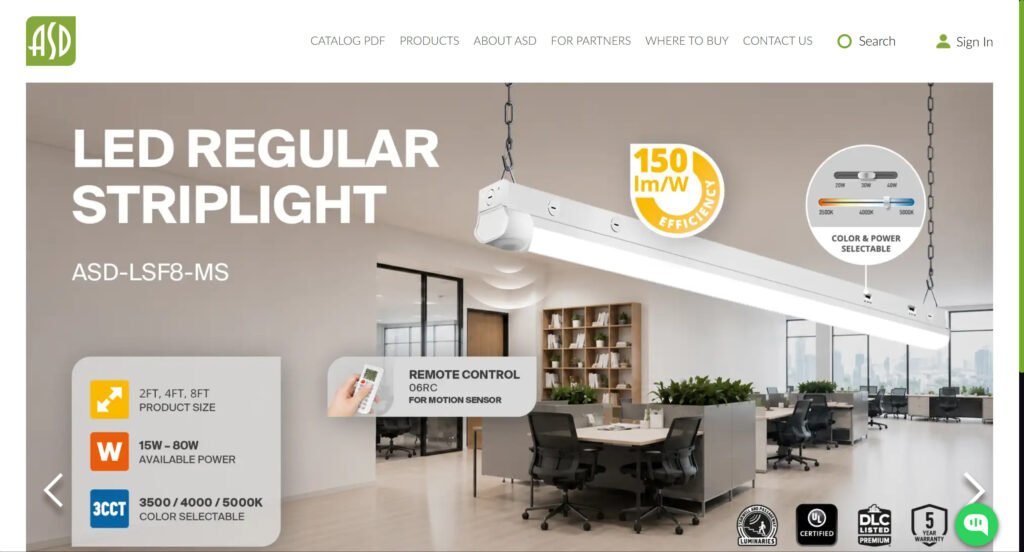
ASD Lighting identifies itself as a U.S. LED lighting manufacturer and lists its corporate address in The Woodlands, Texas. That establishes its U.S. commercial presence—not the factory location of every luminaire.
Recent bills of lading show ASD receiving large shipments of LED lighting from suppliers such as Vietnam Huadian Lighting Company and Jiangjing Lighting Bac Ninh Company. The same import history also includes suppliers and loading routes connected to China and other Asian manufacturing locations.
This indicates a diversified, multi-factory supply chain.
It also creates a procurement risk: the origin attached to one order may not remain valid for the next order simply because the brand and catalog number appear unchanged.
Does Vietnam Production Remove China Section 301 Duties?
China Section 301 measures generally depend on the legally determined country of origin and the applicable HTS classification. Routing Chinese components through Vietnam or attaching a Vietnam label does not by itself change origin.
CBP applies a substantial-transformation analysis. The relevant questions can include:
- Where the essential components were produced
- Where the fixture obtained its final name, character or use
- How complex the Vietnam manufacturing operations were
- Whether the work was meaningful manufacturing or minor assembly
- Which component or process gave the luminaire its essential character
CBP rulings show that Vietnam assembly can establish Vietnam origin when the operations and locally produced components are sufficiently meaningful. Other rulings reach the opposite conclusion when the essential character remains with Chinese-origin components.
Importers should also remember that avoiding a China-specific Section 301 measure does not mean the shipment is duty-free. Other tariffs, surcharges and ordinary duties may apply according to the entry date, HTS code and current trade policy.
Use the USTR Section 301 product search and obtain a written classification and origin assessment from a customs broker. Do not calculate landed cost from “Made in Vietnam” alone.
A 180,000-Hour Calculation Is Not a 180,000-Hour Warranty
ASD states that the standard BLP series has a calculated lifespan of up to 180,000 hours. The same product family carries a five-year limited warranty.
These statements describe different things.
Calculated life is an engineering projection based on lumen-maintenance assumptions and operating conditions. A warranty defines the manufacturer’s contractual remedy and its time limit.
For B2B buyers, warranty exposure should be evaluated through:
- Covered components
- Maximum daily operating hours
- Ambient-temperature limits
- Labor reimbursement
- Freight responsibility
- Advance-replacement terms
- Required failure-rate evidence
- Whether the original model or only an equivalent replacement is guaranteed
The BLP-PRO cut sheet offers a ten-year standard warranty under specified conditions, including operation below 16 hours per day and stated ambient limits. If those conditions are exceeded, the document says the applicable warranty may be five years.
Therefore, BLP and BLP-PRO should not be treated as interchangeable simply because their visible panel format is similar.
Do Not Copy One Lumen Number From a Summary Page
ASD’s detailed BLP documentation gives output by wattage and CCT.
For ASD-BLP-24A40-4P at 40W, the published matrix includes different lumen outputs at 3500K, 4000K and 5000K. A shorter product-page summary may show only one value associated with each wattage setting.
That is not necessarily a test-data contradiction. It demonstrates why a distributor should not build a submittal by copying isolated figures from different documents.
For each project, lock the following to one dated document revision:
- Exact catalog number
- Selected wattage
- Selected CCT
- Delivered lumens
- Input watts
- Efficacy
- Driver designation
- Dimming range
- DLC product ID
- Emergency configuration
- Warranty conditions
If the specification, DLC record and carton label do not match, stop the shipment review before delivery.
What B2B Buyers Should Request From ASD or Any Panel Supplier
Before issuing a purchase order, request:
- A country-of-origin declaration naming the complete model number.
- A carton and fixture-label photo from the production lot.
- The factory name and physical manufacturing address.
- A description of the operations performed in that factory.
- The origin of the driver, LED boards, housing and diffuser.
- The HTS classification used for U.S. entry.
- The current UL file and DLC product ID.
- A dated LM-79 report for the supplied configuration.
- The warranty document applicable to the exact series.
- Written notification requirements for factory or component changes.
A supplier statement that says only “Vietnam origin” is insufficient when the importer must defend the declaration to Customs or a customer.
What an Alternative Manufacturing Partner Should Disclose
A top LED flat panel manufacturer should be able to connect the quotation, production factory, certification records and finished-product labels to the same model.
When comparing an established U.S. brand with a direct OEM program, buyers can review Xmart’s backlit LED panel platform and certification capabilities. The goal is not merely to find a lower unit price. It is to control:
- Product configuration
- Private-label documentation
- Batch consistency
- Driver and LED substitutions
- Certification coverage
- Country-of-origin evidence
- Warranty-failure cost
- Lead-time and tariff exposure
For sourcing teams evaluating diversification beyond China, this guide to commercial lighting manufacturers in Vietnam provides a broader supplier-screening starting point.
Buyers with a defined specification can also request a project quotation for a model-level comparison.
Frequently Asked Questions
Where is ASD Lighting based?
ASD Lighting Corp lists its address in The Woodlands, Texas. This is a corporate location and should not be interpreted as the manufacturing origin of every product.
Are ASD LED flat panels made in China?
Some legacy ASD ELP edge-lit models are publicly listed as products of China. That answer should not be applied automatically to the current BLP family.
Are current ASD BLP panels made in Vietnam?
There is meaningful evidence of a Vietnam supply route for ASD-BLP-24A40-4P, including an exact-model packaging-label record and recent ASD imports from Vietnamese lighting suppliers. Public records do not prove that every BLP model or production lot is Vietnam origin.
What is the difference between ASD ELP and BLP panels?
ELP refers to older edge-lit models, while BLP refers to the current backlit product family. The construction, generation and available origin evidence are different.
Is ASD-BLP-24A40-4P DLC Premium listed?
ASD’s current product materials identify the model as UL certified and DLC Premium listed. Buyers should still confirm the active DLC product ID and approved configuration at the time of purchase.
Does a Vietnam-made ASD panel avoid all U.S. tariffs?
No. Vietnam origin may change exposure to China-specific Section 301 duties, but other duties and trade measures can still apply. Legal origin, HTS classification and the entry date must all be verified.
Final Verdict
The statement “ASD LED panels are made in China” is too broad.
It accurately describes some older ELP models found in distributor databases. Current evidence, however, points to a Vietnam manufacturing or packaging program for at least one major BLP model: ASD-BLP-24A40-4P.
The evidence is strong enough to challenge the old assumption, but not strong enough to assign Vietnam origin to the entire ASD panel portfolio.
For B2B procurement, the correct question is not:
Where does ASD manufacture its LED panels?
It is:
Where was this exact model and production lot manufactured, and what documentation supports that origin declaration?
That question is more difficult—but it is the one that protects landed cost, compliance and project margin.