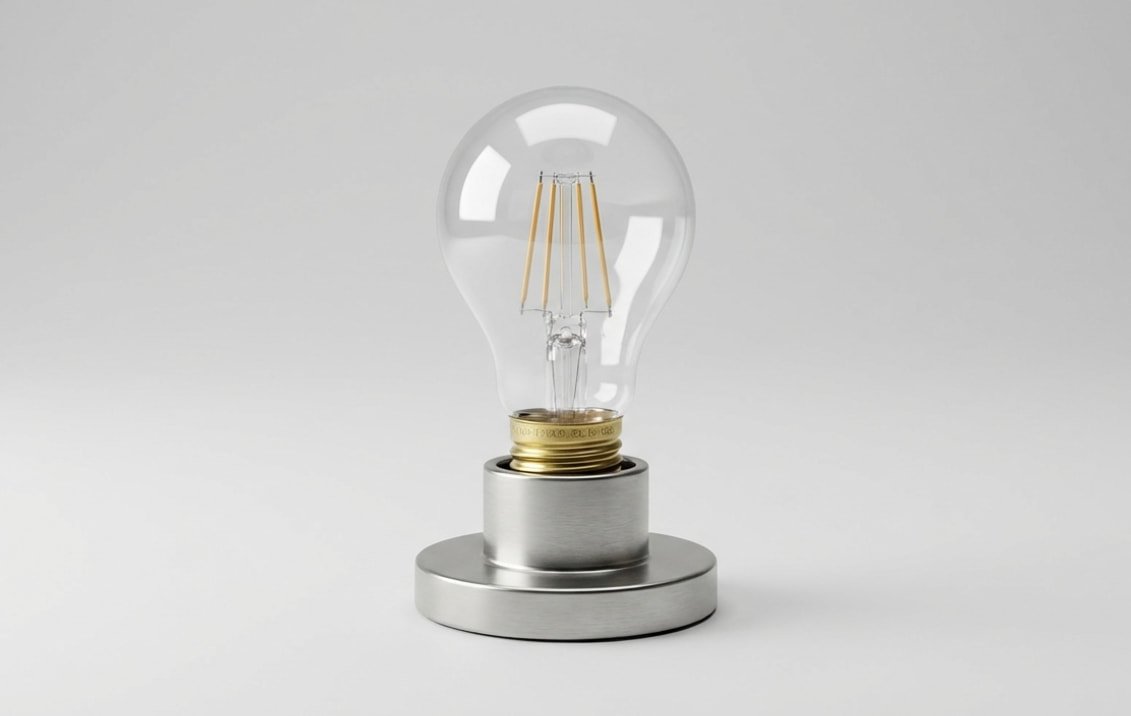
E26 bulbs represent the most common light bulb base type in North America, featuring a 26-millimeter diameter Edison screw base that fits standard household fixtures.
This universal design has become the backbone of residential and commercial lighting systems, making it essential knowledge for anyone selecting bulbs for their home or business. Understanding E26 specifications helps ensure compatibility with your existing fixtures while maximizing the benefits of modern LED technology.
Video Guide: This comprehensive demonstration shows how to identify and measure E26 screw bases, helping you confirm bulb compatibility before purchase.
What is LED Lighting?
LED lighting utilizes light-emitting diodes as semiconductor devices that convert electrical energy directly into visible light through electroluminescence. Unlike traditional incandescent bulbs that waste 90% of energy as heat, LEDs channel most input power into light production, achieving efficiency ratings of 80-90%. This technology has revolutionized the lighting industry by offering longer lifespans, lower energy consumption, and superior light quality compared to conventional options.
Video Guide: Learn about standard light bulb sizes and codes, including how E26 fits into the broader classification system.
Core Components and Architecture
LED bulbs contain several critical components working in harmony. The LED chip serves as the heart, mounted on a heat sink that dissipates thermal energy. A driver circuit regulates voltage and current, while the diffuser lens spreads light evenly. The E26 base connects these components to standard fixtures, making LED technology accessible without rewiring.
Based on our internal data and market analysis, here is the breakdown:
| Component | Function | Impact on Performance |
|---|---|---|
| LED Chip | Light generation | Determines brightness and color |
| Heat Sink | Thermal management | Extends lifespan to 25,000+ hours |
| Driver Circuit | Power regulation | Ensures stable output and dimming |
| Diffuser | Light distribution | Creates uniform illumination |
| E26 Base | Electrical connection | Universal compatibility |
Xmart Lighting Pro Tip: When upgrading to LED, always check the maximum wattage rating on your fixture. While a 9W LED replaces a 60W incandescent in brightness, the fixture rating refers to heat generation, not light output. LED’s lower heat output means you can safely use higher lumen bulbs without exceeding thermal limits.
How Does LED Lighting Work?
LED lighting operates through electroluminescence, where electrons moving through semiconductor material release photons as they drop to lower energy states. When current flows through the diode’s p-n junction, electrons combine with electron holes, releasing energy as light. The semiconductor material’s composition determines the light’s wavelength and color, while phosphor coatings on white LEDs convert blue light into a full spectrum output.
Video Guide: Explore various applications and benefits of E26 LED Edison bulbs in real-world settings.
The Science Behind Light Generation
The LED process begins when voltage applied across the diode causes electrons to jump the energy gap. This quantum leap releases precise wavelengths of light without generating significant heat. Modern E26 LED bulbs incorporate multiple diodes arranged in arrays, allowing manufacturers to fine-tune color temperature and brightness levels.
Key advantages of LED operation include:
- Instant full brightness without warm-up time
- No UV or infrared radiation in the light beam
- Directional light emission reducing waste
- Solid-state construction resisting vibration damage
- Mercury-free composition ensuring environmental safety
Xmart Lighting Pro Tip: Color temperature dramatically affects ambiance. Choose 2700K-3000K E26 LEDs for cozy living spaces, 3500K-4000K for task lighting in kitchens, and 5000K+ for garages or workshops where detail work requires daylight-quality illumination.
Are E26 bulbs just regular bulbs?
E26 bulbs are indeed “regular bulbs” in North American contexts, representing the standard medium Edison screw base found in approximately 90% of household fixtures. The designation refers specifically to the base type, not the bulb technology, meaning E26 encompasses incandescent, CFL, halogen, and LED options. This standardization makes E26 the default choice for table lamps, ceiling fixtures, and outdoor lighting throughout the United States and Canada.
Video Guide: Comprehensive overview of different lamp base types and how E26 became the industry standard.
Understanding Base Standardization
The E26 specification emerged from Thomas Edison’s original design, with “E” honoring Edison and “26” indicating the 26mm diameter. This measurement standard ensures universal compatibility across manufacturers and decades of fixture production. While other bases exist for specialized applications, E26 dominates residential and commercial markets.
Based on our internal data and market analysis, here is the breakdown:
| Base Type | Diameter | Common Applications | Market Share |
|---|---|---|---|
| E26 (Medium) | 26mm | General household lighting | 90% |
| E12 (Candelabra) | 12mm | Chandeliers, decorative | 5% |
| E39 (Mogul) | 39mm | High-bay, street lights | 3% |
| GU10/GU24 | Varies | Track lighting, specialty | 2% |
Xmart Lighting Pro Tip: When shopping internationally, note that Europe uses E27 bases (27mm diameter). While E26 bulbs often fit E27 sockets, the thread pitch differs slightly. For optimal performance and safety, match the exact specification, especially in commercial installations where insurance compliance matters.
Does an E26 bulb fit in a regular socket?
Yes, E26 bulbs fit perfectly in regular sockets throughout North America, as E26 defines the standard medium base used in most residential fixtures. Any socket labeled as “standard,” “medium,” or “regular” accepts E26 bulbs, including table lamps, ceiling fixtures, outdoor lights, and floor lamps. This universal compatibility makes E26 the go-to choice for general lighting applications, eliminating confusion when replacing bulbs.
Video Guide: Detailed explanation of light bulb base variations and why E26 became the universal standard.
Socket Compatibility Guidelines
E26 compatibility extends across voltage ratings and fixture types. Standard 120V household sockets accept any E26 bulb within wattage limits. The threaded design ensures secure connection while allowing easy installation without tools. Modern fixtures often include labels confirming E26 compatibility, though the medium base assumption applies to unmarked sockets.
Installation best practices for E26 bulbs:
- Turn off power at the switch before changing bulbs
- Allow hot bulbs to cool before handling
- Screw in gently until snug, avoiding overtightening
- Check fixture’s maximum wattage rating
- Ensure bulb sits straight without wobbling
- Test dimmer compatibility with LED models
Xmart Lighting Pro Tip: Older fixtures may have oxidized contacts causing flickering. Before replacing the bulb, clean socket contacts with a pencil eraser while power is off. This simple maintenance restores reliable connection and extends both fixture and bulb life.
Are A19 and E26 bulbs the same?
A19 and E26 describe different bulb characteristics that often appear together but aren’t interchangeable terms. A19 refers to the bulb’s shape and size (standard pear shape, 19/8 inches diameter), while E26 specifies the base type (26mm Edison screw). Most A19 bulbs feature E26 bases, creating confusion, but you can find A19 bulbs with different bases and E26 bases on various bulb shapes like A21, BR30, or PAR38.
Video Guide: Review of E26 LED bulbs showcasing different shapes and their applications.
Decoding Bulb Nomenclature
Understanding bulb coding prevents purchasing mistakes. The letter indicates shape (A=Arbitrary/standard, BR=Bulged Reflector, PAR=Parabolic Aluminized Reflector), while numbers represent diameter in eighths of an inch. A19 means 19/8″ or 2.375″ diameter. E26 remains constant across these shapes, ensuring base compatibility.
Based on our internal data and market analysis, here is the breakdown:
| Designation | Type | Measurement | What It Means |
|---|---|---|---|
| A19 | Shape/Size | 2.375″ diameter | Standard bulb profile |
| E26 | Base | 26mm screw | Medium Edison base |
| A21 | Shape/Size | 2.625″ diameter | Larger standard bulb |
| BR30 | Shape/Size | 3.75″ diameter | Flood light shape |
| PAR38 | Shape/Size | 4.75″ diameter | Spot/flood light |
Xmart Lighting Pro Tip: For ceiling fans and enclosed fixtures, choose A19 E26 LEDs rated for enclosed spaces. Standard LEDs may overheat in confined areas, triggering thermal protection that dims output. Enclosed-rated models feature enhanced heat dissipation, maintaining full brightness and extending lifespan even in challenging installations.
Key Features & Comparison
Modern E26 LED bulbs offer remarkable advantages over traditional lighting technologies. Energy efficiency leads the benefits, with LEDs consuming 75-80% less electricity than incandescent equivalents. Longevity extends to 25,000-50,000 hours versus 1,000 hours for incandescent bulbs. Additional features include instant brightness, dimming compatibility, smart home integration, and color temperature selection ranging from warm white to daylight.
Video Guide: In-depth demonstration of E26 LED Edison bulbs showcasing features and real-world performance.
Comprehensive Technology Comparison
Based on our internal data and market analysis, here is the breakdown:
| Feature | LED E26 | Incandescent E26 | CFL E26 | Halogen E26 |
|---|---|---|---|---|
| Lifespan | 25,000-50,000 hrs | 1,000 hrs | 8,000 hrs | 2,000 hrs |
| Energy Use (60W equivalent) | 8-12W | 60W | 13-15W | 43W |
| Annual Cost* | $1.20 | $7.20 | $1.80 | $5.16 |
| Heat Output | Minimal | Very High | Moderate | High |
| Dimmable | Most models | Yes | Limited | Yes |
| Mercury Content | None | None | 4mg | None |
| Color Options | Multiple | Limited | Limited | Limited |
| Smart Compatible | Yes | No | No | No |
*Based on 3 hours daily use at $0.12/kWh
Xmart Lighting Pro Tip: Invest in quality E26 LEDs with Energy Star certification. While cheaper options exist, certified bulbs undergo rigorous testing for color consistency, lifespan, and performance. The slightly higher upfront cost pays dividends through reliable operation and maintained light quality throughout the bulb’s life.
Cost & Buying Factors
E26 LED bulbs range from $3-15 per bulb for standard models, with smart bulbs reaching $15-40. Initial investment recovers quickly through energy savings, typically within 6-12 months. Calculate total ownership cost including purchase price, energy consumption, and replacement frequency. A single LED E26 bulb saves $50-80 over its lifetime compared to incandescent alternatives, making the higher upfront cost a wise investment.
Video Guide: Top-rated E26 bulbs reviewed with pricing and performance comparisons.
Strategic Purchasing Considerations
Smart buying involves evaluating multiple factors beyond price. Lumens indicate actual brightness, not watts. Color Rendering Index (CRI) above 80 ensures accurate color representation. Warranty coverage varies from 2-10 years among manufacturers. Bulk purchasing reduces per-unit costs for whole-home conversions.
Key selection criteria for E26 LED bulbs:
- Brightness: Match lumens to replaced bulb (800lm = 60W incandescent)
- Color Temperature: 2700K (warm) to 5000K (daylight)
- Dimming: Verify compatibility with existing dimmers
- Beam Angle: 220° for general use, narrower for accent lighting
- Special Features: Motion sensing, color changing, smart control
- Certifications: Energy Star, UL listing, FCC compliance
Xmart Lighting Pro Tip: Time purchases around utility rebate programs. Many power companies offer instant discounts or mail-in rebates for Energy Star certified E26 LEDs, reducing costs by 50% or more. Check your utility’s website for current programs, and consider upgrading all bulbs simultaneously to maximize savings.
Conclusion

E26 bulbs represent the cornerstone of modern lighting systems, combining universal compatibility with cutting-edge LED technology. Understanding the distinction between base types like E26 and bulb shapes like A19 empowers informed purchasing decisions. The transition to E26 LED bulbs delivers immediate energy savings, superior light quality, and decades of reliable performance.
Whether upgrading a single fixture or converting entire properties, E26 LED bulbs from Xmart Lighting provide professional-grade illumination with residential convenience. Our comprehensive selection includes options for every application, from warm ambient lighting to bright task illumination. Contact our lighting specialists today to discover the perfect E26 LED solutions for your specific needs, and experience the difference quality engineering makes in everyday lighting.