Choosing between IP65, IP67 and IP68 LED strips looks simple: the higher the number, the better the waterproof protection. That is not how professional waterproof lighting should be specified.
An IP rating describes protection against dust and water under defined test conditions. It does not automatically prove resistance to chlorine, seawater, UV radiation, cleaning chemicals, condensation, thermal cycling or years of outdoor exposure.
It also does not automatically apply to the completed installation.
An IP68 strip connected through an indoor connector is not an IP68 system. An IP67 strip can survive temporary immersion but may not be tested against water jets. An unnecessarily thick IP68 enclosure may trap more heat than a correctly selected IP65 construction.
The correct rating depends on:
- How water reaches the strip
- Exposure duration
- Water depth and pressure
- Water chemistry
- UV exposure
- Temperature
- Mechanical movement
- End-sealing method
- Cables and connectors
- Drainage
- Required service life
- Applicable electrical standards
Quick Answer: Which IP Rating Should You Choose?
Choose IP65 when the LED strip must withstand dust, rain, splashes or water jets but will not be immersed.
Choose IP67 when temporary immersion is possible, provided that the complete strip, cable entry and end seals have been tested together.
Choose IP68 for immersion only after confirming the declared water depth, test duration, cable configuration and operating conditions.
For pools, fountains, spas and marine environments, IP68 is only one requirement. Chemical resistance, electrical isolation, approved underwater equipment, cables, connectors and installation standards must also be evaluated.
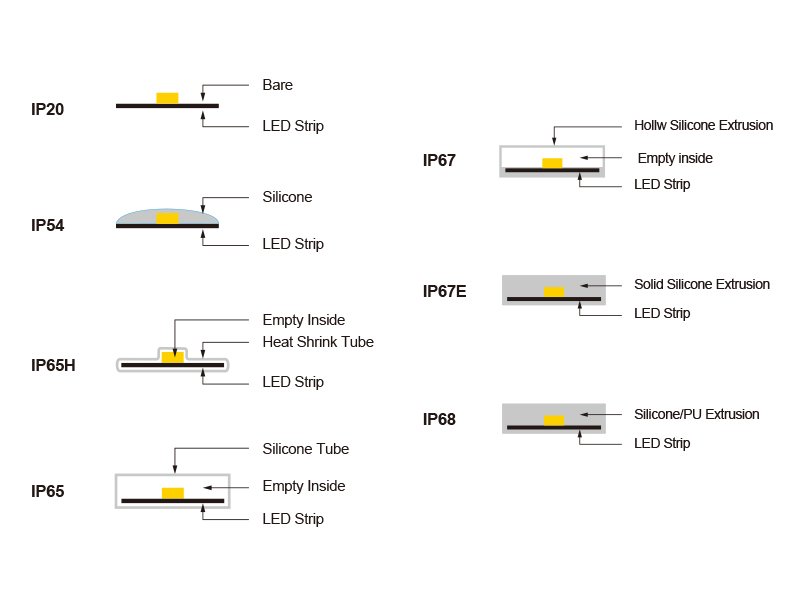
IP65 vs IP67 vs IP68 at a Glance
| Rating | Solid protection | Water exposure | Suitable starting point | Not automatically suitable for |
|---|---|---|---|---|
| IP65 | Dust-tight | Water jets | Rain, splashes, damp interiors and protected outdoor lighting | Immersion or standing water |
| IP67 | Dust-tight | Temporary immersion | Exposed outdoor installations and possible short-term flooding | Permanent submersion or water jets unless separately tested |
| IP68 | Dust-tight | Immersion under product-specific declared conditions | Engineered underwater installations | Unlimited depth, chlorine, seawater or pressure washing |
The product test report—not the marketing label—should determine whether the strip is appropriate for a particular project.
Three Different Questions Must Be Answered
Professional waterproof selection requires three separate approvals.
1. Is the LED strip body adequately protected?
This concerns:
- PCB enclosure
- Coating or extrusion
- End caps
- Cable entry
- Connector
- Factory sealing
This is where the IP rating is primarily relevant.
2. Is the completed installation adequately protected?
This concerns:
- Field cuts
- Junction boxes
- Power injection
- Cable glands
- Drainage
- Mounting profiles
- Mechanical stress
- Installer workmanship
A product-level IP rating does not automatically become an installation-level rating.
3. Is the electrical system approved for the location?
This concerns:
- Driver type
- Electrical isolation
- Maximum voltage
- Ground-fault protection
- Pool or fountain zones
- Equipment listing or certification
- Applicable local regulations
An IP68 LED strip can pass an ingress test and still be unsuitable or unapproved for a swimming pool electrical system.
What Does an IP Rating Mean?
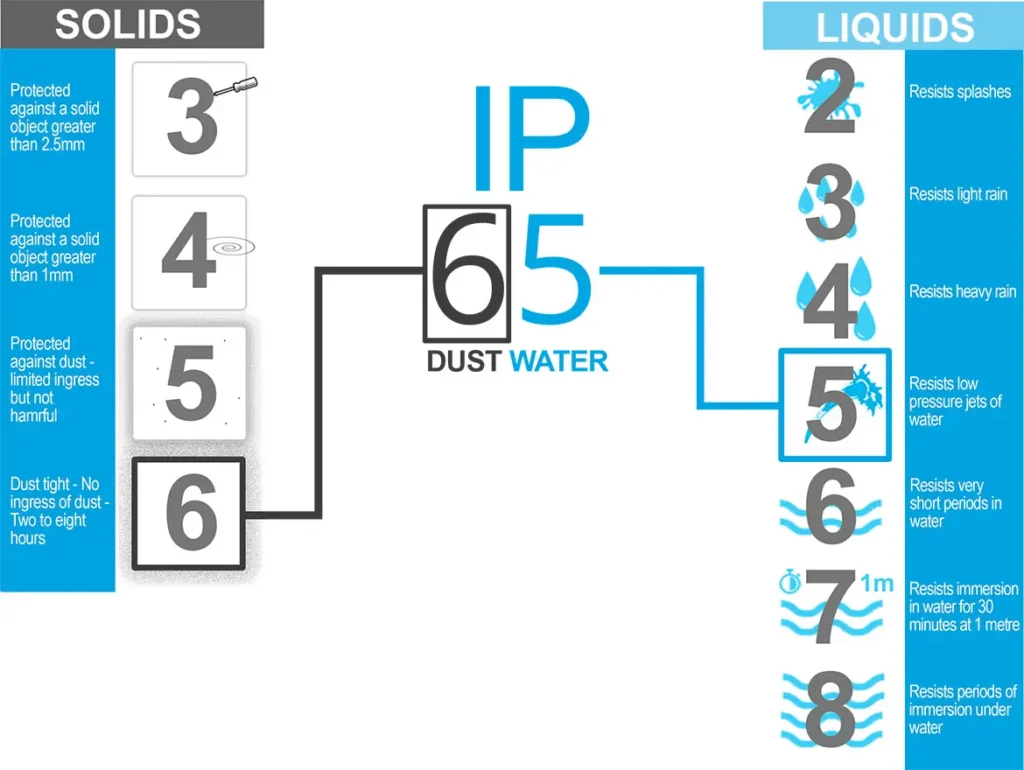
IP means Ingress Protection.
IEC 60529 defines a classification system for degrees of protection provided by enclosures.
A typical marking contains two digits:
IP68
- The first digit describes protection against access to hazardous parts and ingress of solid foreign objects.
- The second digit describes protection against water.
If a characteristic has not been tested or declared, the digit can be replaced by X.
For example:
- IP6X indicates that dust protection is specified but water protection is not declared.
- IPX7 indicates that temporary-immersion protection is specified but solid-particle protection is not declared.
What Does the First Digit 6 Mean?
IP65, IP67 and IP68 all use 6 as the first digit.
In this classification, 6 means dust-tight.
That does not mean the product is automatically resistant to:
- Abrasion
- Impact
- Vandalism
- UV degradation
- Chemicals
- Cable pulling
- Repeated bending
- High temperatures
- Freeze–thaw cycles
Those characteristics require separate evaluation.
What Does the Second Digit Mean?
For the ratings covered in this guide:
- 5 represents protection against water jets.
- 7 represents protection against the effects of temporary immersion.
- 8 represents protection against immersion under conditions agreed or declared for the product and more severe than IPX7.
These tests represent different exposure mechanisms.
They should not always be treated as a simple sequence where a higher water digit automatically includes every lower test.
What Does IP65 Mean for LED Strips?
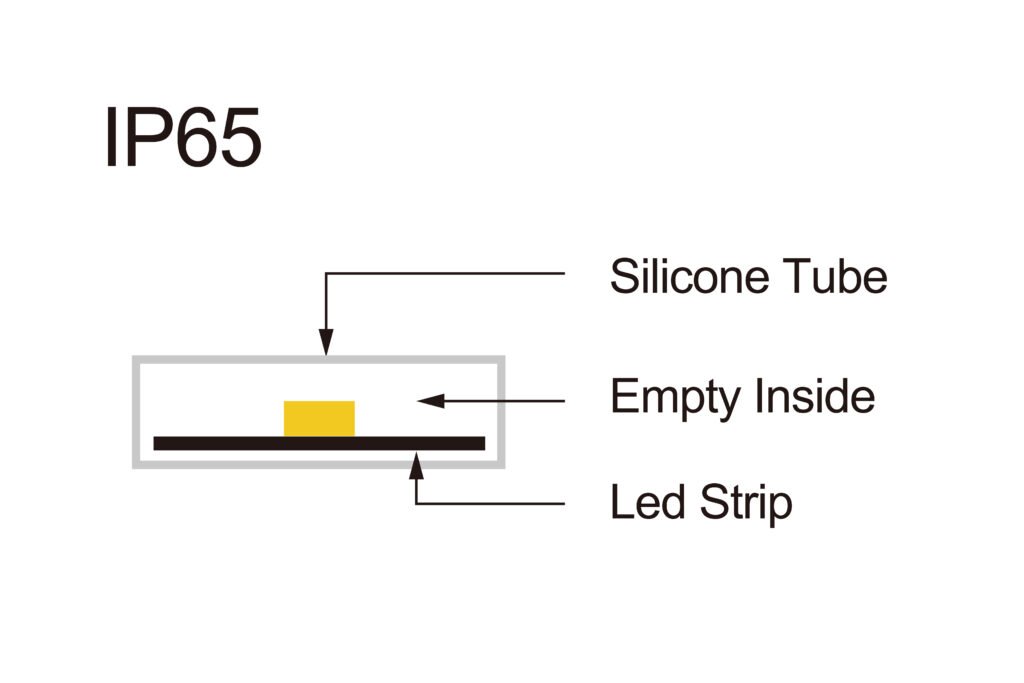
IP65 means that the tested enclosure is dust-tight and protected against water jets under the applicable IEC 60529 conditions.
Common IP65 LED strip applications include:
- Kitchen cabinetry
- Shelving exposed to cleaning
- Protected bathroom locations
- Roofed outdoor walkways
- Covered terraces
- Outdoor signs
- Architectural coves with drainage
- Garden structures installed above ground
IP65 is not intended as an immersion rating.
It should not be selected for:
- Pool interiors
- Fountain basins
- Gutters
- Locations with standing water
- Temporary flooding
- Direct burial
- Underwater use
- High-pressure steam cleaning
An IP65 strip can still fail outdoors if water collects around a cut end or connector.
What Does IP67 Mean for LED Strips?
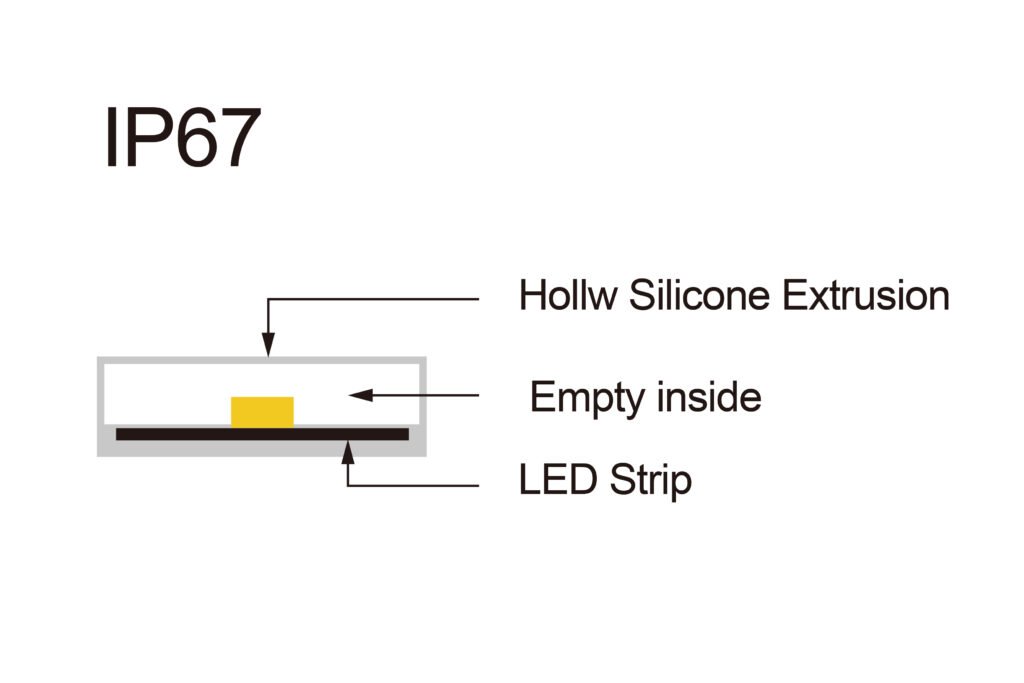
IP67 means that the tested enclosure is dust-tight and protected against the effects of temporary immersion.
The IPX7 test is commonly summarized as immersion for approximately 30 minutes at a water level of about one meter for a small enclosure. The exact positioning and water level are defined by the standard and the geometry of the tested product.
IP67 is a useful starting point for:
- Exposed building façades
- Outdoor handrails
- Landscape structures
- Wet architectural recesses
- Outdoor signage
- Locations subject to brief flooding
- Installations exposed to wind-driven rain
IP67 does not automatically prove suitability for:
- Permanent underwater use
- Months of standing water
- Swimming pools
- Saltwater
- Chlorine
- Water jets
- Pressure washing
Temporary immersion of a new laboratory sample and continuous outdoor service are different requirements.
What Does IP68 Mean for LED Strips?
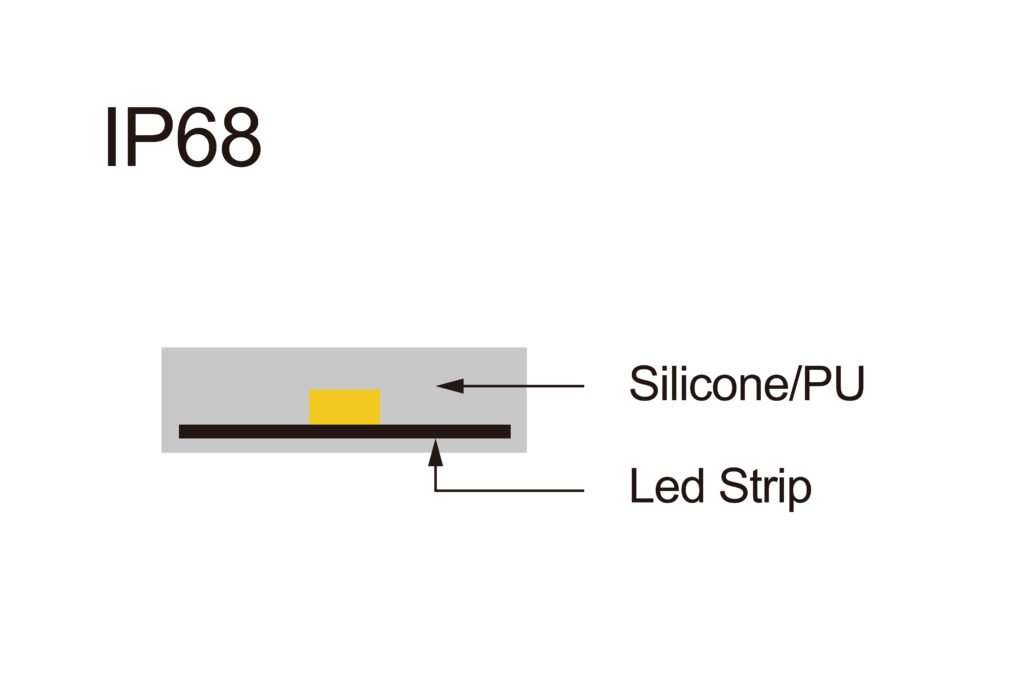
IP68 means that the enclosure is dust-tight and protected against immersion under conditions declared for the product.
There is no single universal IPX8 depth or duration that applies to every LED strip.
The manufacturer should declare:
- Water depth
- Test duration
- Water temperature
- Product orientation
- Cable and end-cap configuration
- Whether the sample was energized
- Whether the test represented continuous operation
- Any installation restrictions
One IP68 product may be tested at 1.5m. Another may be tested at 5m. Both can carry IP68 when their declared conditions satisfy the applicable requirements.
The IP68 marking without its test conditions is therefore incomplete purchasing information.
Water Depth Changes the Pressure on the Seal
Water pressure increases with depth.
The approximate hydrostatic pressure is:
Pressure = Water density × Gravity × Depth
Or:
ΔP = ρgh
In fresh water, every additional meter of depth adds approximately 9.8kPa of gauge pressure.
This means:
| Water depth | Approximate additional pressure |
| 1m | 9.8kPa |
| 2m | 19.6kPa |
| 3m | 29.4kPa |
| 5m | 49kPa |
This pressure acts on:
- End caps
- Cable glands
- Connector seals
- Encapsulation interfaces
- Small cracks
- Air cavities
A product tested at 1.5m should not be assumed suitable for 5m.
Depth is an engineering parameter, not a marketing detail.
IP68 Does Not Mean “Hermetically Sealed”
The word “hermetic” implies an extremely high level of gas-tight sealing.
Most flexible LED strips use polymer materials such as silicone, PU or other elastomers. These materials can provide excellent water protection while still allowing very slow vapor or gas permeation.
A flexible IP68 strip should therefore not automatically be described as hermetically sealed.
More accurate language is:
- Protected against the effects of immersion under declared conditions
- Fully encapsulated
- Factory-sealed
- Submersible within the rated conditions
This distinction matters in long-term installations with temperature cycling, humidity and chemical exposure.
Passing an IP Test Does Not Always Mean Zero Water Molecules Entered
IP water protection is generally concerned with preventing ingress that causes harmful effects under the relevant evaluation.
The exact acceptance criteria depend on the standard and product construction.
A passing result should not automatically be interpreted as proof that:
- No moisture entered at a microscopic level
- No water vapor can permeate the enclosure
- Condensation can never occur
- The seal will remain unchanged for years
- The product will survive every water chemistry
For project approval, ask what inspection and pass criteria were used after testing.
IP68 Does Not Automatically Mean Pool-Safe
This is the most important limitation of IP68.
An IP test primarily evaluates water ingress. It does not automatically test:
- Chlorine
- Bromine
- Ozone
- Saltwater
- Pool-cleaning chemicals
- Sunscreen or oils
- High water temperature
- Electrical leakage in conductive water
- Pool-specific mechanical requirements
- Compliance with local pool-lighting regulations
A strip can remain watertight while its enclosure:
- Yellows
- Swells
- Hardens
- Becomes brittle
- Loses adhesion
- Develops stress cracks
- Changes optical transmission
For a pool or spa project, specify:
- Chlorine or bromine concentration
- pH range
- Salt concentration
- Water temperature
- Maximum immersion depth
- Continuous exposure duration
- Cleaning method
- Required underwater-lighting certification
- Cable and connector construction
- Driver and isolation requirements
For example, UL guidance notes that underwater pool lighting in the United States must be listed for the application regardless of operating voltage. IP68 alone is not an alternative to an applicable underwater luminaire evaluation.
Pool Water and Seawater Are Not the Same
A salt-chlorinated swimming pool and a seawater installation have different conductivity and corrosion conditions.
Relevant differences can include:
- Salt concentration
- Electrical conductivity
- Galvanic corrosion
- Cable compatibility
- Metal fitting selection
- Connector design
- Seal aging
A product approved for freshwater or a salt-treated pool should not automatically be specified for seawater.
Request explicit evidence for the actual water environment.
IP67 or IP68 Does Not Automatically Include IP65
IPX5, IPX7 and IPX8 evaluate different forms of water exposure.
Water jets can attack a seal differently from static immersion.
A jet can concentrate force on:
- End-cap edges
- Cable entries
- Soft extrusion
- Connector seals
- Joints
An immersion-rated product may not have been tested with jets.
If the application involves both cleaning jets and immersion, request evidence for both conditions. Depending on the applicable declaration, separate or dual markings may be appropriate.
IP68 Does Not Mean Pressure-Washable
High-pressure or high-temperature cleaning is not the same as immersion.
Equipment intended for pressure washing may need a separate IP69 or IP69K-type evaluation under the relevant standard.
These classifications should also not be confused:
- IP68 does not automatically include high-pressure cleaning.
- IP69 does not automatically prove long-term immersion.
- Neither automatically proves chemical resistance.
For industrial cleaning, define:
- Water pressure
- Flow
- Temperature
- Nozzle distance
- Spray angle
- Cleaning frequency
- Detergent or disinfectant
The IP Rating Belongs to the Tested Assembly
IEC 60529 evaluates an enclosure as tested.
For an LED strip, the tested assembly may include:
- LED strip body
- Encapsulation
- End cap
- Cable entry
- Cable
- Connector
- Molded joint
- Sealant
- Specified length
The original rating may no longer apply after:
- Cutting
- Soldering
- Replacing the cable
- Removing an end cap
- Changing the connector
- Drilling the enclosure
- Bending below the rated radius
- Damaging the extrusion
- Using a different sealant
The purchasing specification should identify the exact tested configuration.
Product Rating vs Installation Rating
Consider this system:
Driver → controller → junction → cable → connector → LED strip → end cap
Every interface can become an ingress point.
An IP68 strip body does not protect:
- An IP20 driver
- An indoor controller
- An unsealed junction
- A damaged cable
- An incorrectly assembled connector
The system rating can be no stronger than its weakest relevant component.
Why Waterproof LED Strips Usually Fail at the Ends
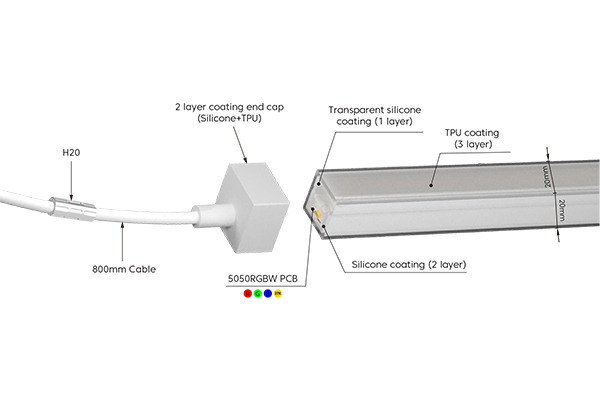
The continuous middle section of an extruded strip is often not the main problem.
Water commonly enters through:
- Cut ends
- Cable exits
- Solder pads
- End caps
- Connectors
- Power-injection points
- Branch joints
- Mechanical damage
In an underwater project, factory-molded or factory-sealed ends are usually more reliable than improvised field sealing.
Capillary Action and Cable Wicking
Stranded cables contain small spaces between conductors.
Water can move through these spaces by capillary action.
A leak at a remote:
- Connector
- Cable joint
- Junction box
- Unsealed cable end
can eventually carry moisture toward the LED strip.
This is why both ends of the cable system matter.
Recommended measures include:
- Environmentally suitable cable
- Molded or approved cable entry
- Sealed remote cable termination
- Strain relief
- Drip loops above water
- Junctions outside standing water
- Correct glands for the cable diameter
Thermal Breathing and Condensation
Temperature changes cause air inside a hollow enclosure to expand and contract.
As the enclosure cools, humid air can be drawn through small seal imperfections. Moisture may then condense internally.
This process is sometimes called thermal breathing.
It is relevant to:
- Hollow silicone tubes
- Outdoor profiles
- Refrigerated displays
- Underground enclosures
- Day–night temperature cycles
- Equipment exposed to sunlight and rain
A strip can develop internal condensation without ever experiencing obvious flooding.
Common Waterproof LED Strip Constructions
Surface silicone coating
A thin silicone layer covers the component side of the strip.
Advantages:
- Thin
- Flexible
- Economical
- Easy to cut
Limitations:
- Ends remain critical
- The back may remain exposed
- Coating thickness can vary
- Not suitable for immersion unless the complete assembly is separately designed and tested
Typical use:
- Damp interiors
- Splash protection
- Protected outdoor installations
Heat-shrink sleeve
The strip is placed inside a heat-shrink enclosure.
Advantages:
- Economical
- Simple construction
- Lightweight
Limitations:
- Ends require sealing
- Air can be trapped
- Sleeve damage can expose the strip
- Thermal behavior may change
Typical use:
- Protected splash-resistant applications
Hollow silicone tube
The LED strip is inserted into a hollow sleeve.
Advantages:
- Surrounding physical enclosure
- Flexible
- Useful for some outdoor applications
- Internal strip may be replaceable in selected designs
Limitations:
- End caps are critical
- Moisture can travel through the hollow space
- Condensation is possible
- Heat transfer depends on internal contact
- Not automatically suitable for permanent immersion
Typical use:
- Outdoor IP67-style construction
Solid silicone extrusion
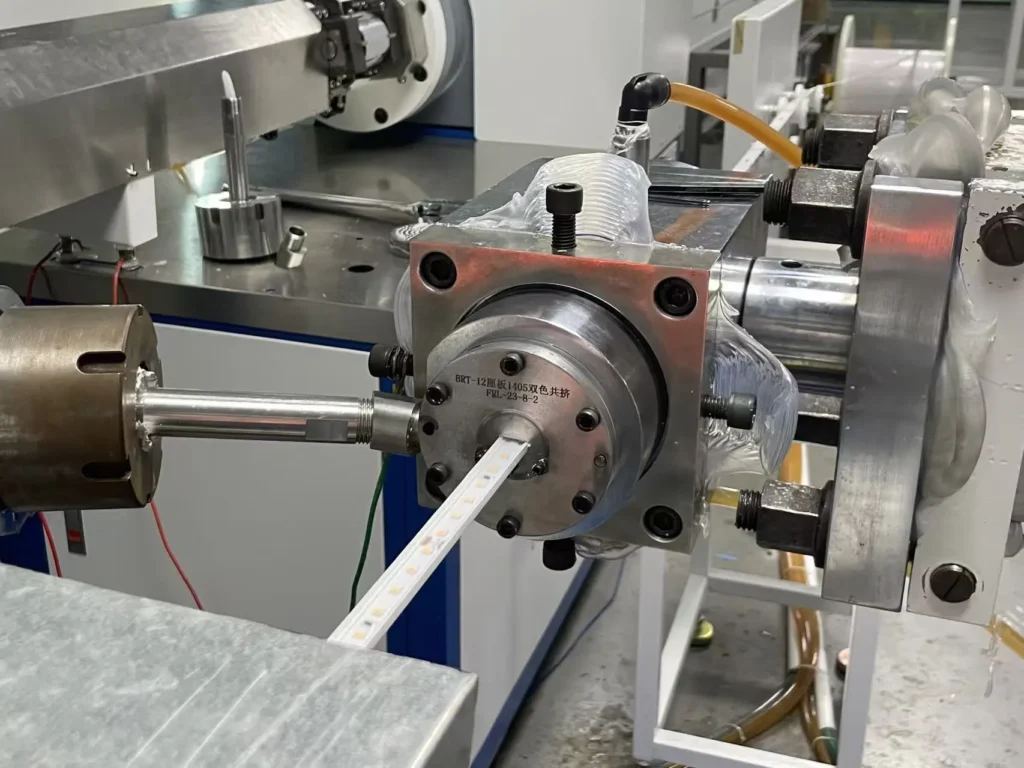
Silicone is extruded around the LED strip.
Advantages:
- Integrated surrounding enclosure
- Good flexibility with a suitable compound
- Good outdoor potential
- Controlled optical surface
Limitations:
- Field sealing is difficult
- End caps remain critical
- Thick material can affect heat
- Minimum bend radius must be observed
- Chemical performance depends on formulation
Typical use:
- Outdoor façades
- Landscape lighting
- Neon flex
- Engineered underwater products
PU potting or extrusion
Polyurethane forms or fills the protective enclosure.
Possible advantages:
- Strong encapsulation
- Abrasion resistance
- Adhesion
- Chemical resistance with the correct formulation
Possible limitations:
- Yellowing in unsuitable grades
- Hydrolysis
- Reduced flexibility
- Difficult repair
- Optical and thermal changes
Typical use:
- Industrial environments
- Selected marine products
- Engineered underwater products
Xmart Waterproof Construction Terminology
Xmart supplies several waterproof construction options. Some names used in the product range describe Xmart construction methods rather than additional IEC rating categories.
| Xmart term | Construction meaning | Intended protection direction |
| IP54 nano coating | Thin conformal surface treatment | Moisture and light splash protection |
| IP65 silicone coating | Surface-applied silicone | Dust and water-jet protection when validated |
| IP65H | Heat-shrink construction | Protected splash and jet applications when validated |
| IP67 | Hollow silicone tube | Temporary immersion-oriented construction |
| IP67E | Solid extrusion construction | More integrated outdoor enclosure |
| IP68 | Fully encapsulated or engineered immersion construction | Product-specific submersible application |
“IP65H” and “IP67E” are useful Xmart construction identifiers. The H and E do not create new IEC 60529 water-protection levels.
The relevant standard classifications remain IP65 and IP67, supported by the report for the exact product.
Silicone vs PU: Which Is Better?
Neither material is universally better.
A suitable silicone compound can offer:
- Flexibility
- Wide temperature performance
- UV stability
- Stable outdoor appearance
- Good optical properties
A suitable PU compound can offer:
- Abrasion resistance
- Strong encapsulation
- Mechanical protection
- Resistance to selected chemicals
Lower-quality versions of either material can fail.
Compare:
- Exact material grade
- UV-aging result
- Chlorine or bromine test
- Saltwater test
- Hydrolysis resistance
- Yellowing resistance
- Tensile strength
- Elongation
- Operating-temperature range
- Adhesion after aging
- Optical transmission after aging
The test evidence matters more than the generic material name.
How Chemicals Damage Waterproof Enclosures
Chemical exposure can cause several different failure mechanisms:
Swelling
The material absorbs a chemical and changes dimensions, stressing joints and seals.
Hydrolysis
Water and heat break down susceptible polymer bonds over time.
Oxidation
Chlorine, ozone or UV exposure degrades the material surface.
Plasticizer extraction
Some plastics become hard or brittle after additives migrate out.
Stress cracking
Chemical exposure and mechanical strain combine to create cracks.
Discoloration
The enclosure remains sealed but becomes yellow, brown or cloudy, reducing light output and changing color.
A successful short immersion test does not predict all these mechanisms.
Why the Highest IP Rating Is Not Always Better
Moving from IP65 to IP68 may increase:
- Price
- Strip dimensions
- Weight
- Minimum bend radius
- Thermal resistance
- Connector size
- Installation time
- Repair difficulty
A thicker enclosure can also affect:
- Luminous output
- CCT
- Duv
- Beam distribution
- RGB color mixing
- Aluminum-profile fit
For a dry hotel cove, IP68 can add heat and cost without improving the project.
Use the protection level that matches the real exposure with an appropriate engineering margin.
Waterproofing Can Increase LED Temperature
Waterproof materials can interfere with the thermal path between the PCB and mounting profile.
Potential causes include:
- Air gaps inside a tube
- Encapsulation around the back of the PCB
- Poor contact with the aluminum profile
- Thick polymer layers
- High watts per meter
- High ambient temperature
Measure the exact waterproof version after it reaches thermal stability.
Do not use the IP20 product temperature to represent the IP67 or IP68 version.
Waterproofing Can Change Light Output and Color
Silicone, PU and other optical materials can:
- Absorb light
- Change beam distribution
- Shift CCT
- Shift Duv
- Alter RGB mixing
- Yellow with age
- Create optical nonuniformity
For color-sensitive projects, request photometric data for the final encapsulated product.
The bare-strip report is not sufficient.
Cutting Usually Invalidates the Factory Seal
A field-cut IP67 or IP68 strip no longer has its original factory termination.
Restoring the seal can require:
- Approved end cap
- Compatible sealant
- Dry and contamination-free surface
- Correct preparation
- Specified sealant thickness
- Complete curing time
- Cable strain relief
- Leak inspection
Generic construction silicone is not automatically suitable.
Some sealants release acidic or other curing by-products that can affect copper and electronic components. Use only a sealant approved for the product materials.
For permanent underwater projects, order factory-cut, factory-cabled and factory-sealed lengths.
Xmart’s IP68 silicone neon flex can be configured in project-specific lengths. The required depth, water chemistry, cable direction and installation method should be defined before production.
Bend Radius Affects Waterproof Integrity
Waterproof strips are flexible but not infinitely flexible.
Bending below the specified radius can cause:
- Encapsulation cracks
- End-cap separation
- PCB damage
- Internal conductor fatigue
- Optical deformation
- Local delamination
Installers should also avoid:
- Twisting a standard strip
- Bending at a connector
- Bending directly beside a molded cable entry
- Pulling the strip by its cable
- Repeatedly flexing the same location
Select top-bending, side-bending or 3D-bending neon according to the installation geometry.
Connector Protection Is Part of the System
A waterproof strip connected through an indoor connector is not a waterproof system.
The connector must match:
- IP requirement
- Strip width
- Pin count
- Current
- Cable diameter
- Jacket dimensions
- Chemical environment
- Installation method
Possible connector failures include:
- Incorrect cable diameter
- Incomplete insertion
- Misaligned contacts
- Damaged gasket
- Poor strain relief
- Local overheating
- Water trapped around the joint
Xmart’s LED strip connector range includes connectors for SMD, COB, single-color and multichannel strips. The connector must be verified against the exact waterproof construction and cable.
Drainage Is Still Necessary
An ingress rating should not be used as an excuse to trap water.
Poorly designed aluminum profiles can become gutters.
Standing water increases:
- Seal exposure time
- Corrosion
- Capillary ingress
- Freeze damage
- Contamination
- Biological growth
- Maintenance difficulty
Good design practices include:
- Drain holes where permitted
- Sloped mounting surfaces
- Cable exits facing down
- Drip loops
- No connectors at the lowest point
- No unsealed screw penetrations
- Accessible inspection points
Reducing exposure is usually more reliable than asking a seal to resist unnecessary standing water for years.
Driver and Controller Location
The LED strip IP rating does not protect its driver or controller.
The system may contain:
- AC connection
- Power supply
- Dimmer
- Controller
- Signal amplifier
- Distribution box
- Connectors
- LED strip
Whenever possible:
- Keep drivers and controllers dry and accessible.
- Use appropriate enclosures and cable glands.
- Do not place junctions in standing water.
- Maintain required ventilation.
- Provide branch protection where required.
- Follow wet-location and pool-zone regulations.
For underwater systems, the driver, isolation method, wiring and protective devices must be designed by qualified professionals.
A Bare LED Strip Is Not Necessarily an Approved Underwater Luminaire
This distinction matters in swimming pools and fountains.
An IP68 LED tape may be a component. A complete underwater luminaire can also include:
- Optical enclosure
- Mechanical protection
- Cable
- Termination
- Mounting system
- Transformer or power unit
- Electrical isolation
- Leakage-current protection
- Product marking
A project specification should confirm whether the proposed strip system is accepted under the standards and regulations applicable to underwater luminaires in that market.
Application Selection Matrix
| Application | Starting point | Additional verification |
| Dry interior | IP20 | Thermal and mechanical protection |
| Kitchen cabinet | IP20 or IP65 | Steam, cleaning and heat |
| Protected outdoor cove | IP65 | UV, drainage and sealed connections |
| Exposed façade | IP65 or IP67 | Wind-driven rain and thermal cycling |
| Outdoor handrail | IP67 | End sealing, cable exit and movement |
| Landscape feature | IP67 | Soil moisture, drainage and damage |
| Temporary flood risk | IP67 | Exact immersion condition |
| Fountain splash zone | IP65 or dual-tested solution | Jets, chemicals and drainage |
| Fountain submerged zone | Engineered IP68 | Depth, chemistry and electrical approval |
| Swimming pool | Pool-evaluated underwater system | Chlorine, temperature and local standard |
| Spa or hot tub | Application-specific submerged system | Heat, bromine/chlorine and electrical approval |
| Seawater installation | Marine-evaluated system | Conductivity, corrosion and cable suitability |
| Industrial washdown | Jet/cleaning-rated system | Pressure, temperature and detergent |
IP Rating vs Outdoor Service Life
IP testing generally evaluates ingress protection of a sample under controlled conditions.
Real outdoor service introduces:
- UV radiation
- Heat
- Cold
- Thermal cycling
- Freeze–thaw
- Wind movement
- Salt spray
- Air pollution
- Cleaning chemicals
- Repeated wetting and drying
- Mechanical damage
A product can pass an IP test when new and fail after the enclosure becomes brittle or a seal separates.
For long-term outdoor projects, consider:
- UV-aging tests
- Damp-heat tests
- Thermal cycling
- Freeze–thaw testing
- Salt-spray testing
- Cable-pull testing
- Bending fatigue
- Aged-sample ingress testing
An IP report does not prove a five-year outdoor life by itself.
A Better Environmental Validation Sequence
A strong project test should not stop after testing a new sample.
Stage 1: Baseline inspection
Record:
- Product code
- Length
- Cable
- End cap
- Connector
- Power
- Light output
- CCT
- Visible condition
Stage 2: Environmental aging
Apply project-relevant stress such as:
- UV
- Heat
- Cold
- Damp heat
- Chlorine
- Saltwater
- Thermal cycling
- Mechanical bending
Stage 3: Ingress retest
Repeat the relevant jet or immersion test after aging.
Stage 4: Electrical inspection
Check:
- Insulation
- Current
- Power
- Corrosion
- Connector condition
- Abnormal heating
Stage 5: Optical inspection
Check:
- Luminous-flux change
- CCT shift
- Yellowing
- Clouding
- Dark sections
- Uneven output
Testing the aged sample is more informative than testing only a new one.
Production Quality Control Matters
A laboratory sample can pass while mass-production sealing varies.
Ask the manufacturer how it controls:
- Extrusion dimensions
- Coating thickness
- End-cap preparation
- Sealant quantity
- Cure time
- Cable molding
- Visual inspection
- Leak testing
- Batch traceability
For high-risk projects, define a production sampling plan rather than accepting one development report for every future order.
Common Failure Modes
Water enters a field-cut end
The strip body remains intact, but an improvised seal fails.
Cable wicking carries water inside
The visible leak begins at a remote junction.
A profile becomes a water channel
The strip receives continuous standing-water exposure that was not anticipated.
IP67 is used for permanent immersion
A temporary test is treated as a long-term underwater rating.
An IP68 product is installed deeper than tested
Hydrostatic pressure exceeds the declared condition.
Pool chemicals damage the enclosure
The product remains initially watertight but becomes brittle or discolored.
Waterproofing causes overheating
A high-power strip is encapsulated without thermal validation.
The connector has a lower environmental rating
The strip survives while the joint fails.
Incorrect bending creates microcracks
Water enters after installation rather than during initial testing.
The driver is installed in a wet location
The LED strip rating is correct, but another system component fails.
How to Write a Professional Waterproof LED Strip Specification
A weak specification says:
“24V waterproof LED strip, IP68.”
A stronger specification says:
“24V LED strip system rated IP68 to IEC 60529 for immersion at the declared project depth and duration. Product shall be supplied in factory-cut lengths with factory-installed cable entries and sealed terminations. Encapsulation, cable and seal materials shall be compatible with the specified water chemistry, operating temperature and UV exposure.”
For a pool, fountain or marine project, add:
- Maximum depth
- Continuous or intermittent immersion
- Chlorine, bromine or salt concentration
- pH range
- Maximum water temperature
- Required underwater luminaire standard
- Cable construction
- Junction location
- Driver and isolation requirements
- Jet exposure
- UV-aging requirement
- Factory sealing
- Field-cutting restrictions
- Production leak-test requirement
- Approved sample
Project Information to Send the Manufacturer
Provide:
- Indoor or outdoor location
- Country and applicable standard
- Rain, splash, jet or immersion exposure
- Maximum depth
- Exposure duration
- Water temperature
- Ambient temperature
- Chlorine, bromine or salt content
- pH range
- UV exposure
- Cleaning method
- Required strip length
- Cable length and exit direction
- Connector type
- Bending direction and radius
- Mounting profile
- Driver location
- Dimming or control system
- Required certification
- Target warranty
This information allows the manufacturer to recommend a complete construction rather than selecting by IP number alone.
Buyer’s Waterproof LED Strip Checklist
Before ordering, ask:
- Which IEC 60529 edition was used?
- What exact product code was tested?
- Was the complete sealed assembly tested?
- What depth and duration apply to IPX8?
- Was the sample energized during testing?
- Was water-jet testing also completed?
- What enclosure construction is used?
- What material grade is used?
- Is UV-aging data available?
- Is chemical-resistance data available?
- Was the actual chlorine or salt concentration tested?
- What cable and connector were included?
- Can the strip be cut on site?
- What sealing procedure is approved?
- What is the minimum bend radius?
- What is the maximum operating temperature?
- Was the final waterproof version photometrically tested?
- Was ingress testing repeated after aging?
- What production leak checks are performed?
- Does the warranty cover the declared application?
Common Misunderstandings
A higher IP rating is always better
False. Higher protection can increase cost, size, thermal resistance and service difficulty.
IP68 means unlimited depth
False. The approved depth and duration are product-specific.
IP68 means completely hermetic
False. Flexible polymer enclosures can resist water while still allowing slow vapor permeation.
IP68 includes water-jet protection
Not automatically. Jet and immersion tests represent different exposure conditions.
IP68 means pool-safe
False. Chemical resistance, electrical approval and complete-system design must also be verified.
Low voltage means safe underwater
False. Suitable isolation, equipment approval and installation protection remain necessary.
No water can enter a passing IP enclosure
Not necessarily. The standard is concerned with protection against harmful ingress under defined conditions.
Silicone is always better than PU
False. Material grade, formulation, processing and validation determine performance.
Field-applied silicone restores IP68
Not automatically. A validated sealing method is required.
IP68 proves long outdoor life
False. UV, temperature, chemicals, mechanical stress and aging are separate issues.
Final Recommendation
Choose IP65 for dust, rain, splashes and water jets where immersion will not occur.
Choose IP67 where temporary immersion is possible and the complete sealed assembly has been validated.
Choose IP68 where immersion is expected—but only after confirming the declared depth, duration, water chemistry, material construction, cables and terminations.
For pools, fountains and marine applications, do not specify an IP68 strip as an isolated component. Specify and approve the complete underwater lighting system.
The best waterproof LED strip is not the product carrying the highest IP number.
It is the product whose enclosure, seals, materials, cables, electrical design and environmental validation match the real installation.
Frequently Asked Questions
What is the difference between IP65, IP67 and IP68 LED strips?
IP65 addresses water jets, IP67 addresses temporary immersion and IP68 addresses immersion under declared product-specific conditions. All three are dust-tight when properly rated.
Is IP65 LED strip waterproof?
IP65 is better described as dust-tight and water-jet resistant under defined test conditions. It is not an immersion rating.
Can IP65 LED strip be used outdoors?
Yes, when the installation includes suitable UV resistance, sealed connections, drainage and protection from standing water.
Can IP67 LED strip be submerged?
IP67 covers temporary immersion under defined conditions. It should not be used for continuous submersion without additional evidence.
Can IP68 LED strip stay underwater permanently?
Some IP68 products are designed for continuous immersion. The approved depth, duration, operating condition and water chemistry must still be confirmed.
Does IP68 mean any water depth?
No. Water pressure increases with depth, and every IP68 product has declared test conditions.
Does IP68 mean hermetically sealed?
No. Flexible silicone and PU enclosures can provide strong immersion protection without being truly gas-tight.
Is IP68 suitable for swimming pools?
Not automatically. The product also needs suitable chemical resistance, cables, electrical protection and any applicable underwater-lighting approval.
Is IP67 resistant to water jets?
Not automatically. IPX7 temporary immersion and IPX5 water-jet tests are different.
Can an IP68 strip be pressure-washed?
Only if it has also been tested for the applicable pressure-washing condition.
Can I cut an IP68 LED strip?
Cutting normally removes the factory termination. For permanent immersion, factory-cut and factory-sealed lengths are strongly preferred.
Why does water enter through the cable?
Water can move along stranded conductors through capillary action from a remote unsealed connection.
Can waterproof LED strips develop condensation?
Yes. Temperature cycling can draw humid air through small imperfections and cause internal condensation.
Does waterproofing reduce brightness?
It can. Encapsulation can absorb light, alter beam distribution and shift CCT or Duv.
Does an IP68 strip run hotter?
It may. Thick encapsulation and air gaps can increase thermal resistance.
Is silicone better than PU for underwater LED strips?
Neither is universally better. Compare the exact material’s UV, chemical, hydrolysis, thermal and optical-aging data.
Does an IP report prove outdoor lifetime?
No. IP testing does not automatically cover years of UV, thermal cycling, chemicals or mechanical stress.
What information should an IP68 report include?
It should identify the product, standard, sample configuration, depth, duration, cable and end seals, test conditions and result.
Need Help Selecting the Correct Waterproof Construction?
Xmart Lighting supplies multiple LED strip and neon flex constructions for damp interiors, outdoor architecture and engineered underwater applications.
Available project directions include:
- Surface silicone coating
- Heat-shrink construction
- Hollow silicone tube
- Solid silicone extrusion
- PU encapsulation
- IP67 neon flex
- Engineered IP68 silicone neon
- Factory-installed cables and end seals
- Waterproof connectors
- Custom project lengths
For qualified commercial and OEM projects, Xmart can evaluate the construction according to:
- Water exposure
- Immersion depth
- Chemicals
- Temperature
- UV
- Cable direction
- Bending requirements
- Installation method
- Required market documentation
Explore the Xmart LED neon flex range, IP68 silicone neon flex and waterproof LED strip connector options, or send the project environment and installation drawing for a construction-level recommendation.