
LED Strip System Engineering
How to Size an LED Strip Power Supply Without Guessing
A reliable LED strip power-supply calculation begins with voltage, watts per meter and connected length—but it should not end there. The selected driver must also support the maximum credible load, operating temperature, installation enclosure, dimming method, branch current, controller, cable and target-market requirements.
For a preliminary constant-voltage calculation:
- Connected load = W/m × length per branch × number of branches × maximum load factor
- Output current = connected load ÷ strip voltage
Final driver capacity must then be checked against the exact driver’s continuous-output rating and derating data.
Calculator Scope
This calculator is intended for low-voltage constant-voltage LED strips and compatible constant-voltage power supplies.
Do not use it to select:
- A constant-current driver for a bare LED array
- A driverless AC LED strip
- A direct-to-mains 110V or 230V strip
- A proprietary luminaire with an integrated driver
- A product requiring a model-specific current and voltage operating window
For addressable, RGB, RGBW, RGBCCT and tunable-white systems, the calculator may be used only after the maximum credible simultaneous load has been confirmed.
Power Capacity and Run Length Are Different Limits
A 240W driver may have enough output capacity for 20 meters of a 12W/m LED strip. That does not mean the complete 20 meters can be connected as one electrical run.
Driver capacity, LED strip run length, cable voltage drop, controller capacity and connector current are separate limitations. Each must be checked independently.
LED Strip Power Supply Calculator
The driver output voltage must match the rated strip voltage.
Use the maximum declared system power unless a lower value is validated and permanently enforced.
Measured in meters.
Lower this only if the control system permanently limits output.
This is a design-loading limit, not a universal electrical rule.
Enter a lower value only when required by the exact driver’s temperature or enclosure data.
Sizing Report
Preliminary CompleteConnected Load
72.0 W
Total Current
3.00 A
Watts / Branch
72.0 W
Current / Branch
3.00 A
Minimum Required Nameplate Wattage
72 W
Based on 100% planned loading and 100% derating factor.
Suggested next available driver size: 75 W
Actual loading on suggested size: 96.0%
Model Verification Required
Do not purchase based on wattage alone. You must also verify:
- Maximum run length for each branch
- Driver-to-strip cable voltage drop
- Controller total and per-channel current
- Connector and common-conductor capacity
- Dimming compatibility
- Environmental and certification requirements
Is the 80% Load Rule Mandatory for Every LED Driver?
No. An 80% loading limit is a common planning approach, not a universal requirement for every LED driver.
Some drivers are rated for continuous operation at full output under defined input-voltage, ambient-temperature and mounting conditions. Other models require substantial derating in hot, enclosed or unusual installations.
Important: “Add 20%” and “load the driver to 80%” are not mathematically identical.
| Method | Calculation for a 100W Load | Selected Capacity | Actual Loading |
|---|---|---|---|
| Add 20% | 100W × 1.20 | 120W | 83.3% |
| Limit loading to 80% | 100W ÷ 0.80 | 125W | 80.0% |
Conclusion: Use one clearly defined loading method. Do not combine several arbitrary safety factors without understanding what each factor represents. The exact driver datasheet and project requirements take priority over a generic 80% rule.
What Is the Difference Between Headroom and Derating?
Headroom / Planned Loading
A design decision that limits how much of the driver’s available capacity the connected load will use.
It may account for:
- Strip power tolerance
- Expected design changes
- Continuous operating conditions
- Project-specific loading requirements
- Desired operating margin
Datasheet Derating
A manufacturer-defined reduction in available output under specified conditions.
It may depend on:
- Ambient temperature
- Input voltage
- Enclosure temperature
- Mounting orientation
- Ventilation & Installation spacing
Conclusion: A 200W driver derated to 80% has only 160W of available output under that condition. Its unused nameplate wattage is not automatically usable capacity.
Worked Example: Three 24V LED Strip Branches
Project Conditions
- Strip voltage: 24V
- Maximum strip power: 9.6W/m
- Branch length: 4m
- Number of branches: 3
- Maximum load factor: 100%
- Planned driver loading: 80%
- Datasheet derating: 100%
Calculation
Power per branch
9.6W/m × 4m = 38.4W
Current per branch
38.4W ÷ 24V = 1.6A
Connected load
38.4W × 3 = 115.2W
Total output current
115.2W ÷ 24V = 4.8A
Min. nameplate capacity (80% loading)
115.2W ÷ 0.80 = 144W
Conclusion
A 150W driver may satisfy the preliminary output calculation because the connected load would use 76.8% of its nameplate capacity.
Final approval still requires confirmation of:
- • Driver output at project ambient temp
- • Current through every branch
- • Cable voltage drop
- • Max LED strip length per feed
- • Controller and connector ratings
- • Dimming method
- • Input voltage and certification
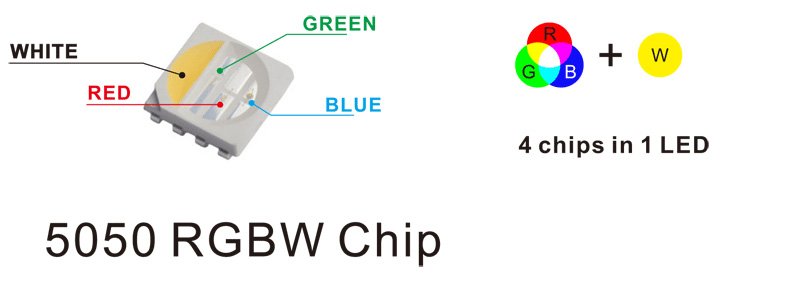
How Should RGB, RGBW and Tunable-White Loads Be Calculated?
Do not assume that the printed W/m value has the same meaning for every multichannel strip. A datasheet may specify power per channel, maximum combined power, power with all channels at full output, power limited by the controller, or typical power for a preset scene.
Before sizing the power supply, confirm the maximum output condition the final system can produce.
Important: A driver can have sufficient wattage while the controller remains undersized.
Check controller maximum total current, maximum current per channel, current through the common positive or negative conductor, terminal/connector rating, and whether all channels can operate simultaneously.
Should Buyers Use Rated or Measured LED Strip Power?
Use the declared maximum power and applicable tolerance for preliminary driver selection unless a different value has been validated for the final controlled system.
A lower site measurement may be caused by voltage drop, dimming, controller limitation, low supply voltage, thermal behavior, product tolerance, measurement position, or an inaccurate specification.
Conclusion: Lower measured power does not automatically mean higher efficiency. It may mean the strip is receiving insufficient voltage and producing less light.
Should Driver Efficiency Be Added to the LED Strip Wattage?
No. Driver output capacity and AC input consumption are different calculations.
If the LED strip requires 144W of DC output and the driver operates at 90% efficiency:
Approximate AC input power: 144W ÷ 0.90 = 160W
The driver still needs to provide 144W of DC output—not 160W of DC output.
- Use DC output capacity to size the LED strip load.
- Use efficiency, power factor, input current and inrush data to design the upstream AC circuit.
Why Does Inrush Current Matter in Large Projects?
The calculator determines steady-state DC output capacity. It does not size the upstream AC breaker, relay or contactor.
When multiple switch-mode drivers start simultaneously, their combined inrush current may cause nuisance breaker trips or stress switching components.
For larger commercial projects, request:
- Maximum AC input current
- Inrush-current peak & duration
- Recommended drivers per breaker
- Circuit-breaker characteristic
- Power factor
- Startup sequence
Should One Large Driver or Several Smaller Drivers Be Used?
| One Larger Driver May Offer | Several Smaller Drivers May Offer |
|---|---|
| Fewer AC connection points | Shorter low-voltage cable runs |
| Centralized maintenance | Easier zoning |
| Lower equipment count | Lower impact from one driver failure |
| Simpler purchasing | Easier branch-current management |
One large driver may also create:
- Longer DC cable routes & greater voltage drop
- More available fault current
- A larger failure zone
- More difficult branch protection
Several smaller drivers may create:
- More AC wiring & dimming interfaces
- More access requirements
- Higher combined inrush current
- More commissioning work
Conclusion: Split the load when branch distance, controller capacity, power-limited output requirements, zoning, maintenance or fault containment justify it.
Why Can the Same Driver Deliver Less Power in a Hot Installation?
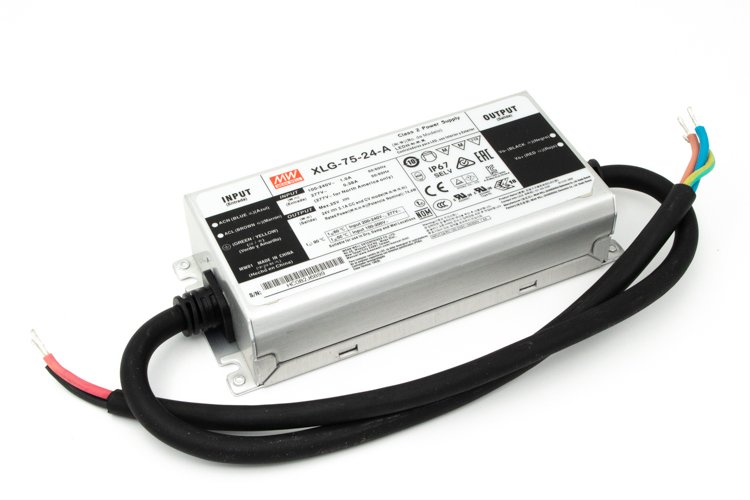
A driver’s nameplate rating may apply only within defined environmental and mounting conditions. Before final selection, verify rated ambient-temperature range, datasheet derating curve, max Tc case temperature, enclosure type, ventilation, and distance from heat sources.
Note: An IP67 driver does not make the complete LED strip system suitable for a wet location. Connections, controllers, junction boxes, cables and the LED strip require their own appropriate protection.
Can Any Dimmable Power Supply Work With Any Controller?
No. Power capacity is only one compatibility requirement.
Confirm architecture (CV vs CC), output voltage, protocol (TRIAC, 0–10V, DALI, downstream PWM), minimum load, dimming range, low-end stability, flicker, and controller input/output current.
A non-dimmable constant-voltage power supply can be used with a compatible low-voltage PWM controller. A mains-dimmable constant-voltage driver uses a different control architecture. Do not mix them without confirming the system.
Does a 12V or 24V Output Automatically Mean Class 2?
No.
For North American projects, Class 2 must be confirmed from the exact driver output classification and applicable documentation. It should not be inferred only from the nominal output voltage.
One large power supply is not automatically equivalent to several separately evaluated Class 2 outputs.
Buyers should request exact model, certification holder, file number, output classification, max voltage/current/power, and conditions of acceptability.
LED Strip Power Supply Selection Workflow
Confirm whether the LED strip requires constant voltage or constant current.
Match the driver output voltage to the LED strip.
Calculate the maximum credible connected load for every branch.
Calculate branch and total output current.
Apply a justified planned-loading limit.
Apply only the derating required by the exact driver datasheet.
Verify branches, cables, controllers, connectors, dimming, environment and documentation.
What Should a B2B Buyer Send for Driver Matching?
“Twenty meters of LED strip” is not enough information to select a driver. Xmart needs the electrical branch schedule, not only the total project length.
- LED strip model/spec
- Rated voltage & Max W/m
- Length of every branch
- Number of branches
- Cable distance
- Color type (RGB, etc.)
- Control/Dimming protocol
- AC input & target market
- IP Rating / Location
- Max ambient temperature
- Certification requirement
- Service/Redundancy needs
LED Strip Power Supply FAQ
What size power supply do I need for LED strip lights?
Must every LED power supply be loaded to only 80%?
Can a larger power supply damage an LED strip?
Can one power supply operate several LED strip branches?
Should LED strips use a constant-voltage or constant-current driver?
Does sufficient driver wattage solve voltage drop?
Which Xmart driver models have UL, ETL or DALI-2 documentation?
Send Xmart Your LED Strip Branch Schedule
Provide the strip voltage, maximum W/m, branch lengths, cable distances, control method, ambient condition and destination market. Xmart can then review the strip, driver, controller and wiring as one coordinated system.
Continue the System Review
Technical References
-
1. MEAN WELL — LED Power Supply Guidance
https://led.meanwell.com/qa.aspx -
2. MEAN WELL — Power Supply Derating and Installation Guidance
https://display.meanwell.com/qa.aspx -
3. UL Solutions — UL 8750 Updates for LED Equipment
https://www.ul.com/news/updates-led-equipment-use-lighting-products-ul-8750-what-you-need-know