Curtain box lighting is supposed to feel soft. You should notice the mood, not the strip.
But in a lot of finished projects, it ends up looking too bright, too direct, or just awkward. The top of the curtain glows like a light bar. The light source is visible from the sofa. The wall suddenly looks uneven. The whole detail feels cheaper than the rendering.
Most of the time, the strip is not the real issue. The real issue is where the strip sits inside the curtain box, and where the light goes first. That is the first decision to make. Not wattage. Not voltage. Not even COB or SMD.
The real starting point is this: Do you want the light to hit the curtain directly, wash it at an angle, graze the side surface, or stay hidden and bounce upward first?
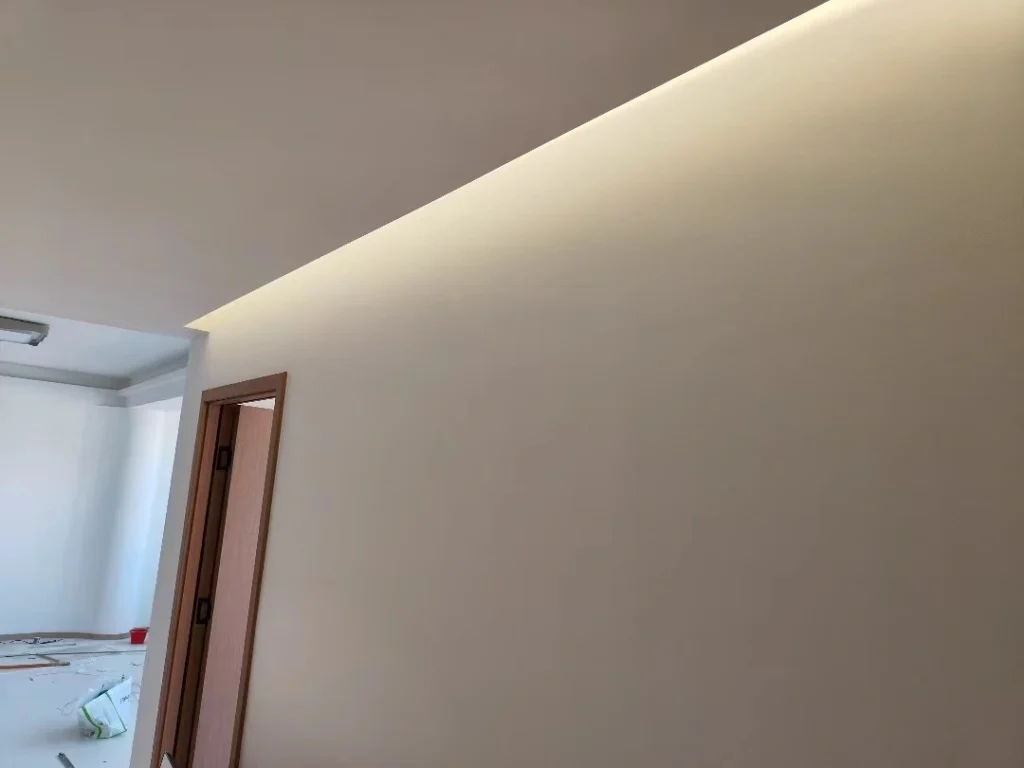
Table of Contents
- Why curtain box lighting often looks wrong?
- The 3 lighting directions that matter first
- The 4 common aluminum profile positions inside a curtain box
- Which position works best for different projects?
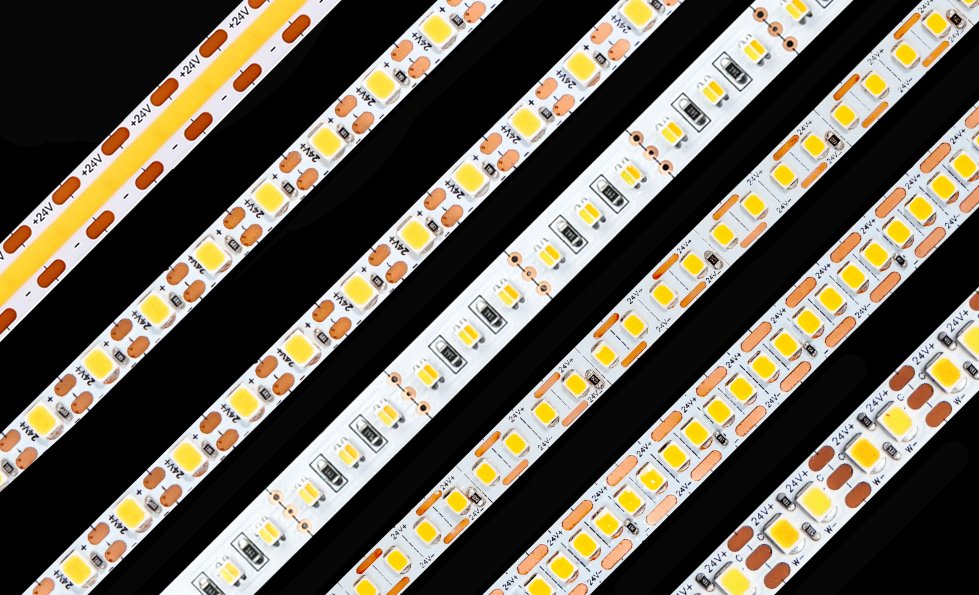
- What kind of LED strip works best?
- Common mistakes in curtain box lighting
- Final takeaway
- FAQ
Why curtain box lighting often looks wrong?
A lot of people start with the product.
They ask:
- 3000K or 4000K?
- COB or SMD?
- 12V or 24V?
- How many watts per meter?
Those questions matter, but they come later.
The bigger decision is the lighting effect.
A curtain box is not just a place to hide a strip. It is a very small lighting system. Move the strip a few centimeters, and the whole result changes. Glare changes. Shadow changes. Curtain texture changes. Whether people can see the strip changes.
That is why the same strip can look premium in one position and cheap in another.
The 3 lighting directions that matter first
Before talking about exact LED aluminum profile positions, it helps to simplify the logic into three lighting directions.
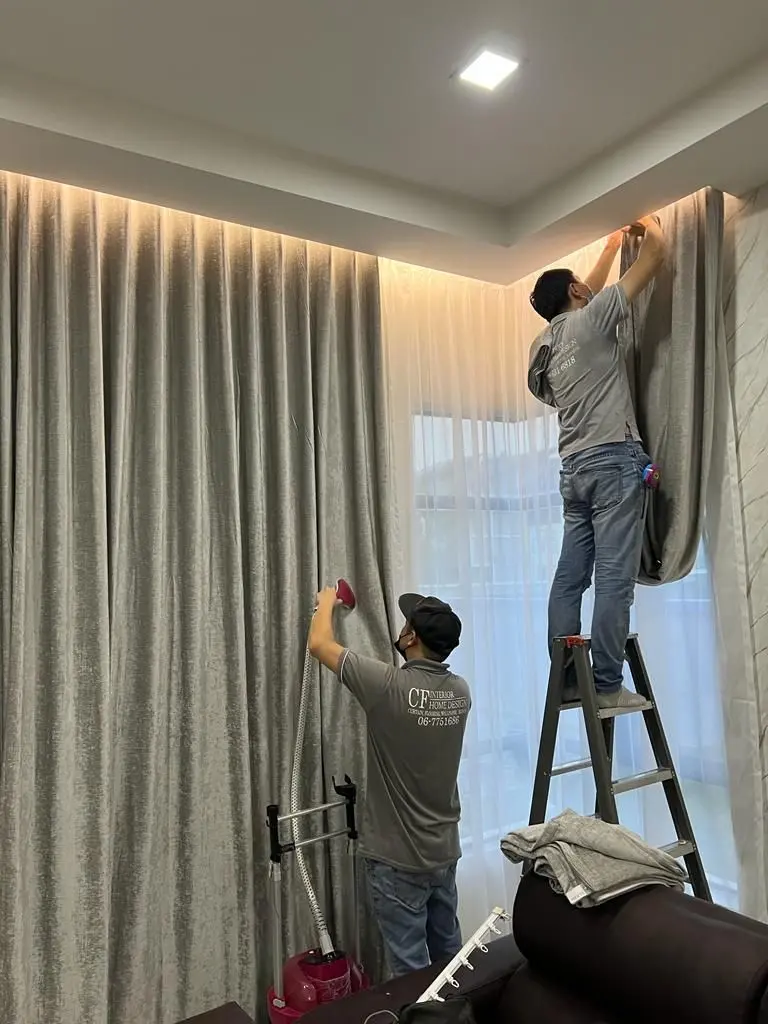
1. Upward lighting
This means the light goes upward first, hits the ceiling or upper inner surface, and then reflects back into the room.
This is usually the safest option if the goal is soft ambient light.
It feels calmer because the ceiling becomes the light source, not the strip itself. You are seeing reflected light, not direct output.
Best for: bedrooms, living rooms, hotels, no-main-light interiors
Main strength: soft, hidden, comfortable
Main weakness: weaker curtain texture, relies on ceiling reflection
If the ceiling is too dark, too rough, or too far away, the effect can look weaker than expected.
2. Downward lighting
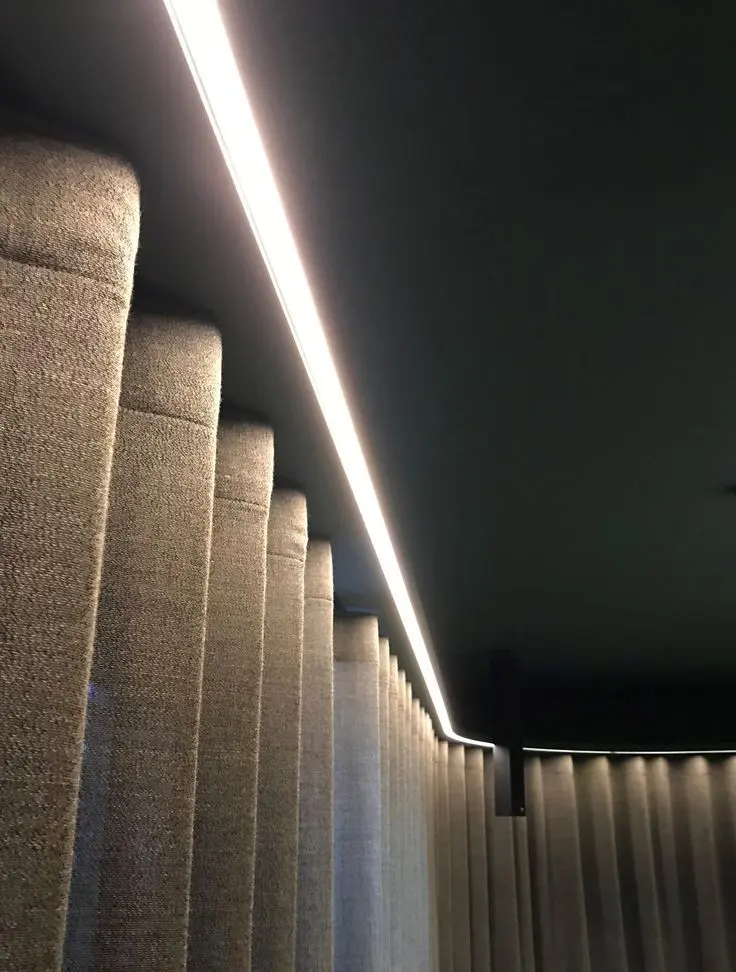
This means the light goes directly onto the curtain.
This gives the curtain more presence. The folds show up more clearly. The fabric feels richer. It can look beautiful when handled well, especially in hotel-style projects.
But this is also where a lot of projects go wrong. If the strip is too exposed, the top of the curtain gets too bright and the whole thing starts to look harsh.
Best for: decorative curtain lighting, hotel-style effects, model homes
Main strength: stronger curtain texture
Main weakness: glare, visible strip, top-heavy brightness
3. Side lighting
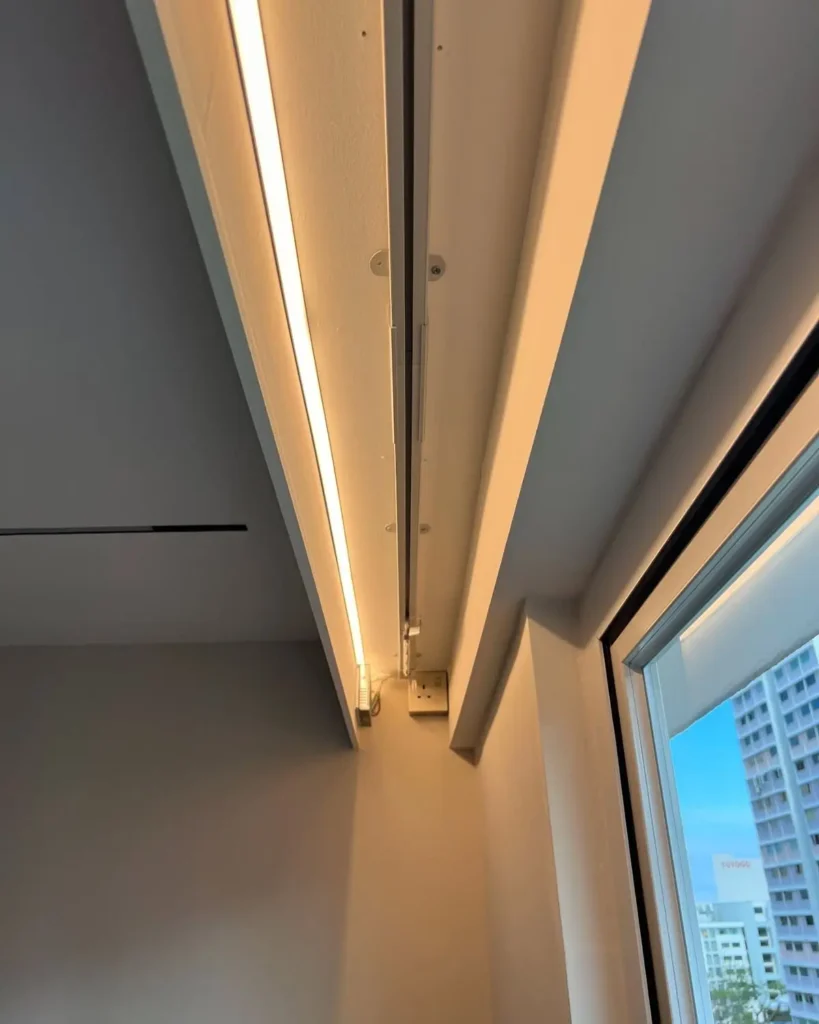
This means the light travels across the nearby side surface instead of washing the curtain directly.
This is usually used to bring out texture in stone, wood veneer, textured paint, or decorative panels beside the curtain.
It can look very expensive on the right material.
It can also make a wall look badly built.
Best for: feature walls, textured surfaces, wood, stone
Main strength: adds depth and texture
Main weakness: exposes wall defects very easily
Quick rule
- Upward = safest for soft ambience
- Downward = best for curtain texture, but riskier
- Side = best for materials, not for every curtain box
The 4 common aluminum profile positions inside a curtain box
Once the lighting direction is clear, the next step is the actual position of the aluminum profile.
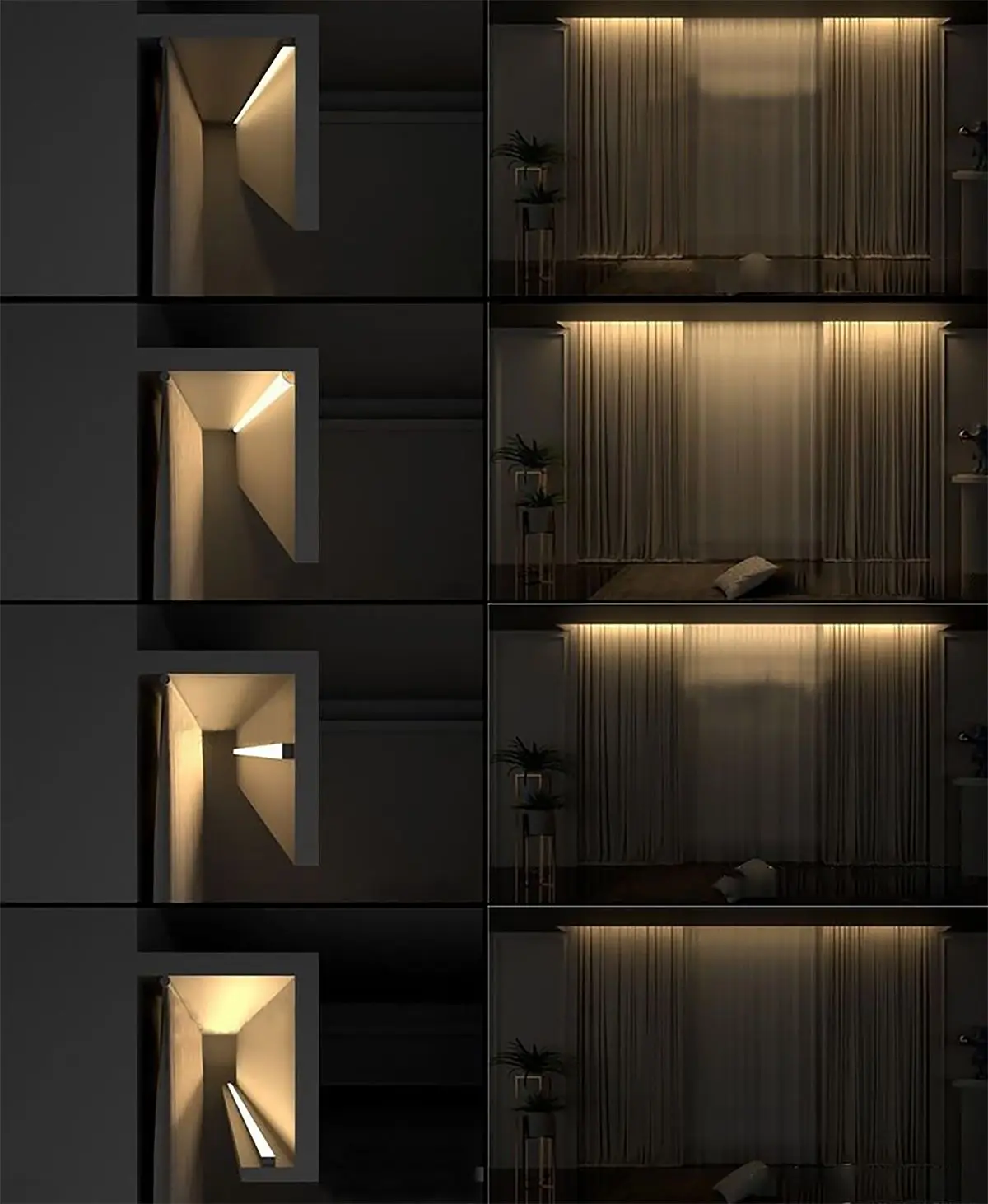
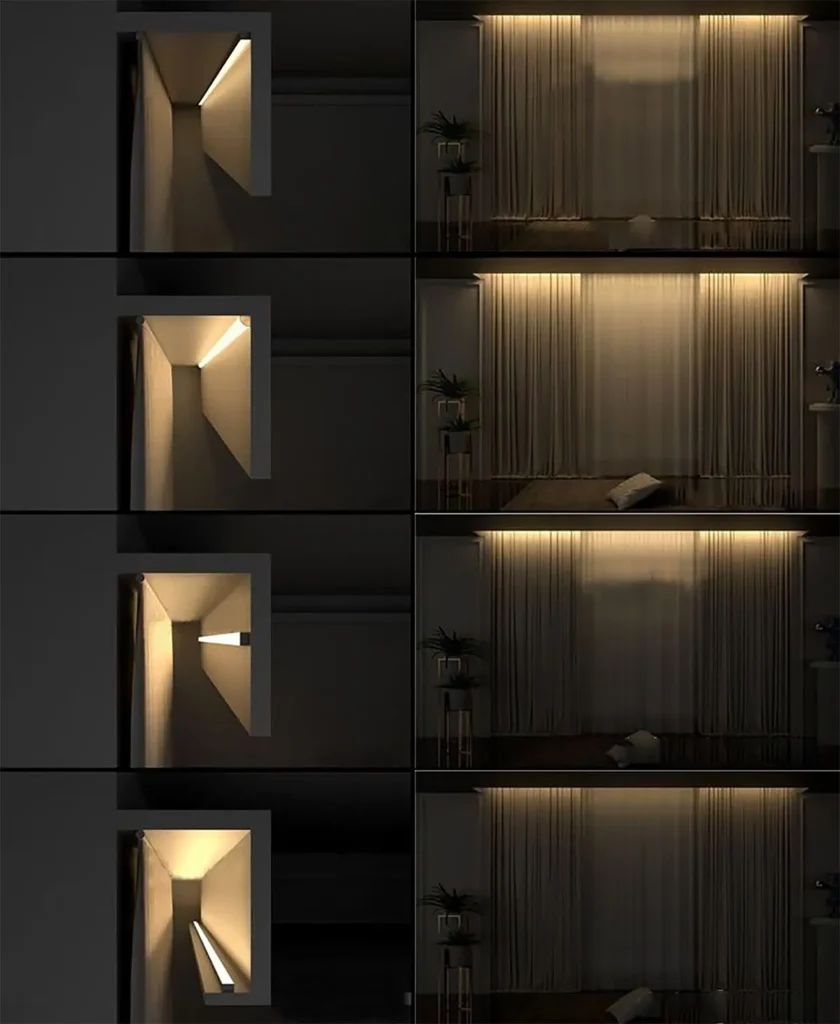
In real projects, curtain box lighting usually falls into four common setups.
1. Flat Pack Downlight Lighting
This is the most direct downward setup.
The profile sits flat inside the curtain box and throws light straight down onto the curtain.
This gives the strongest curtain wash in the shortest distance. It makes folds show up fast, and it works well when the curtain is meant to be part of the visual feature.
But it is also one of the easiest positions to get wrong.
If the profile sits too close to the front edge, people may see the light source directly. If the strip is too bright, the top of the curtain becomes a glowing band while everything below falls off too quickly.
That is when the result starts to feel cheap.
Best for: hotels, showrooms, model homes, decorative curtain lighting
Main benefit: strongest curtain effect
Main risk: highest glare risk
Simple judgment:
Use this when you want the curtain to stand out. Avoid it when comfort matters more than drama.
2. 45 Degree Tilt Lighting
This is often the most balanced position.
The strip is still lighting the curtain, but instead of shining straight down, the profile is tilted so the light hits the fabric more gently.
That usually gives a better-looking result.
The curtain still has texture. The top edge feels softer. The lighting looks more controlled and less blunt. In many residential projects, this is the version that feels the most “designed.”
It still needs control. You still need enough setback. And in a very shallow curtain box, you may not have enough room to make the angle work well.
But overall, this is often the best middle ground between softness and definition.
Best for: living rooms, bedrooms, premium apartments, hotel-style homes
Main benefit: good curtain texture without looking harsh
Main risk: still needs careful angle and hiding
Simple judgment:
If you want the curtain to look richer, but you do not want the result to feel aggressive, this is usually the best compromise.
3. Side Lighting
This position sends light across the nearby side surface rather than straight onto the curtain.
In a curtain box detail, that usually means grazing the side wall of the recess or the decorative surface beside the curtain.
This is less about making the curtain glow and more about making the surrounding material feel deeper.
On stone, wood veneer, or textured finishes, it can look great.
On a bad wall, it can look brutal.
If the wall is not flat, the light will show it. If the plaster has waves, the light will show it. If the paint finish is uneven, the light will show it.
So this position is powerful, but it is not forgiving.
Best for: stone, wood veneer, textured paint, wall panels
Main benefit: strong architectural texture
Main risk: reveals wall defects
Simple judgment:
Use side lighting for materials, not as the default answer for a curtain box.
4. Light Upwards
This is usually the safest option when the goal is a soft, quiet glow.
The profile sends light upward first. The ceiling reflects it back into the room. The strip stays more hidden, and the room feels calmer.
This is the version most likely to feel premium in a bedroom or living room.
It is not trying to show off the curtain. It is trying to improve the whole room mood.
That is why this method works especially well in no-main-light interiors, soft residential spaces, and hotel-style environments where comfort matters more than curtain drama.
The trade-off is simple: you get less direct curtain texture.
So if the curtain itself needs to stand out, this may feel too subtle. But if the goal is comfort and a clean hidden effect, it is hard to beat.
Best for: bedrooms, living rooms, hidden ambient lighting, soft residential mood
Main benefit: softest and safest effect
Main risk: weaker curtain definition
Simple judgment:
If you are unsure, start here. Upward lighting is usually the safest choice.
Which position works best for different projects?
Choose Flat Pack Downlight Lighting when the curtain should be a strong design feature and the project can handle more dramatic light.
Choose 45 Degree Tilt Lighting when you want curtain texture, but still want the result to feel refined.
Choose Side Lighting when the nearby material matters more than the curtain itself, and the wall quality is good enough.
Choose Light Upwards when you want soft ambient light, lower glare, and a more hidden premium effect.
Quick comparison
| Position | Best For | Main Benefit | Main Risk |
|---|---|---|---|
| Flat Pack Downlight | Strong curtain effect | Brightest curtain wash | Glare and top-heavy brightness |
| 45 Degree Tilt | Balanced decorative effect | Better curtain texture with softer feel | Still needs control |
| Side Lighting | Feature materials | Adds texture and depth | Reveals wall defects |
| Light Upwards | Soft ambient glow | Hidden, calm, premium effect | Less curtain texture |
What kind of LED strip works best?
There is no single best strip for every curtain box.
But for most curtain box lighting projects, the strip should give you:
- smooth light output
- stable dimming
- clean profile integration
- manageable heat
Best practical matching
For most premium hidden curtain boxes
COB LED strip is usually the safest choice. It gives a smoother light line and reduces visible dot issues.
For very narrow curtain boxes
CSP or other compact strip solutions are often better where space is limited.
For short sections that need precise finishing
Mini-cut strip is useful when normal cut lengths leave awkward gaps.
For long continuous runs
Higher-voltage or high-efficiency strip is usually a better fit.
For direct-view light lines
Anti-glare silicone neon flex can work better than a bare strip.
Simple product rule
- most premium hidden curtain boxes → COB
- very narrow details → CSP or slim strip solution
- precise short sections → mini-cut
- long runs → higher-voltage or high-efficiency solution
- direct-view line → anti-glare neon flex
Common mistakes in curtain box lighting
Starting with wattage
A brighter strip does not automatically create a better result. In many curtain boxes, it just makes the detail harsher.
Forgetting the real viewing angle
A strip may look hidden when you stand near the window, but fully visible from the sofa or bed.
Using side lighting on a poor wall
Side lighting can make a wall look premium or badly built. Test first.
No dimming control
Curtain box lighting usually looks better when dimmable. Night-time brightness is often much lower than people expect.
Hiding the driver with no service access
A clean light line is not enough. The driver and controller still need to be reachable later.
Final takeaway
Good curtain box lighting is not about making the strip brighter.
It is about putting the light in the right place.
Flat downlighting makes the curtain stronger.
45-degree tilt makes the curtain richer and more controlled.
Side lighting makes nearby materials more dramatic.
Upward lighting makes the room softer and calmer.
Every position has a trade-off.
The best result comes from deciding the lighting effect first, then matching the strip, profile, driver, dimming, and voltage around that effect.
A good curtain box light should not shout.
It should quietly make the room feel better.
FAQ
What is the best LED strip position for curtain box lighting?
For most soft, premium curtain box lighting, upward lighting is usually the safest choice. If you want stronger curtain texture, 45-degree tilt lighting is often the more balanced decorative option.
Is flat downlight positioning good for curtain box lighting?
It can be, especially when the curtain should be more dramatic. But it also has the highest glare risk and can easily create a harsh bright band at the top of the curtain.
Is 45-degree tilt better than straight-down curtain lighting?
In many residential and hotel-style projects, yes. It usually gives better curtain texture with a softer and more controlled look.
Is side lighting good for curtain box details?
Yes, but mainly when you want to highlight nearby wall texture or materials. It is not the safest choice for poor painted walls or when the only goal is soft ambience.
What is the best LED strip for curtain box lighting?
For most premium curtain box lighting, COB LED strip is usually the safest choice because it creates a smoother, more dot-free light line.
Do I need dimming for curtain box lighting?
In most cases, yes. Curtain box lighting usually looks better when dimmable, especially in bedrooms, living rooms, and hospitality-style interiors.
Can curtain box lighting replace the main light?
Usually no. It is mainly ambient or decorative lighting and works best as part of a layered lighting scheme.
A better curtain box light does not start with wattage. It starts with position. Once the lighting direction is clear, the right strip is much easier to choose. For the next step, see our guide on how to choose the right LED strip.