
COB vs SMD vs CSP LED Strips for Commercial Products
A practical guide for lighting brands, fixture manufacturers and project buyers comparing LED strip construction, visual appearance, profile fit and model-specific performance.
Compare the Three OptionsWhich Is Better: COB, SMD or CSP LED Strip?
None of the three is automatically better for every commercial lighting product.
COB is often evaluated when the project prioritizes a continuous emitting surface. Conventional SMD remains useful when the fixture requires an established LED package, optical layout, approved BOM or certification-covered model. CSP can support compact, high-density layouts using packages close to the size of the LED die.
The final decision should be based on the actual model, fixture dimensions, required light appearance, measured performance, control system, operating environment and certification coverage.
What Is the Structural Difference?
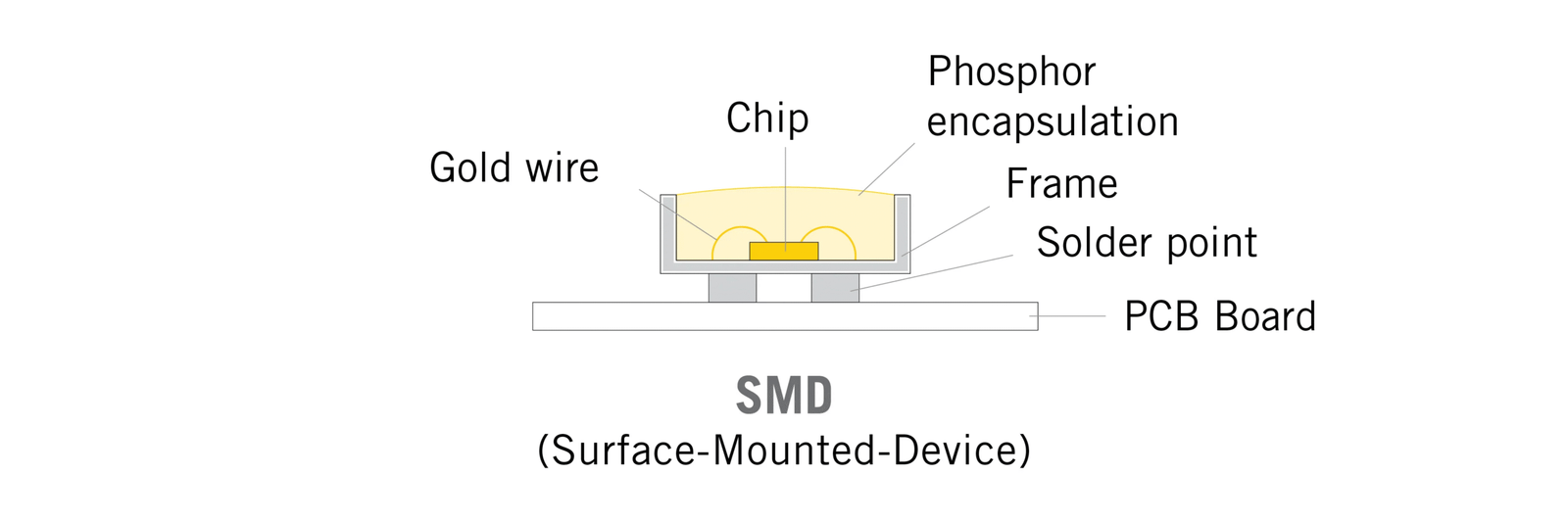
Conventional SMD LED Strip
Individually packaged LED components are mounted onto a flexible PCB. Package size, LED pitch, density and optical layout vary by model.

COB LED Strip
Multiple LED dies are mounted or bonded onto the flexible PCB and covered by a continuous encapsulation layer, creating a continuous emitting surface.
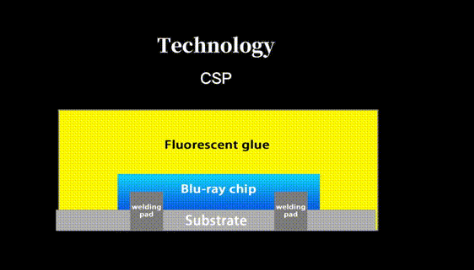
CSP LED Strip
CSP uses packages whose dimensions are close to the LED die. These compact packages can be mounted at high density on a flexible PCB.
These are common commercial product categories rather than three perfectly equivalent technical terms. CSP components are also surface-mounted, while COB describes a chip-on-board construction with continuous encapsulation.
COB vs SMD vs CSP LED Strip Comparison
| Buyer Consideration | Conventional SMD | COB | CSP |
|---|---|---|---|
| Basic construction | Individually packaged LEDs mounted on the PCB. | Multiple dies under a continuous encapsulation layer. | Near-chip-size packages mounted at high density. |
| Visible light points | Individual light points may remain visible when LED pitch is wide or the optical distance is limited. | Often selected when a continuous emitting surface is required. | Compact package size and high density can reduce visible points, but the result depends on pitch and installation. |
| Shallow-profile suitability | Requires evaluation of LED pitch, profile depth and diffuser performance. | Frequently considered for shallow profiles and close-view light lines. | Can be suitable for compact profiles, subject to sample validation. |
| Mechanical integration | Available in many established PCB widths, packages and optical layouts. | Check encapsulation width, PCB width, solder pads, cut length and connector fit. | Check PCB width, package spacing, cut length, solder pads and connector compatibility. |
| Color and control options | Broad established options, including single color, tunable white, RGB and addressable configurations. | Single-color and multichannel options are available, depending on the model. | Single-color and multichannel options may be available, depending on the model. |
| Best starting point | Existing luminaires, specified LED packages, mature BOMs and projects requiring a particular optical layout. | Visible linear light, shallow profiles and applications prioritizing a continuous emitting surface. | Compact, high-density or multichannel layouts where small package dimensions may be useful. |
| Not determined by the technology name | Luminous efficacy, operating temperature, lifetime, voltage drop, maximum run length, color consistency, reliability and certification must all be verified using the exact model and operating conditions. | ||
The table describes common selection tendencies, not guaranteed product performance. Compare identified models under the same electrical, thermal and optical conditions.
Which LED Strip Should Buyers Evaluate First?
Visible Light Line in a Shallow Profile
Start by evaluating COB and a suitable high-density CSP model. Test both inside the actual profile because diffuser material, profile depth and viewing distance affect whether light points remain visible.
Existing Fixture or Approved Product BOM
Start with conventional SMD when the fixture already specifies a package, PCB layout, lens position, connector or certification-covered construction.
Compact Furniture or Retail Profile
Compare the available PCB width, cut length, solder-pad dimensions and connector fit before choosing COB or CSP. A product that looks smoother but cannot fit the assembly is not a workable solution.
Long-Run Commercial Installation
Do not choose between SMD, COB and CSP based on run length alone. Voltage, watts per meter, PCB conductor design, acceptable voltage drop and power-feed arrangement are more important.
For commercial products, the correct first question is not "Which technology is newest?" It is "Which verified model meets the fixture, light, electrical and market requirements?"
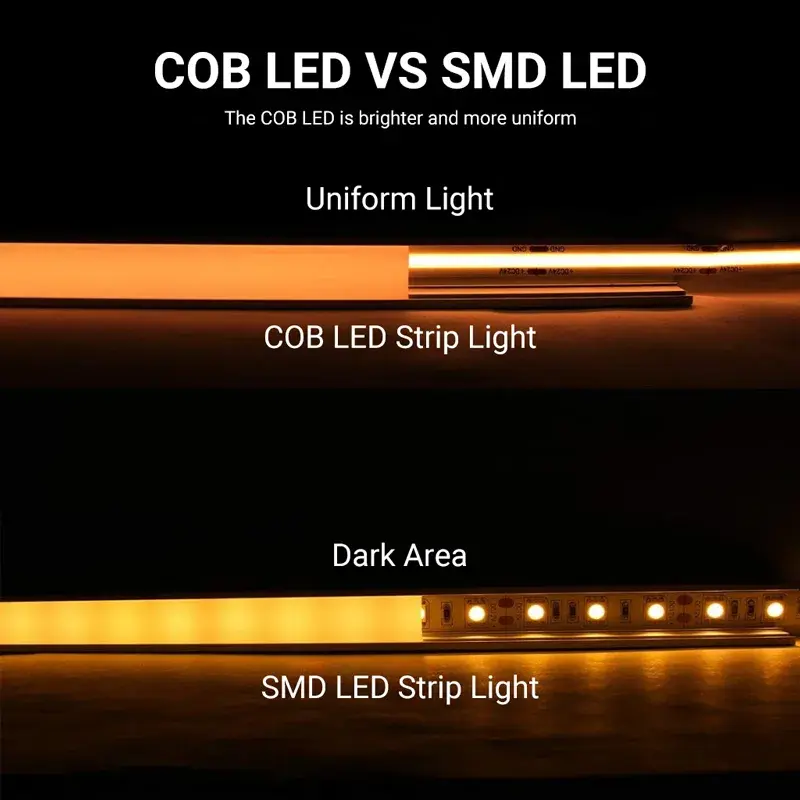
Retail Shelf Profile with a Visible Light Line
Project Conditions
- Application
- Retail shelf and display lighting
- Profile
- Shallow aluminum profile with opal diffuser
- PCB Limit
- Maximum 8 mm
- Light Requirement
- Continuous white light at close viewing distance
- Voltage
- 24V DC
- Color
- 4000K, CRI Ra ≥90
- Control
- Single-color PWM dimming
- Market
- USA
Selection logic:
Begin with a COB model and a compatible high-density CSP model that fit the same profile. Compare the samples at the same input voltage, wattage range, profile depth and viewing distance.
A conventional SMD model may also be evaluated if its LED pitch and the profile’s optical distance can produce the required appearance.
Selection result:
Do not select a winner from catalogue photos. Approve the construction only after comparing the installed appearance, measured light output, operating temperature, mechanical fit and model-specific certification documentation.
This example explains the selection process. It is not a published performance claim for a specific Xmart model.
What Should Buyers Validate Before Selecting a Model?
Installed Light Appearance
Evaluate visible points, shadows, reflections and color mixing inside the actual profile and diffuser.
Measured Optical Performance
Compare stabilized lumens per meter, watts per meter, efficacy, CCT, Duv, CRI and color consistency under documented conditions.
Mechanical Fit
Confirm PCB width, encapsulation width, cut length, solder pads, cable exit and connector dimensions.
Electrical Performance
Confirm voltage, current, control method, feed length and start-to-end voltage behavior.
Thermal Conditions
Measure stabilized strip or profile temperature at the intended wattage and ambient temperature.
Documentation
Confirm the exact specification, approved sample, BOM reference and applicable certification coverage.
Product density, package name and catalogue photographs cannot replace an installed sample and model-specific data.
What Information Does Xmart Need to Recommend an Option?
- Application and target market
- Direct-view, reflected or concealed installation
- Profile drawing and internal dimensions
- Diffuser material and LED-to-diffuser distance
- Voltage and watts-per-meter limit
- Required luminous flux
- CCT, CRI and color channels
- PCB width and cut-length limits
- Required section and feed length
- Control method
- IP and operating environment
- Required certification or documentation
The buyer does not need to select COB, SMD or CSP in advance. Xmart can compare suitable constructions after reviewing the fixture, optical target, electrical limits and target market.
Model availability, production route and certification coverage must be confirmed before sampling.
COB, SMD and CSP LED Strip Questions
Is COB LED strip always better than SMD?
Which LED strip is the most dotless?
Is CSP LED strip more reliable than COB?
Which technology has the highest luminous efficacy?
Is COB better for long LED strip runs?
Can all three constructions support tunable white or RGB?
Do Xmart COB, SMD and CSP LED strips have UL or ETL documentation?
Compare LED Strip Options for Your Fixture
Send Xmart your fixture drawing, profile dimensions, required light output, voltage, control method and target market. The team can identify suitable SMD, COB or CSP models for sample evaluation.
Last reviewed: October 2025
Technical review: Xmart Engineering Team