Euri Lighting’s country of origin is easier to verify than one of its published CCT specifications.
The current Euri 2×2 backlit flat panel is publicly listed as a product of China. Euri’s parent company, IRTronix, also has a long and active import history dominated by Chinese lighting suppliers.
But buyers should notice another issue: Euri’s current product page presents conflicting information about whether the lowest selectable CCT is 3000K or 3500K.
For a contractor, distributor or private-label buyer, that documentation inconsistency can be more immediate than the country printed on the carton.
Direct Answer
Based on public information reviewed in August 2026:
- Euri Lighting is a California-based brand operated by IRTronix Inc.
- Euri Lighting was launched as a lighting brand in 2013.
- The current Euri 2×2 backlit flat panel is publicly identified as China origin.
- IRTronix’s principal lighting supply chain is strongly connected to China.
- Euri has business and technical operations in the United States and Asia, but no evidence reviewed establishes U.S. manufacture of its commercial panels.
- Current and previous Euri panel generations use different model numbers and should not share one origin declaration.
- Euri’s current 2×2 product page contains a CCT discrepancy that should be resolved before specification.
The most defensible conclusion is:
Euri Lighting’s current commercial flat panels appear to be contract-manufactured in China, with product specifications, certification and warranty controlled by the California-based brand.
Who Actually Owns Euri Lighting?
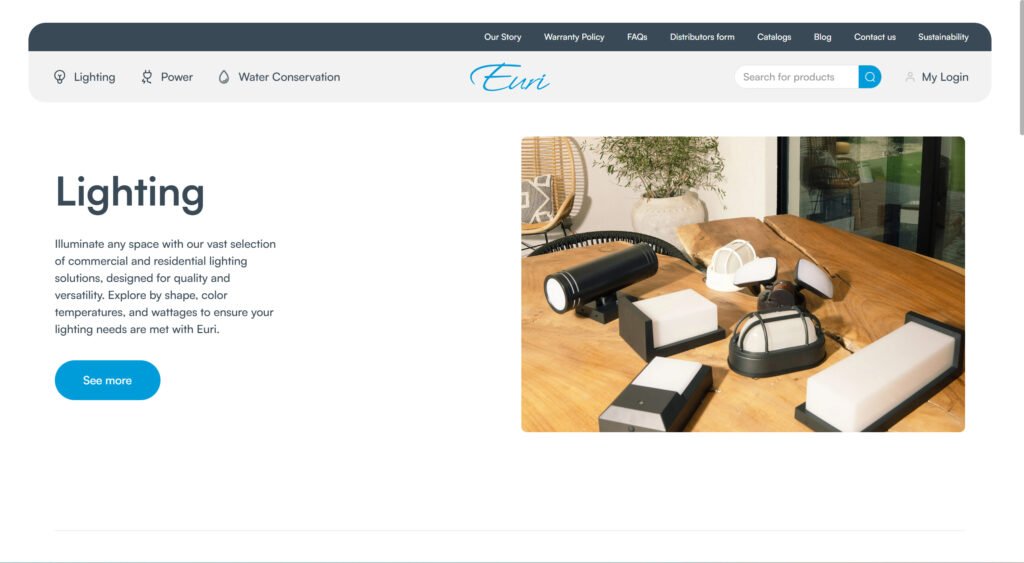
Euri Lighting is a division of IRTronix Inc.
IRTronix is a California corporation with experience in semiconductors, LED components and other electronic products. The Euri brand began in 2008 with a consumer electronics concept, while Euri Lighting launched in 2013.
The company describes itself as family-owned and native to Los Angeles. Its U.S. operations are based in Torrance, California.
IRTronix also publishes business locations in:
- Shenzhen, China
- Hong Kong
- South Korea
These international locations help explain Euri’s access to Asian electronics and lighting suppliers. They do not identify the exact factory manufacturing a particular panel.
The Current 2×2 Euri Panel Is Listed as China Origin
A current distributor listing identifies Euri’s backlit 2×2 panel as a product of China.
The listed configuration includes:
- 2×2 nominal size
- Selectable wattage
- Selectable CCT
- 120–277V operation
- 0–10V dimming
- UL listing
- DLC qualification
- Five-year warranty
- Country of origin: China
This is product-level evidence, not merely an assumption based on the location of Euri’s suppliers.
Which Euri Model Is the Current Panel?
Euri’s current product page identifies:
EBPN22-40WS2000-2
Published specifications include:
- 20/30/40W selectable power
- 2,600/3,900/5,200 lumens
- 130 lm/W
- AC100–277V
- 0–10V dimming
- CRI 80
- 110-degree beam angle
- Damp-location rating
- 50,000-hour rated life
- Five-year warranty
- Two fixtures per pack
The EBPN prefix identifies a backlit panel. The 22 indicates a nominal 2×2 format, and the -2 suffix is associated with two-pack packaging.
Euri also references a 2×4 version:
EBPN24-50WS2000-2
Buyers should not shorten these models to “Euri 2×2 panel” on quotations or purchase orders.
The CCT Specification Does Not Agree With Itself
Euri’s current product page contains two different lowest CCT values.
Parts of the page identify the selectable range as:
- 3500K
- 4000K
- 5000K
The product description and detailed specification section state:
- 3000K
- 4000K
- 5000K
This is not a trivial typing difference.
A 3000K panel and a 3500K panel can serve different specifications. The discrepancy affects:
- Product schedules
- Architectural finish coordination
- Replacement matching
- Hotel and healthcare applications
- DLC configuration checks
- Distributor inventory descriptions
- Carton and fixture labeling
Before specifying the model, request a photograph of the actual CCT switch and production label.
The purchase order should state the required positions explicitly. For example:
Selectable CCT: 3000K/4000K/5000K—no substitution without written approval.
If the production model is actually 3500K/4000K/5000K, the supplier should revise the submittal before approval.
Euri’s Older and Current Panel Models Should Not Be Mixed
Previous Euri flat-panel models include:
- EPN22-2040S-2
- EPN22-2050S-2
- EBPN22-40W103SW-2
- EBPN24-50W103SW-2
- EBPN14-40W103SW-2
The EPN models were associated with Euri’s edge-lit panel range. The EBPN models identify backlit panels.
Euri later introduced the WS2000 model format.
A quotation that combines an older specification sheet with a newer model can create several problems:
- Incorrect lumen output
- Wrong wattage options
- Incorrect panel depth
- Different CCT settings
- Inactive DLC records
- Different driver
- Different factory
- Incorrect country-of-origin statement
The fact that two models are both called Euri backlit panels does not prove they are the same product revision.
Edge-Lit vs Backlit Euri Panels
Euri has sold both optical constructions.
EPN Edge-Lit Panels
In an edge-lit panel, LEDs direct light into a PMMA light-guide plate from the fixture’s edges.
Euri’s earlier edge-lit models included fixed-CCT options and outputs such as 3,750 lumens from a 30W 2×2 fixture.
The principal long-term variables include:
- Light-guide plate quality
- Dot-pattern consistency
- PMMA yellowing
- Edge coupling
- Frame alignment
EBPN Backlit Panels
The current EBPN design places LEDs behind the diffuser.
Euri promotes a concave-convex backplate intended to improve structural strength and reduce light leakage. The backlit architecture also removes the separate edge-lit light-guide plate.
For B2B buyers, the shift to backlit technology can improve cost control and reduce dependence on PMMA plate quality. It does not by itself guarantee better driver life, color consistency or origin documentation.
Euri’s Import Records Support a China-Based Supply Chain
IRTronix appears in U.S. customs records as the importer behind Euri Lighting.
Identified suppliers include:
- National State Industries Limited
- Zhejiang Hongyao Lighting
- Zopoise Technology
- Shenzhen SNC Opto Electronic
- Xiamen Longstar Lighting
- Other Chinese electronics and lighting companies
Public records show hundreds of IRTronix shipments through major Chinese ports, including Yantian, Ningbo, Xiamen, Shanghai and Shekou.
Cargo descriptions include:
- LED light products
- LED lamps
- LED fixtures
- LED drivers and stabilizers
- Commercial lighting products
Some recent shipments involve suppliers based in Thailand, Bangladesh or other countries. Those records relate to Euri’s wider portfolio and do not establish a non-China origin for its flat panels.
The model-level panel listing and the broader supplier history both support China as the current origin conclusion.
“Manufacturing With a Purpose” Is Not a Factory Declaration
Euri uses the phrase “manufacturing with a purpose” when describing its goal of making energy-saving products affordable.
That statement explains the brand’s mission. It does not state that the fixtures are manufactured in California.
Likewise, these phrases do not establish U.S. origin:
- California company
- Los Angeles-based
- American brand
- Designed in the USA
- U.S. warranty
- U.S. customer support
- Manufacturer of LED lighting products
For customs, tariff or government-procurement purposes, the buyer still needs an exact-model origin declaration.
Is the Euri Panel Really DLC Premium?
Euri’s current product page promotes the EBPN22-40WS2000-2 as DLC 5.1 Premium.
That claim should be checked using the exact model number and the current qualified-products record.
This is especially important because selectable fixtures can have multiple wattage and CCT combinations. Buyers should determine:
- Which model appears in the DLC database
- Whether the suffix matches
- Which wattage settings are covered
- Which CCT settings are covered
- Whether the product remains active
- Whether the listing applies to the supplied driver
- Which configuration qualifies for the intended rebate
A DLC logo on a webpage does not guarantee a utility incentive for every production lot or configuration.
The Two-Pack Suffix Is a Supply-Chain Detail
Euri sells the current panel as a two-pack.
Packaging appears minor, but it affects commercial procurement:
- Pallet quantity
- Minimum order multiple
- Replacement-unit availability
- Freight-damage exposure
- Distributor stock control
- Warranty replacement handling
If one fixture fails, the distributor should confirm whether Euri will provide a single replacement or require replacement through a complete two-pack.
This matters when a project needs one matching fixture several years after installation.
What the Five-Year Warranty May Not Cover
Euri’s current panel page states a five-year warranty.
Older Euri warranty documents show that commercial product coverage may vary by product and that labor, removal, reinstallation and return-shipping costs can be excluded.
Therefore, “five-year warranty” should not be interpreted automatically as a five-year project-cost guarantee.
Request written answers to these questions:
- Is the driver covered for the full five years?
- Is commercial operation covered?
- Are maximum daily operating hours specified?
- Is replacement labor included?
- Who pays return freight?
- Will Euri advance-ship replacements?
- Is the replacement guaranteed to match the original CCT?
- Does the replacement carry a new warranty or only the remaining term?
For a distributor, the most expensive part of a panel failure may be the site visit—not the fixture.
Does China Origin Trigger Section 301 Duties?
China origin means the panel should be evaluated for China Section 301 treatment using its actual HTS classification.
The importer should verify:
- HTS code
- Ordinary duty
- Applicable Section 301 rate
- Current exclusions
- Other Chapter 99 measures
- Entry-date requirements
A safety or efficiency certification does not affect customs origin.
Use the USTR Section 301 search tool and obtain a calculation from a qualified customs broker.
What B2B Buyers Should Request From Euri
Before placing a commercial order, request:
- Exact model and UPC.
- Current specification-sheet revision.
- Photograph of the wattage and CCT switches.
- Confirmation of whether the lowest CCT is 3000K or 3500K.
- Active UL certification information.
- Current DLC product ID.
- LM-79 report.
- Driver manufacturer and model.
- Country-of-origin declaration.
- Factory name and address.
- Carton and fixture-label photographs.
- Warranty terms for commercial operation.
- Written factory and component-change policy.
The approved submittal, production label and delivered fixture should contain the same technical information.
Comparing Euri With a Direct OEM Panel Program
Euri offers an accessible commercial product with selectable configurations, U.S. sales support and established distribution channels.
A direct OEM program becomes valuable when the buyer needs control over:
- Factory location
- Private labeling
- Driver selection
- CCT configuration
- Photometric performance
- Packaging quantity
- Certification ownership
- Component substitutions
- Tariff planning
- Warranty process
A top LED flat panel manufacturer should resolve specification discrepancies before mass production and connect the model number to the same factory, test report and certification record.
Buyers can review Xmart’s backlit LED panel platform and certification capabilities when developing a distributor or project-specific alternative.
For buyers evaluating China-plus-one sourcing, Xmart’s audit of the top commercial lighting manufacturers in Vietnam provides additional factory-selection context.
Project requirements can be submitted through the Xmart quick-quote page.
Frequently Asked Questions
Is Euri Lighting an American company?
Yes. Euri Lighting is operated by California-based IRTronix Inc. Euri Lighting launched in 2013.
Are Euri LED flat panels made in the USA?
No evidence reviewed establishes U.S. manufacture of Euri’s commercial panels. The current 2×2 backlit panel is publicly listed as China origin.
Are Euri LED panels made in China?
The available model-level evidence identifies the current Euri 2×2 backlit panel as a product of China. IRTronix’s broader import history also shows extensive China sourcing.
What is the current Euri 2×2 panel model?
The current product page identifies EBPN22-40WS2000-2, a 20/30/40W selectable backlit panel sold as a two-pack.
Is the lowest CCT 3000K or 3500K?
Euri’s current page contains conflicting information. Buyers should verify the actual switch and production label before approving the model.
What is the difference between EPN and EBPN?
EPN has been used for Euri’s edge-lit panels. EBPN identifies backlit panels.
Is the Euri EBPN panel DLC Premium?
Euri promotes the current model as DLC 5.1 Premium. The exact model and active configurations should be verified in the current qualified-products database.
Does a five-year warranty include installation labor?
Not necessarily. Euri’s warranty documents have excluded labor, removal, reinstallation and shipping expenses. Obtain the current model-specific warranty before purchase.
Final Assessment
Euri Lighting is a California brand backed by an electronics-focused parent company and an extensive Asian supplier network.
The available evidence points to China as the origin of its current commercial flat panel.
The more revealing procurement issue is the documentation gap. The current Euri 2×2 panel page does not consistently identify whether the lowest CCT is 3000K or 3500K.
For a B2B order, the lesson is clear:
Country of origin tells you where the product was made. Document control tells you whether you are buying the product that was actually specified.
Both must be verified before the panel reaches the jobsite.