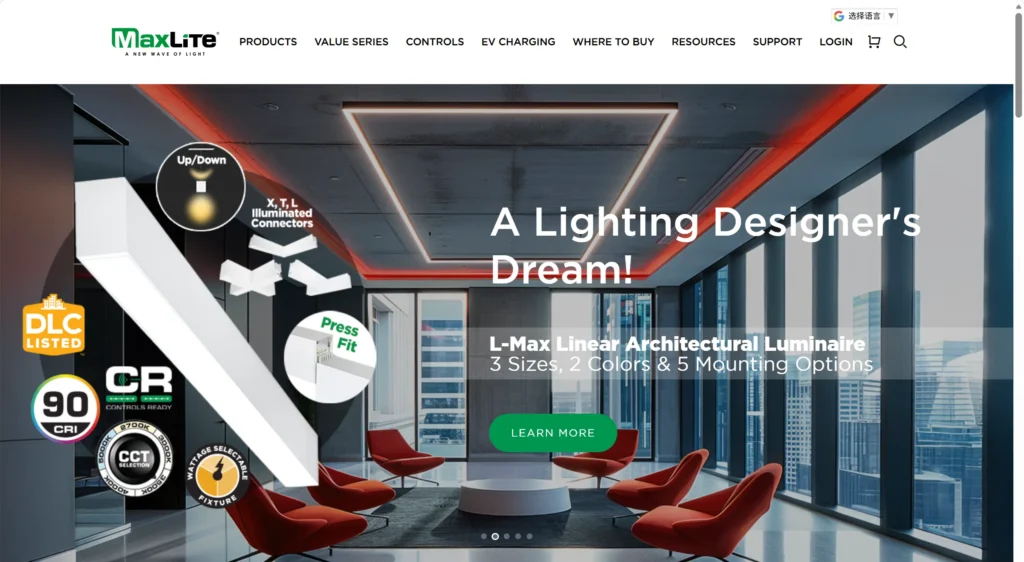
MaxLite’s FlatMax tells buyers more about product configuration than factory location.
That distinction matters.
Public MaxLite information does not support assigning one manufacturing country to every FlatMax LED panel. Some G5 documents separate standard sourcing from TAA-country sourcing, but they do not publicly name the exact country behind every SKU.
For distributors, contractors and private-label buyers, the correct question is therefore not:
“Where does MaxLite manufacture its panels?”
It is:
“What is the documented country of origin for this exact SKU and shipment?”
The Short Answer
MaxLite offers multiple FlatMax product families, including G5 and G6 panels. Its published G5 sourcing codes distinguish between:
- Standard models sourced from a “Non-TA Country”
- Models carrying a
TAsuffix sourced from a “TAA Country”
However, neither description identifies one universal manufacturing country.
A TAA version should not automatically be interpreted as Made in USA. Likewise, a standard model should not automatically be labelled as made in China without SKU-specific documentation.
What the Model Number Actually Reveals
Consider these FlatMax G5 examples:
| Model | Format | Published sourcing signal |
|---|---|---|
| MLFP14G515WCSCR | 1×4 | Standard sourcing |
| MLFP22G515WCSCR | 2×2 | Standard sourcing |
| MLFP24G522WCSCR | 2×4 | Standard sourcing |
| MLFP14G515WCSCRTA | 1×4 | TAA version |
| MLFP24G522WCSCR/2PTA | 2×4 | TAA version |
The TA suffix is commercially important because it identifies a different sourcing qualification.
It still does not tell a buyer:
- The exact assembly country
- Where the driver was manufactured
- Where the LED boards were produced
- Whether the country stays unchanged between purchase orders
- Whether emergency packs and controls share the fixture’s origin
This is the evidence gap procurement teams must close before approving the product.
TAA-Compliant Does Not Mean Made in USA
This is one of the most common specification mistakes in commercial lighting.
A TAA-compliant product may originate in the United States or another designated country. The label is a procurement qualification—not proof of domestic manufacturing.
Before quoting a public-sector or federally funded project, request:
- The exact TAA SKU
- A current country-of-origin declaration
- Written confirmation that the quoted configuration is TAA compliant
- Separate origin information for emergency drivers, sensors and controls
- Confirmation that substitutions require buyer approval
Never extend the compliance status of one model to an entire product family.
A New Generation Does Not Prove a New Factory
FlatMax G6 is a newer product generation, but a product-generation change is not country-of-origin evidence.
A brand may change:
- Driver suppliers
- Housing vendors
- LED packages
- Final assembly locations
- Emergency components
- Control modules
without making those changes obvious on a general product page.
Conversely, a redesigned panel may still come from the same manufacturing base.
For B2B buyers, G5 documentation should therefore not be reused to approve a G6 order. Each new generation, wattage and configuration needs its own document set.
Why an Unnamed Origin Creates Tariff Risk
“Non-China” and “tariff-free” are not equivalent.
Country of origin can affect:
- Section 301 exposure
- Reciprocal or country-specific duties
- Antidumping or countervailing duty screening
- Government procurement eligibility
- Importer-of-record documentation
- Landed-cost calculations
Vietnam, for example, can help companies diversify away from China-specific exposure. But Vietnam origin does not automatically eliminate all US import duties.
The actual result depends on the current tariff schedule, HTS classification, substantial-transformation facts and any applicable exemptions.
Procurement teams should calculate duty exposure from documents—not from a supplier’s country-level marketing statement.
What to Request Before Issuing a Purchase Order
Send the supplier this exact request:
Please confirm the legal country of origin for the quoted MaxLite FlatMax SKU and provide a current signed manufacturer declaration. The declaration must cover the complete fixture configuration, including the driver, emergency option and controls. Please also confirm whether the origin may change without written notice.
For larger programs, add:
- Sample carton label
- Fixture nameplate photo
- Commercial invoice example
- Packing-list example
- TAA letter where applicable
- DLC and safety certification references
- Change-notification agreement
This creates a usable compliance file instead of relying on a salesperson’s email statement.
When Buyers Need a More Transparent Sourcing Alternative
If a distributor needs greater visibility into the manufacturing source, the next step is not simply to replace one brand with another.
The better approach is to compare factories and manufacturing programs directly.
Our guide to commercial lighting and LED panel manufacturers in Vietnam provides a broader shortlist for buyers evaluating Vietnam-based panel, troffer and commercial-lighting supply chains.
The list is useful for initial sourcing, but every manufacturer should still be audited for:
- Actual production capability
- Export-market experience
- Certification ownership
- Driver and LED sourcing
- Quality-control procedures
- Country-of-origin documentation
- MOQ and lead time
- Engineering-change control
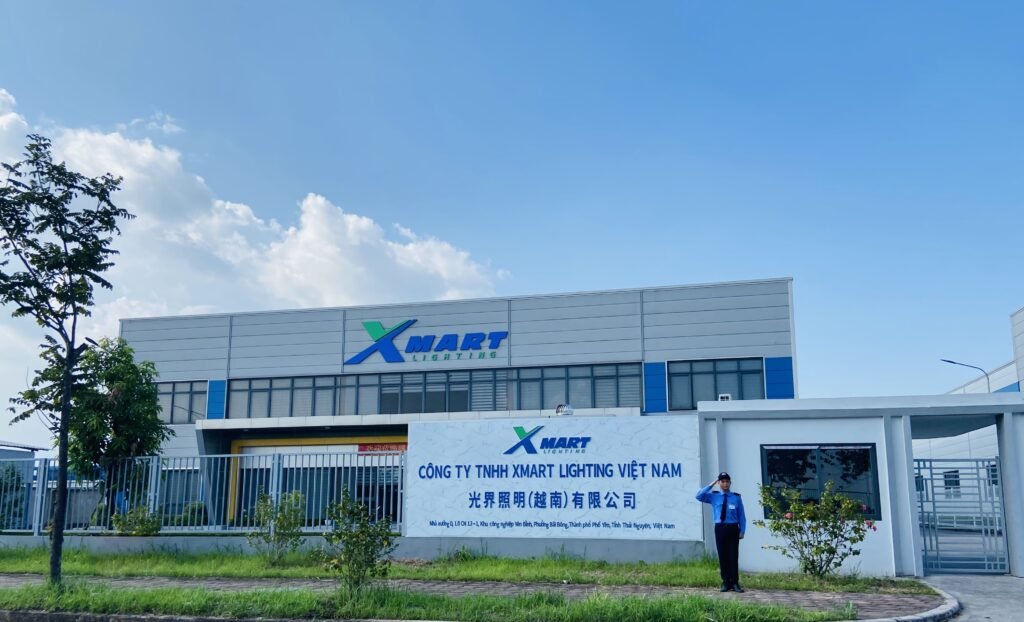
Xmart manufactures commercial backlit LED flat panel lights in Vietnam for distributors, importers and private-label programs.
Available B2B options include:
- 1×4, 2×2 and 2×4 formats
- Wattage and CCT selectable configurations
- 0–10V dimming
- Emergency and sensor options
- Custom labels and packaging
- Project-based photometric documentation
- Certification support
- Country-of-origin documentation
Vietnam production can provide a useful supply-chain alternative, but tariff treatment must still be confirmed for the exact product and shipment.
Buyers comparing MaxLite with a factory-direct panel program can request a specification and landed-cost review.
MaxLite FlatMax Buyer Checklist
Before approving a FlatMax panel, verify:
- Exact model number
- Standard or
TAsourcing version - Written country-of-origin declaration
- TAA status, if required
- Current DLC listing
- Safety certification and model match
- Driver manufacturer and replacement policy
- Emergency-component origin
- Controls compatibility
- Tariff classification
- Origin-change notification procedure
Frequently Asked Questions
Are all MaxLite FlatMax panels manufactured in the same country?
Public documentation does not establish one manufacturing country for every FlatMax model. Origin should be confirmed by exact SKU and shipment.
Does the TA suffix mean the panel is made in the United States?
No. It indicates a TAA sourcing version, which may originate in the United States or another designated country.
Can G5 origin documents be used for G6 models?
They should not be treated as interchangeable. Buyers should request current documentation for the exact G6 model being quoted.
Are Vietnam-made LED panels automatically exempt from US tariffs?
No. Vietnam origin may avoid certain China-specific duties, but it does not guarantee zero tariffs. Classification and current trade measures still apply.
What should distributors compare besides unit price?
Compare landed cost, certification ownership, warranty exposure, replacement availability, origin stability, lead time and supplier change-control procedures.
Final Takeaway
The most useful fact in MaxLite’s FlatMax documentation is not a country name. It is the existence of separate standard and TAA sourcing categories.
That tells procurement teams that sourcing is SKU-dependent.
Do not approve a FlatMax panel based only on the brand name, generation or product-family page. Verify the model suffix, obtain a written origin declaration and calculate the landed cost using current trade rules.
For buyers requiring a documented factory-direct alternative, compare qualified Vietnam commercial lighting manufacturers before selecting a production partner.