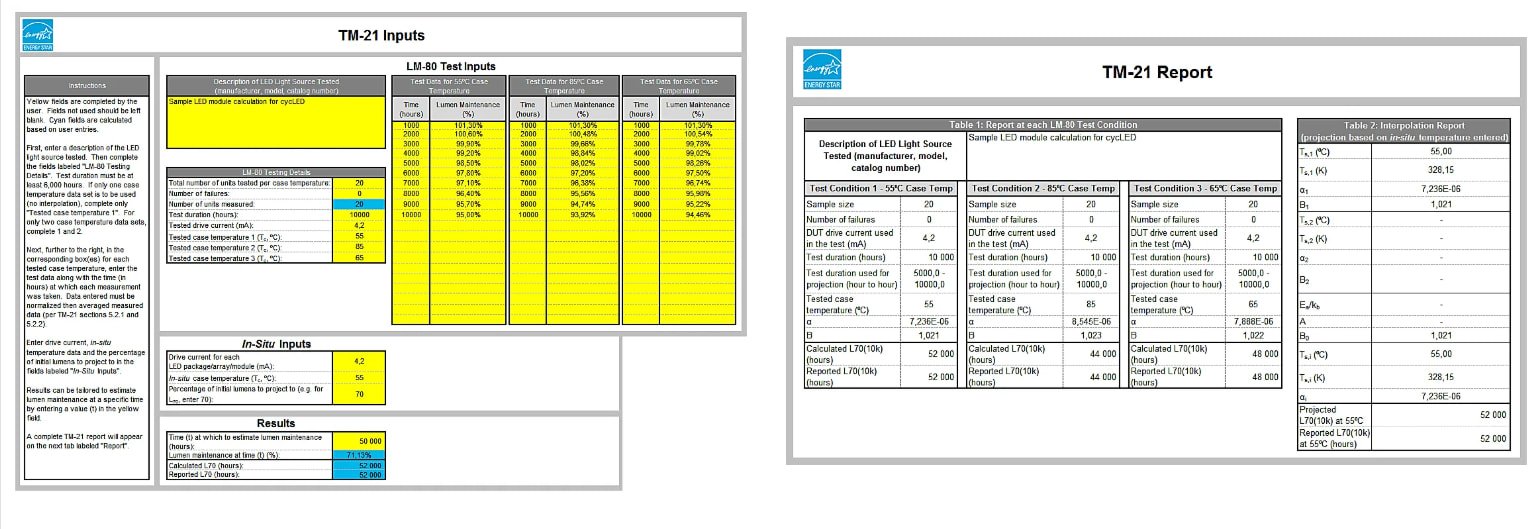
LM-79 measures the optical and electrical performance of a complete LED panel at a specific point in time. LM-80 measures how LED packages, arrays or modules maintain light output and color over time. TM-21 uses LM-80 data to project the future flux maintenance of those LED light sources.
The important distinction is often missed:
None of these documents, alone or together, automatically proves the service life of a complete LED panel light.
For distributors, importers and project buyers, understanding this difference helps prevent unsupported 50,000-hour claims, mismatched test reports and expensive warranty failures.
LM-79 vs LM-80 vs TM-21: Quick Comparison
| Standard | What It Evaluates | Test Subject | Typical Output | What It Does Not Prove |
|---|---|---|---|---|
| LM-79 | Initial optical and electrical performance | Complete LED luminaire | Lumens, watts, efficacy, color and distribution | Long-term product life |
| LM-80 | Light-output and color maintenance over time | LED package, array or module | Measured maintenance data at controlled temperatures and drive levels | Complete LED panel life |
| TM-21 | Projected flux maintenance based on LM-80 data | LED light source | Projected L70, L80 or other maintenance value | Driver, diffuser or complete-luminaire reliability |
As of 2026, the relevant current editions include ANSI/IES LM-79-24, ANSI/IES LM-80-21 and ANSI/IES TM-21-21. A specification may still reference an earlier edition, but buyers should confirm that the report version is accepted by the target certification or qualification program.
What Does LM-79 Test?
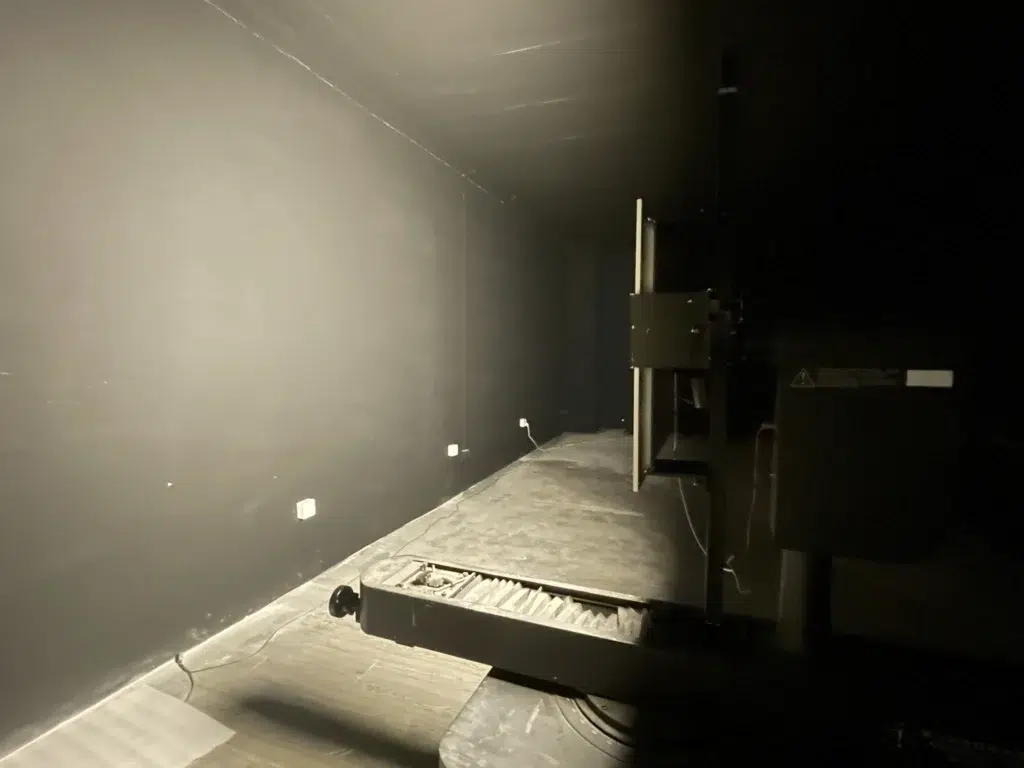
ANSI/IES LM-79 defines procedures for measuring the optical and electrical performance of a solid-state lighting product under standardized conditions.
For an LED flat panel, an LM-79 report may include:
- Total luminous flux
- Input power
- Luminaire efficacy
- Correlated color temperature
- Color-rendering data
- Chromaticity
- Power factor
- Current and voltage
- Luminous-intensity distribution
LM-79 is mainly a performance snapshot.
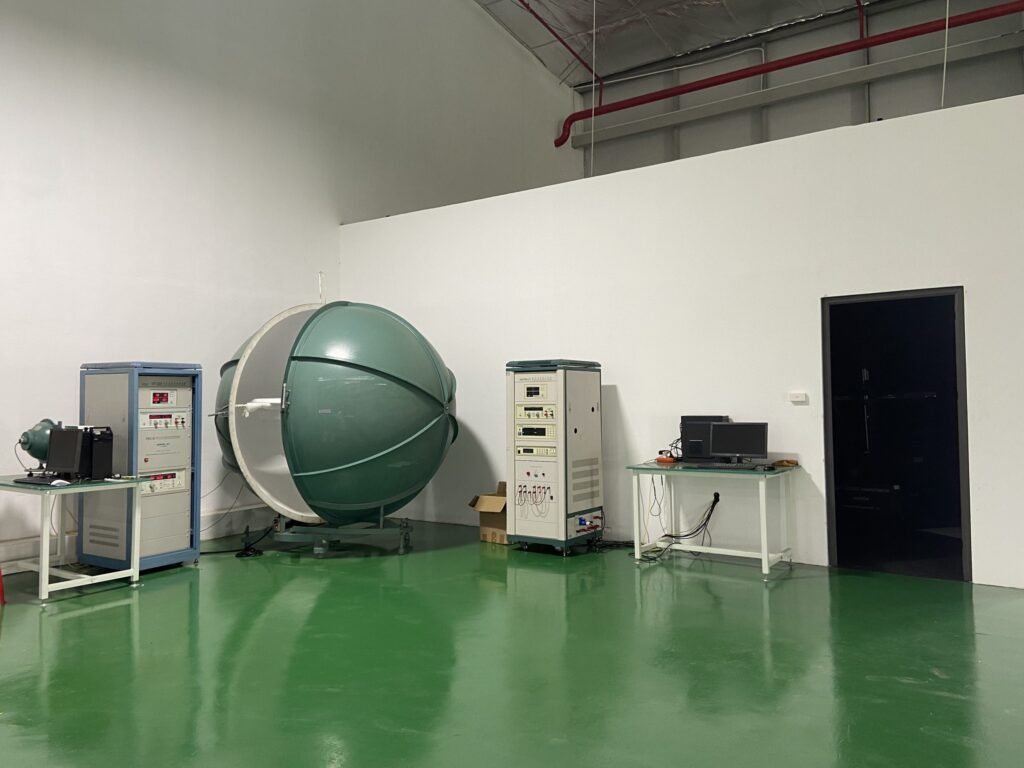
It can show whether a 40 W panel produces the stated lumens during testing. It cannot show whether the driver will survive five years, the diffuser will remain clear or the LEDs will maintain the same output after long-term operation.
A Panel Can Pass LM-79 and Still Be a Poor Long-Term Product
This is the first counterintuitive procurement lesson.
A factory can optimize a sample for high initial efficacy while using a driver, diffuser or thermal design that performs poorly over time. LM-79 may confirm excellent initial lumens per watt without detecting:
- Early driver failure
- Flicker developing after thermal cycling
- Diffuser yellowing
- Dark spots caused by individual LED or connection failures
- Solder-joint fatigue
- Dimming-component failure
- Excessive long-term color shift
Therefore, buyers should not treat an LM-79 report as a lifetime certificate.
What Does LM-80 Test?
ANSI/IES LM-80-21 measures luminous-flux and color maintenance for LED packages, arrays and modules under controlled operating conditions.
It does not normally test the finished LED flat panel.
An LM-80 report typically comes from the LED package or module manufacturer. The panel-light manufacturer then uses the relevant data for the LEDs installed in its product.
The report records performance over time at defined:
- Temperature conditions
- Drive levels
- Measurement intervals
- Sample quantities
LM-80 provides measured historical data. It does not independently predict the future life of the LED source.
The Manufacturer Name on the Report May Not Be the Panel Manufacturer
This is normal and should not automatically be treated as a problem.
However, the LED part number in the LM-80 report must match the LED package, array or module used in the commercial product. A reputable report for a different LED family does not validate the panel being purchased.
For OEM and private-label orders, buyers should also ask whether the approved LED remains locked in the production bill of materials. An unreported LED substitution can break the technical link between the product and its maintenance claim.
What Does TM-21 Calculate?
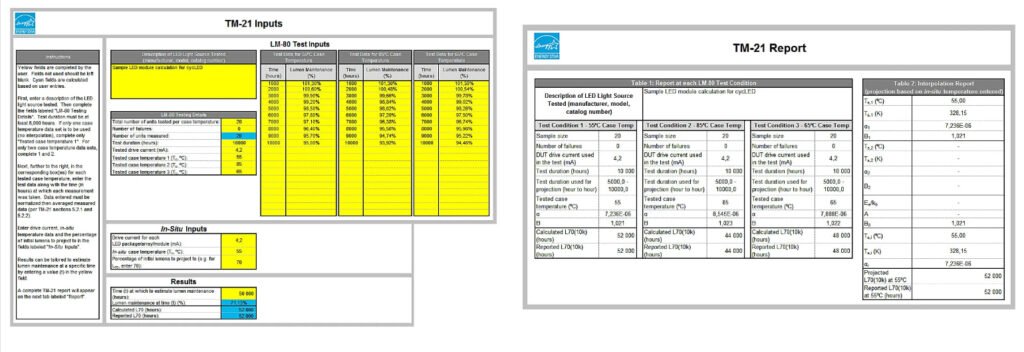
ANSI/IES TM-21-21 provides a method for projecting long-term flux maintenance using LM-80 data.
TM-21 considers factors including:
- LM-80 test duration
- Sample size
- LED operating temperature
- Drive current
- The measured rate of light-output decline
- Limits on extrapolation
The result may be expressed as a projected value such as L70.
L70 does not mean the LED suddenly fails at that hour. It indicates the point at which the LED source is projected to maintain 70% of its initial light output.
It also does not mean that 70% of the luminaires will still operate. That is a different reliability question.
The Missing Link: Actual Temperature Inside the LED Panel
LM-80 data are collected under controlled component-level conditions. The same LED may perform differently when installed in different panel designs.
Its operating temperature can change with:
- LED board layout
- Drive current
- Housing construction
- Thermal contact
- Insulation around the luminaire
- Ambient temperature
- Installation method
- Selectable wattage setting
An in-situ temperature measurement test, commonly called an ISTMT, measures the temperature of the LED source at the specified temperature measurement point while it operates inside the actual luminaire.
This temperature helps connect the real panel design to the appropriate LM-80 data and TM-21 projection.
A TM-21 spreadsheet without corresponding LED identity, drive-current information and in-situ temperature data may be mathematically complete but commercially irrelevant to the panel being purchased.
Why “50,000 Hours” May Not Mean 50,000-Hour Panel Life
Many specifications place “50,000 hours,” “L70” and “five-year warranty” on the same line. These are not interchangeable claims.
A TM-21 projection addresses the flux maintenance of the LED light source. It does not directly predict the life of:
- The LED driver
- Dimming electronics
- Connectors and wiring
- Diffusers and light guides
- Selectable wattage or CCT switches
- Solder joints
- The complete luminaire system
The Illuminating Engineering Society’s position on LED product lifetime explicitly warns against using TM-21 projections alone to claim the lifetime of an entire luminaire.
For luminaire-level luminous-flux maintenance, buyers may also encounter LM-84 measurement data and TM-28 projection methods. Even these should not be confused with a prediction of every possible catastrophic failure mechanism.
The more accurate commercial statement is therefore:
TM-21 may support an LED-source lumen-maintenance claim, but complete panel reliability also depends on the driver, thermal design, optical materials and manufacturing controls.
One Report May Not Cover Every Selectable Configuration
Selectable LED panels create another documentation risk.
A single product may offer several wattages and CCTs, but the hottest or highest-current setting can place greater stress on the LEDs and driver. A report completed at one setting does not automatically prove that every available combination performs identically.
Before approving a selectable panel, verify:
- Which wattage and CCT setting was tested.
- Whether the tested configuration represents the worst-case thermal condition.
- Whether the LM-79 model number matches the quoted model.
- Whether all drivers and LED boards are covered by the product family.
- Whether certification family rules permit the claimed variants.
This is especially important for private-label projects, where model names may change while the internal construction is expected to remain equivalent.
How B2B Buyers Should Verify the Reports
A buyer searching for a top LED flat panel manufacturer should ask for traceability, not just a folder of certificates.
Use the following review sequence.
1. Match the LM-79 Report to the Product
Check:
- Manufacturer and model number
- Panel size
- Wattage
- CCT
- Driver model
- Voltage
- Test date
- Laboratory identity
- Reported lumens and efficacy
The results should correspond to the actual product specification, not merely to a similar-looking panel.
2. Match the LM-80 Report to the LED Source
Verify:
- LED manufacturer
- Exact package, array or module identification
- Tested temperature conditions
- Tested drive levels
- Test duration
- Sample information
Do not accept “same LED brand” as sufficient evidence. Different LED packages from the same brand can have different maintenance behavior.
3. Review the In-Situ Temperature
Confirm that:
- The measurement point follows the LED supplier’s specified location.
- The measured temperature is within the applicable LM-80 conditions.
- The test was performed on the relevant panel construction.
- The tested wattage represents the intended or worst-case configuration.
4. Check the TM-21 Inputs
The TM-21 projection should use the correct:
- LM-80 data set
- LED case temperature
- Drive current
- Sample size
- Test duration
- Projection limit
A large projected number is not automatically better. A clearly traceable and properly limited projection is more valuable than an unsupported 100,000-hour headline.
5. Evaluate the Non-LED Components Separately
Request information about:
- Driver manufacturer and model
- Driver warranty
- Operating-temperature rating
- Surge protection
- Dimming compatibility
- Diffuser or lens material
- Thermal and switching tests
- Production change control
The longest-lived LED cannot compensate for a weak driver or unstable optical material.
What Should a Qualified LED Panel Manufacturer Provide?
For a distributor, importer or project buyer, a useful technical file may include:
- Model-specific LM-79 report
- Relevant LM-80 report
- TM-21 calculation or report
- In-situ temperature data
- LED and driver identification
- Safety and market-access documentation
- Current specification sheet
- Warranty terms
- Bill-of-material change-control policy
Buyers can review Xmart’s available certificate and patent information and its commercial backlit LED panel range before requesting model-level documentation.

The purpose is not to collect the largest number of PDF files. It is to establish an unbroken technical chain:
Quoted panel model → installed LED source → operating current and temperature → applicable LM-80 data → TM-21 projection.
If one link cannot be verified, the lifetime claim should be treated as unconfirmed.
Questions to Send an LED Panel Supplier
Before issuing a purchase order, ask:
- Does the LM-79 model match the quoted product?
- Which LED package or module is used?
- Can you provide the matching LM-80 report?
- What in-situ LED temperature was measured?
- At which wattage and CCT setting was it measured?
- Which drive current was used in the TM-21 calculation?
- Does the projection comply with the applicable extrapolation limit?
- Is the driver covered by a separate reliability specification?
- Can the LED, driver or diffuser be changed without buyer approval?
- Which documents remain valid for the private-label model?
These questions quickly separate document ownership from genuine technical control.
Frequently Asked Questions
Does LM-79 test LED panel lifespan?
No. LM-79 measures the optical and electrical performance of the complete luminaire under specified test conditions. It is primarily an initial-performance test.
Is LM-80 a complete LED panel test?
No. LM-80 applies to LED packages, arrays and modules. It does not represent all components or failure mechanisms in a complete panel light.
Does TM-21 prove a 50,000-hour luminaire life?
No. TM-21 projects the flux maintenance of an LED light source using LM-80 data. It does not independently predict driver, optical-material or complete-luminaire life.
What does L70 mean?
L70 is the point at which an LED light source is measured or projected to maintain 70% of its initial light output. It is not automatically the moment of complete product failure.
Can one LM-79 report cover every panel size and wattage?
Not automatically. Buyers should verify the model, construction, wattage, CCT and applicable product-family rules.
Which reports should an LED panel buyer request?
Depending on the market and claim, buyers may request LM-79, matching LM-80 data, a TM-21 calculation, in-situ temperature information and separate documentation for the driver, safety certification and warranty.
Final Procurement Takeaway
LM-79 tells you how the LED panel performs now. LM-80 shows how its LED source has maintained light and color during controlled testing. TM-21 projects how that source may maintain flux in the future.
The reports become commercially meaningful only when they match the exact LED panel, LED source, drive current and operating temperature.
For a distributor, importer or private-label project, that traceability is more valuable than a large lifetime number printed on a specification sheet.
To evaluate a specific model, send Xmart the required panel size, wattage, CCT, voltage, certification market and estimated order volume through the commercial lighting quotation form.