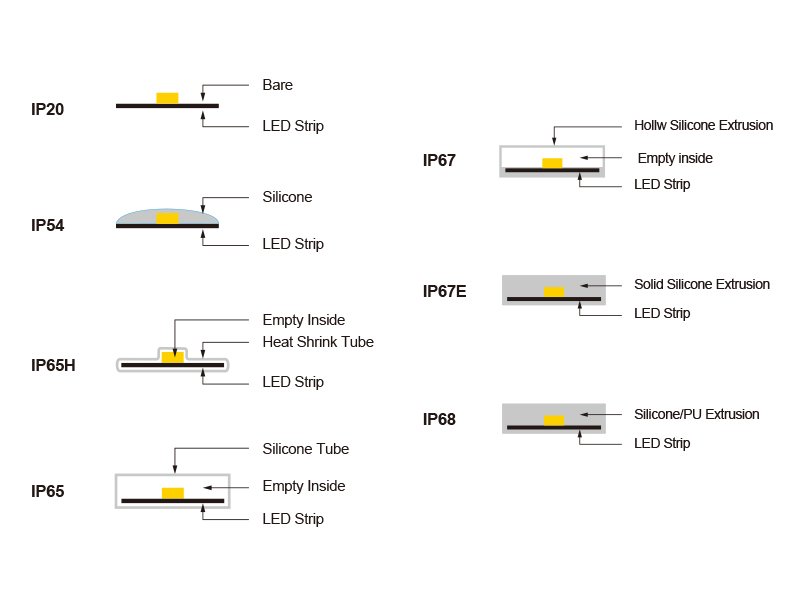
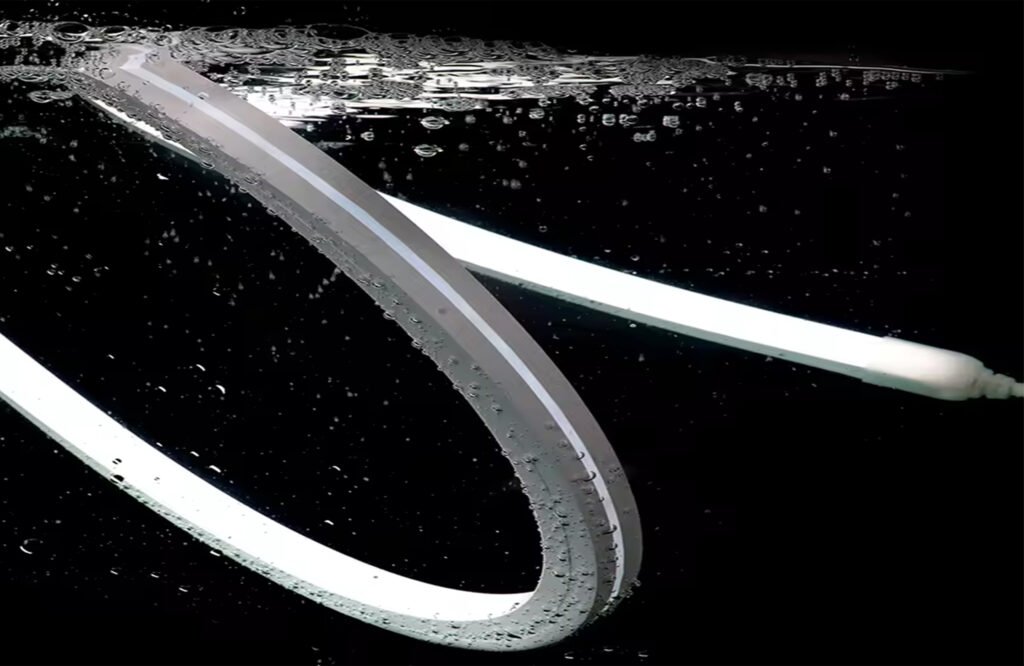
No. An IP68 rating alone does not make an LED strip safe for use in a swimming pool.
IP68 indicates that an enclosure has been tested for dust protection and immersion under specified conditions. It does not automatically prove that the complete lighting system is:
- Approved as an underwater swimming-pool luminaire
- Safe against electric shock
- Supplied by the correct isolating power source
- Resistant to chlorine, bromine, salt or cleaning chemicals
- Suitable for the pool’s exact depth and water temperature
- Protected at cut ends, cable entries and connectors
- Qualified for years of continuous immersion
- Compliant with local pool electrical regulations
A pool-safe lighting system requires all of these factors to be evaluated together:
Luminaire construction + electrical certification + isolated power supply + cable and joint design + chemical resistance + installation + maintenance
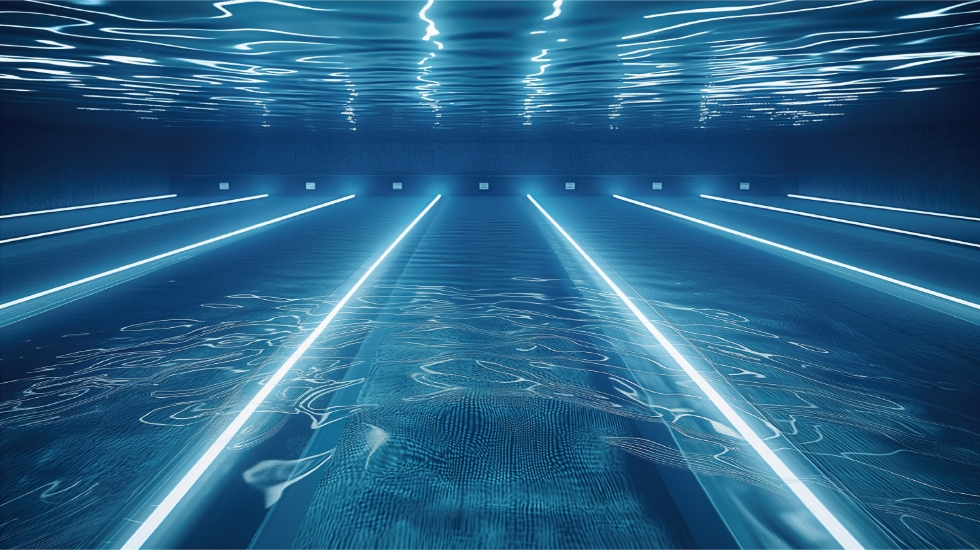
The counterintuitive answer is that a properly certified lower-voltage pool luminaire with a documented sealing system can be safer than a generic product carrying a prominent IP68 label.
Quick Answer: What Does IP68 Prove—and What Does It Not Prove?
| Requirement | Proven by IP68 alone? |
|---|---|
| Dust-tight enclosure | Yes, when the complete tested construction is covered |
| Resistance to immersion | Yes, under the specified test conditions |
| Suitable for every water depth | No |
| Suitable for unlimited immersion time | No |
| Swimming-pool electrical safety | No |
| Resistance to electric shock | No |
| Chlorine resistance | No |
| Bromine resistance | No |
| Saltwater resistance | No |
| UV resistance | No |
| Resistance to low or high pH | No |
| Resistance to thermal cycling | No |
| Suitability of field-cut ends | No |
| Suitability of connectors not included in the test | No |
| Five-year underwater lifetime | No |
| Compliance of every mass-produced unit | No |
IP68 should therefore be treated as one item in a pool-lighting specification—not the complete specification.
What Does IP68 Actually Mean?
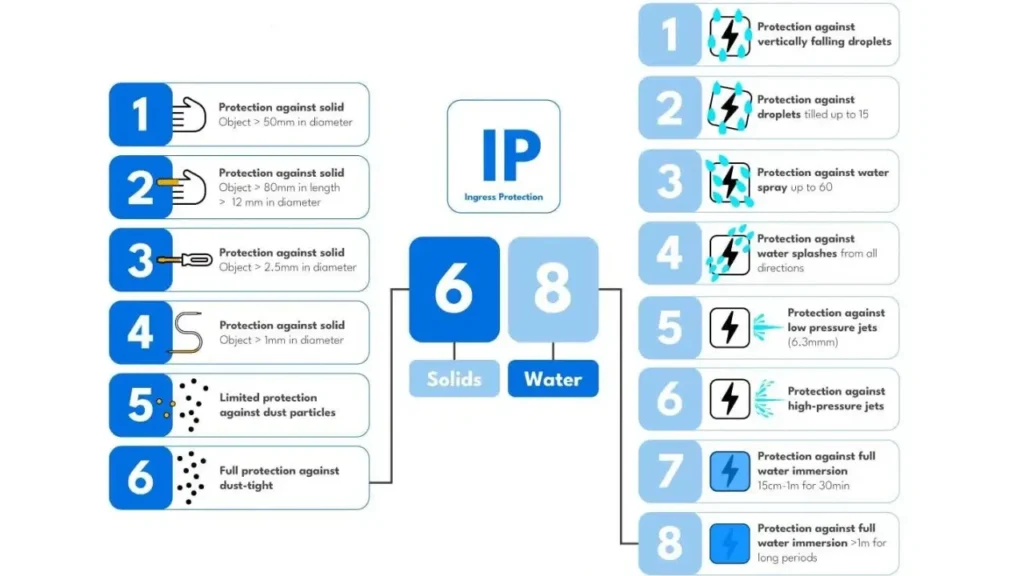
IP ratings are classified under IEC 60529.
In IP68:
- The first digit, 6, indicates protection against dust ingress.
- The second digit, 8, indicates protection against the effects of continuous immersion under specified conditions.
The critical phrase is specified conditions.
IPX8 does not establish one universal depth, duration, water chemistry or operating temperature for every product. The relevant conditions must be defined for the tested construction.
An IP68 claim is incomplete unless the supplier can state:
- Test standard and edition
- Test laboratory
- Exact product model
- Water depth or test pressure
- Test duration
- Water temperature
- Whether the product was energized
- Sample quantity
- Whether cable entries and end caps were included
- Whether the product was flexed or aged before testing
- Acceptance criteria
- Report number and date
“IP68 tested” without these details is not enough for a pool project.
IP68 Is an Enclosure Test, Not a Pool-Luminaire Approval
IEC 60529 classifies protection against the ingress of solid objects and water. It does not replace standards written specifically for pool luminaires.
For international and European projects, IEC 60598-2-18:2022 specifies particular requirements for fixed luminaires used in or in contact with water in swimming pools, fountains, paddling pools and similar applications.
For North American projects, underwater luminaires and submersible junction boxes may fall within the scope of UL 676 and applicable pool-installation requirements. UL states that the U.S. National Electrical Code requires underwater lighting to be listed regardless of voltage. See UL’s low-voltage LED lighting guidance for pools and spas.
This creates an important procurement distinction:
A flexible LED product can pass an IP68 immersion test without being evaluated or listed as a complete swimming-pool luminaire.
The exact strip, extrusion, cable, end caps, connectors and power architecture must be covered by the relevant approval or accepted by the project authority.
“24V Low Voltage” Does Not Automatically Mean Pool-Safe
Low voltage can reduce electric-shock risk, but the voltage number alone is not enough.
A pool system must consider:
- Output voltage
- AC or DC output
- Electrical isolation
- Power-supply construction
- Maximum available current
- Ground-fault or residual-current protection
- Cable routing
- Bonding and grounding requirements
- Location of the driver and junction boxes
- Local pool zones
- Product listing or certification
- Installation instructions
An ordinary 24V constant-voltage driver designed for indoor cabinets is not automatically suitable for an underwater pool luminaire.
Likewise, an IP67 or IP68 driver is not automatically approved for installation inside a pool zone. Its location must comply with the product instructions and applicable local requirements.
The safest general arrangement is normally based on:
- A pool-approved or project-approved isolating power source
- A protected low-voltage circuit
- A complete underwater luminaire identified for the purpose
- Factory-sealed cable entries
- Accessible connections outside the submerged area wherever the approved design permits
The final design must be approved by a qualified pool electrician, electrical engineer or local authority having jurisdiction.
IP68 Does Not Test Chlorine Resistance
Swimming-pool water is not simply clean water.
The lighting system may be exposed to:
- Free chlorine
- Combined chlorine and chloramines
- Bromine
- Salt used by chlorine generators
- Ozone
- Acids and alkaline chemicals
- Cleaning agents
- Body oils and cosmetics
- UV radiation
- Elevated water temperature
- Repeated shock treatment
- Periods of concentrated chemical exposure near return jets
A material can prevent water ingress during an IPX8 test and still:
- Yellow
- Become brittle
- Swell
- Lose optical transmission
- Crack at bends
- Delaminate from the cable
- Lose adhesion at an end cap
- Corrode internal copper
- Develop stress around mounting clips
“IP68” and “chlorine-resistant” are separate claims and require separate evidence.
What a Chlorine-Resistance Test Should Include
A meaningful pool-lighting chemical test should define:
- Free-chlorine concentration
- Combined-chlorine condition where relevant
- pH
- Water temperature
- Exposure duration
- Continuous or cyclic exposure
- Shock-chlorination cycles
- UV exposure for outdoor pools
- Mechanical bending or tensile stress
- Electrical operation during exposure
- Post-test insulation or leakage measurements
- Changes in color, hardness, tensile strength and light transmission
A report that only says “chlorine resistant” without test conditions cannot be compared across suppliers.
Water chemistry also affects corrosion. The CDC recommends controlling pool chlorine and pH and notes that low pH can increase the likelihood of pipes and equipment corroding or breaking down. See the CDC pool water treatment guidance.
A lighting warranty should therefore define the permitted water-chemistry range and maintenance obligations.
Saltwater Pool Does Not Always Mean Seawater
“Saltwater pool” can describe two very different environments.
Salt-chlorination pool
A residential or commercial pool may add salt so an electrolytic chlorine generator can produce chlorine.
Its salinity is normally much lower than seawater, although the exact concentration depends on the system.
Seawater pool
A seawater pool, marine facility or coastal water feature can have much higher conductivity and a different corrosion environment.
The same luminaire should not automatically be approved for both.
UL’s guidance distinguishes salt-treated pool water from actual seawater and explains that luminaires intended for seawater use require appropriate evaluation and marking. See UL’s explanation of swimming-pool luminaires and saltwater.
Ask the supplier whether the product is qualified for:
- Conventional chlorinated freshwater
- Salt-chlorinated pool water
- Brominated spa water
- Actual seawater
- Brackish water
- Decorative fountains with chemical treatment
“Salt-resistant” without a defined salt concentration, temperature and exposure period is another incomplete claim.
Why Pool LED Strip Joints Usually Fail First
The center of an extruded or potted strip may be well sealed. The highest risks are often found at:
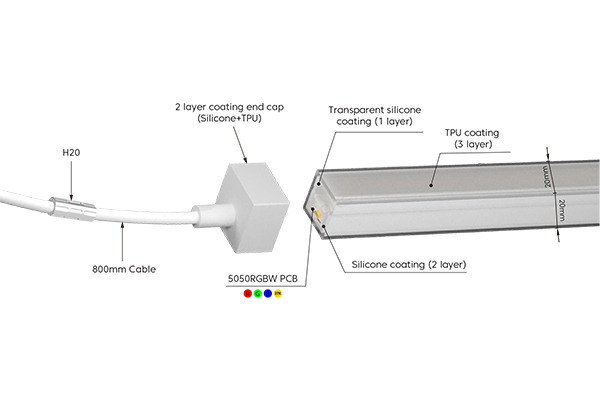
- Power-input cable entry
- End cap
- Field-cut end
- Soldered splice
- Connector
- Branch joint
- Cable-to-junction-box entry
- Areas repeatedly bent during installation
These locations combine different materials with different:
- Thermal expansion rates
- Hardness
- Adhesion
- Flexibility
- Chemical resistance
Repeated heating, cooling, flexing and water pressure can gradually create a microscopic path for moisture.
The body can remain fully waterproof while the end termination fails.
Capillary Action Can Move Water Through a Cable
Water does not always enter through an obvious hole in the light body.
It can travel along:
- Stranded copper conductors
- Gaps between conductor and insulation
- Poorly filled cable glands
- Incomplete adhesive bonds
- Soldered wire entries
This is known as capillary migration or wicking.
A visibly sealed end cap may therefore be insufficient if the cable-entry design does not block water migration.
For permanent underwater products, ask whether the cable entry uses:
- Factory overmolding
- Injection-molded end termination
- Pressure-resistant potting
- Water-blocked cable
- Tested strain relief
- Chemical-compatible sealant
- A documented immersion test that includes the cable entry
Should LED Strip Joints Be Installed Underwater?
Avoid submerged field joints wherever the approved system design allows them to be located outside the water.
The preferred strategy is usually:
- Factory-cut the required length
- Factory-install and mold the power cable
- Factory-seal the opposite end
- Use one uninterrupted cable to the approved junction point
- Keep serviceable connections accessible and outside the submerged area
If a submerged connector or junction is unavoidable, it must be specifically identified, tested and accepted for that use. A generic “waterproof connector” is not sufficient.
Do not assume a connector is pool-safe because it is:
- IP68
- Filled with grease
- Wrapped in heat-shrink tubing
- Covered with silicone
- Installed inside another box
The connector, cable and complete assembly must be evaluated together.
Can an IP68 LED Strip Be Cut on Site?

A strip may be electrically cuttable while no longer being waterproof after cutting.
Field cutting opens the protective system and can expose:
- Copper pads
- PCB layers
- Phosphor
- Conductors
- Capillary paths
- Internal cavities
Resealing underwater products on site is much harder than sealing an ordinary outdoor strip.
For pool installations, factory-prepared lengths are strongly preferred. The factory should control:
- Cut position
- Cable soldering
- End-cap molding
- Potting volume
- Curing time
- Adhesion
- Strain relief
- Pressure or immersion testing
A field-sealing kit should be used only when it is part of an approved system and installed by qualified personnel according to documented instructions.
Silicone vs PU: Which Is Better for Pool LED Lighting?
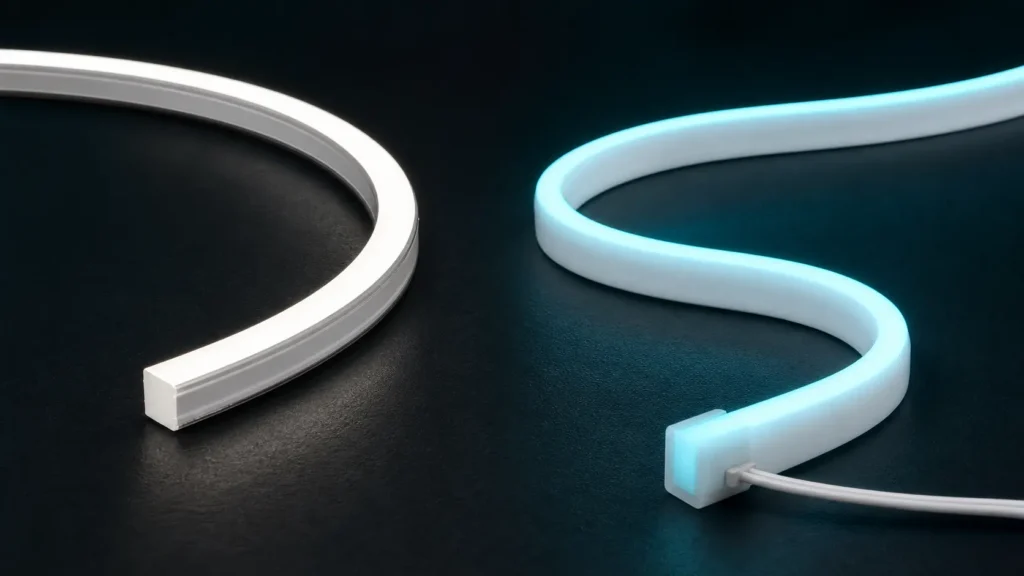
Neither material is universally superior.
Performance depends on the exact formulation, additives, processing and interface design.
Silicone can offer:
- Good temperature stability
- Good flexibility
- Good UV performance in appropriate formulations
- Stable performance over a wide temperature range
Possible concerns include:
- Tear damage
- Chemical compatibility of the exact formulation
- Sealant-to-cable adhesion
- Dirt pickup
- Gas or moisture permeability
- Mechanical damage at clips
Polyurethane can offer:
- High mechanical strength in appropriate formulations
- Good abrasion resistance
- Strong encapsulation
- Useful water and chemical resistance in selected products
Possible concerns include:
- Hydrolysis in unsuitable formulations
- Yellowing
- Hardening or softening
- UV degradation
- Material-specific chemical sensitivity
Do not buy “silicone” or “PU” as if the material name were a performance specification.
Request test data for the exact compound and finished construction.
Is IP68 Automatically Better Than IP67 for a Pool?
IP67 and IP68 cover different immersion conditions. A product intended for continuous submersion generally requires an appropriate IPX8 evaluation.
However, IP68 is not automatically better in every other way.
An IPX8 product is not necessarily qualified for:
- High-pressure water jets
- Steam cleaning
- Chlorine
- Seawater
- UV
- Abrasion
- Impact
- Repeated bending
IEC 60529 allows different IP designations to communicate different types of water exposure. Immersion and water-jet resistance should not be treated as identical tests.
A pool product may need several environmental and product-specific tests beyond IPX8.
Pool Edge, Splash Zone and Underwater Are Different Applications
Above-water pool-edge lighting
The product may receive splashes, condensation, UV and cleaning chemicals without continuous immersion.
The electrical installation still falls within regulated pool areas in many jurisdictions. Do not specify it as ordinary landscape lighting merely because it is above the waterline.
Waterline lighting
A product near the waterline may experience alternating wet and dry cycles.
This can be more difficult than stable immersion because:
- Evaporation concentrates salts and chemicals
- UV reaches the exposed surface
- Temperature cycles are larger
- Deposits build up
- The product repeatedly absorbs and releases moisture
Permanently submerged lighting
This requires validated depth, electrical safety, sealing, chemical resistance and underwater installation.
Decorative fountain lighting
A fountain may not normally contain swimmers, but it still combines electricity and water. Its electrical and product requirements must be established separately.
Do not apply swimming-pool assumptions automatically to fountains, ponds, spas or seawater installations.
Why Underwater LED Strips Can Overheat
Water can remove heat effectively, but that does not mean every submerged LED strip runs cool.
Thermal risk can arise from:
- High watts per meter
- Thick encapsulation
- Insulating mounting channels
- Poor contact with the surrounding water
- Operation when the pool is drained
- Partial submersion
- Scale or biofilm buildup
- High water temperature
- Overvoltage
- Coiled excess strip hidden in a niche
A product designed to operate underwater may rely on water for cooling. Operating it at full power when the pool is empty can create a different thermal condition.
The manufacturer should state whether the product may be energized:
- In air
- During pool draining
- During installation testing
- When only partially submerged
- At the maximum water temperature
Mechanical Design Matters Underwater
A flexible light still requires controlled mounting.
Check:
- Minimum bend radius
- Top-bend or side-bend direction
- Maximum installation tension
- Clip spacing
- Expansion allowance
- Resistance to pool-cleaning equipment
- Resistance to swimmer contact
- Protection from sharp tile or stone edges
- Cable strain relief
- Compatibility with grout, sealants and cleaning products
Do not stretch neon flex around a curve. Stretching loads the internal PCB and the sealed terminations.
Do not force a top-bending product sideways or a side-bending product vertically.
Adhesive alone is rarely an appropriate permanent underwater mounting strategy unless the complete approved system specifically relies on it.
Pool Lighting Electrical Architecture
A conceptual low-voltage pool-lighting system may include:
Mains circuit → required protective device → pool-approved isolating transformer or power supply → protected low-voltage cable → factory-sealed underwater luminaire
This is only a conceptual relationship, not an installation diagram.
The qualified designer must determine:
- Permitted voltage
- Required isolation
- GFCI or RCD protection
- Power-supply location
- Cable method
- Junction-box location
- Grounding
- Equipotential bonding
- Circuit protection
- Inspection and testing
GFCI or RCD protection is important where required, but it does not make an unsuitable underwater product acceptable. It is one layer of protection, not a substitute for proper isolation, listing and installation.
Never bypass a GFCI or RCD that trips repeatedly. The trip may indicate water ingress, damaged cable or insulation failure.
Pool-Safe LED Strip Procurement Checklist
Before accepting an underwater LED strip or neon flex, request the following.
Product identity
- Exact model number
- Voltage and power
- Maximum continuous length
- Cut length
- Cable type
- Bending direction
- Minimum bend radius
- Operating water-temperature range
- Maximum immersion depth
IP test
- IEC 60529 report
- IPX8 depth or pressure
- Test duration
- Exact tested construction
- Sample quantity
- End-cap and cable-entry details
- Pass/fail criteria
- Accredited laboratory information
Pool electrical safety
- Relevant pool-luminaire standard
- Certification body
- Certificate or listing number
- Exact models covered
- Required transformer or driver
- Installation restrictions
- Target-market compliance documentation
For North America, ask whether the complete product is appropriately evaluated for underwater pool use under the applicable system, such as UL 676—not merely whether one LED component is UL Recognized.
For international projects, ask how the finished product addresses IEC 60598-2-18 and applicable national installation requirements.
Chemical compatibility
- Chlorine concentration
- Salt concentration
- pH range
- Water temperature
- Test duration
- Shock-treatment exposure
- Bromine compatibility
- UV test
- Seawater approval where required
- Permitted cleaning agents
Terminations
- Factory-molded power entry
- Factory-sealed end
- Water-blocked cable design
- Strain-relief test
- Connector rating
- Permitted joint location
- Field-cutting restrictions
Manufacturing quality
- Batch traceability
- Seal-material batch control
- Curing-process controls
- Leak-test method
- Electrical testing
- Sampling plan
- Change-control procedure
- Warranty conditions
A Passed Sample Does Not Guarantee Mass-Production Waterproofing
Waterproof performance depends heavily on manufacturing consistency.
Potential production variations include:
- Incorrect sealant ratio
- Insufficient potting
- Air bubbles
- Contaminated bonding surfaces
- Incomplete curing
- Cable-position variation
- Damaged extrusion
- Incorrect end-cap pressure
- Poor soldering
- Seal damage during packaging
For large pool projects, specify batch-level controls such as:
- Visual inspection
- Electrical safety testing
- Pressure or vacuum leak testing where applicable
- Sample immersion testing
- Cable pull testing
- Bend inspection
- Batch records
- Retained samples
A laboratory report proves the tested sample passed the defined test. Quality control is what helps later production match that sample.
Pool LED Strip Sample Validation
Before mass installation:
- Confirm the exact approved model.
- Order factory-cut and factory-sealed samples.
- Install them using the proposed clips and channel.
- Use the intended cable length and power source.
- Test at the maximum permitted operating load.
- Expose samples to representative pool water.
- Include expected temperature and UV conditions.
- Inspect optical and mechanical changes.
- Verify electrical performance after exposure.
- Have the proposed installation reviewed by the responsible electrical professional.
Accelerated testing can compare materials, but it should not be converted directly into an unsupported number of years of field life.
Pool LED Lighting Maintenance Plan
Underwater lighting is not maintenance-free.
During commissioning
Confirm:
- Product and certificate model
- Power-supply output
- Protective-device operation
- Cable and termination condition
- Current and power
- Light output and color
- Water chemistry
- Installation depth
- Controller operation
Required electrical tests should be performed by qualified personnel before the pool is opened.
During regular operation
Inspect for:
- Condensation
- Bubbles inside the extrusion
- Haze
- Yellowing
- Cracks
- Swelling
- Dark sections
- Color shift
- Flicker
- Loose clips
- Rust staining
- Exposed cable
- Repeated protective-device trips
Maintain water chemistry within both local operating requirements and the lighting manufacturer’s limits.
After shock treatment or unusual chemistry
Inspect the lighting after:
- High-concentration chlorine treatment
- Major pH excursion
- Chemical-feed failure
- Salt-system fault
- Accidental chemical spill
- Extended pool shutdown
During draining or annual service
Check:
- End caps
- Cable entries
- Mounting clips
- Cable jackets
- Tile or channel edges
- Corrosion
- Mechanical damage
- Seal hardness or brittleness
Do not continue operating a submerged light after visible water ingress, unexplained flicker or repeated GFCI/RCD operation.
Warning Signs of Underwater LED Strip Failure
Condensation or water bubbles
Possible causes:
- Seal failure
- Cable-entry leakage
- Pressure cycling
- Capillary water migration
Required action:
Disconnect the affected circuit and inspect the complete assembly.
Green, black or white deposits near conductors
Possible causes:
- Copper corrosion
- Galvanic corrosion
- Salt or mineral deposits
- Water entering the termination
Required action:
Do not simply dry and reseal the visible surface. Determine how water entered and whether conductor damage has occurred.
Yellowing without water ingress
Possible causes:
- UV degradation
- Chlorine exposure
- Material aging
- Excess heat
The product may remain electrically dry while its optical and mechanical properties deteriorate.
Repeated flicker or protective-device trips
Possible causes:
- Water ingress
- Insulation failure
- Driver fault
- Corroded connection
- Damaged cable
Never bypass the protection or repeatedly reset it without diagnosis.
Specifying an Xmart Pool Lighting Solution
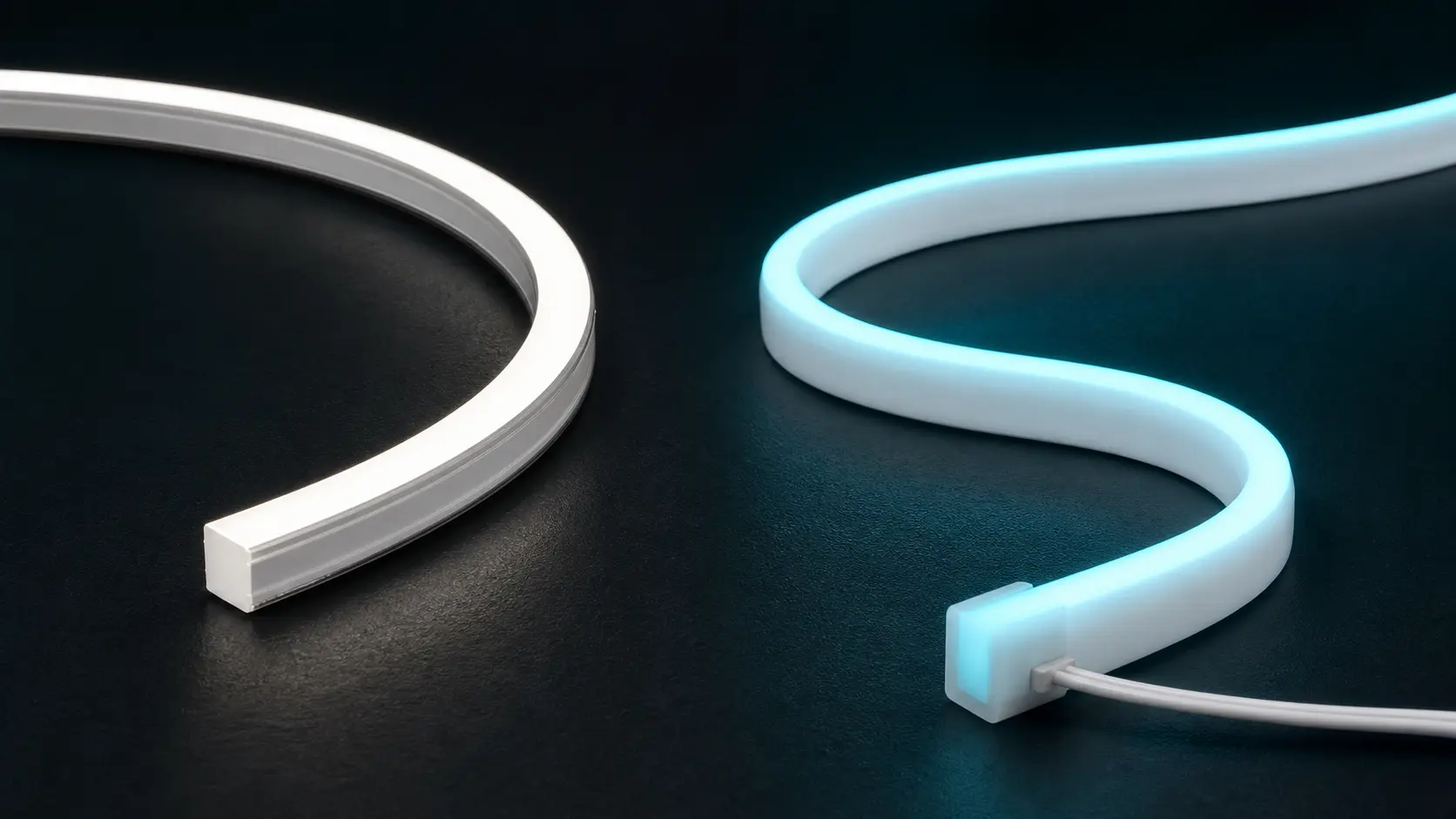
Xmart’s IP68 silicone neon flex can be configured with different bending directions, voltages, cable exits, factory-sealed lengths and material constructions for underwater projects.
However, an Xmart product should be described as pool-suitable only when the exact supplied configuration has the documentation required for that project.
For a meaningful recommendation, provide:
- Country and applicable standard
- Residential or commercial pool
- Pool, spa, fountain or seawater application
- Freshwater, salt-chlorinated water or seawater
- Chlorine or bromine range
- pH range
- Water-temperature range
- Maximum depth
- Total run length
- Location of every power feed
- Required color and control system
- Available driver location
- Joint and junction-box plan
- Mounting detail
- Expected maintenance access
- Required certification
For OEM or commercial pool projects, submit these details through the Xmart project quotation form and request model-specific reports rather than a general certificate package.
Frequently Asked Questions
Can an IP68 LED strip be used underwater?
It may be used underwater only within its specified depth, duration, temperature and installation conditions. For a swimming pool, it must also meet the relevant electrical, chemical and product requirements.
Is every IP68 LED strip suitable for swimming pools?
No. A generic IP68 strip may have been tested only for water ingress and may lack pool-luminaire approval, chlorine resistance or suitable sealed terminations.
Is 24V LED strip safe in a swimming pool?
Not automatically. The complete 24V system must use the correct isolated power source, approved underwater luminaire, protective devices and code-compliant installation.
Is 12V safer than 24V in a pool?
A lower voltage may reduce shock risk, but voltage alone does not determine compliance. Use the voltage, power source and product construction permitted by the applicable pool standard and local authority.
Does IP68 mean permanently waterproof?
IP68 means protection under specified immersion conditions. It does not promise unlimited service life or immunity to aging, chemicals, UV, damage and seal failure.
Can I cut and reseal IP68 LED strip myself?
For permanent pool installations, factory-cut and factory-sealed lengths are strongly preferred. Field resealing should be used only when it is part of an approved installation system.
Can an IP68 connector remain underwater?
Only if the exact connector assembly is identified and tested for that application. A general IP68 connector should not automatically be accepted as a submerged pool joint.
Is silicone resistant to chlorine?
Some silicone formulations provide useful chlorine resistance, but the material name alone is not proof. Ask for test conditions and results for the exact compound and finished product.
Is PU neon flex suitable for saltwater?
Some polyurethane formulations may be suitable, while others can degrade. Request exact salt concentration, temperature, duration, UV and post-test data.
Can I use an IP68 strip in seawater?
Only if it is specifically qualified for seawater. Salt-chlorinated swimming-pool water and actual seawater should not be treated as the same environment.
Does an IP68 pool strip need a GFCI or RCD?
Protection requirements depend on the region, voltage, power architecture and installation. Follow the applicable electrical rules and product listing. IP68 does not replace ground-fault or residual-current protection where required.
Can the LED driver be installed beside the pool?
Only in a location permitted by the driver instructions and local pool electrical requirements. A waterproof driver is not automatically approved for every pool zone.
Can underwater LED strip operate when the pool is empty?
Only if the manufacturer permits dry operation. Some underwater products rely on surrounding water for cooling.
How long should an IP68 pool LED strip last?
There is no universal lifespan. It depends on electrical load, water chemistry, material formulation, seals, temperature, UV, manufacturing consistency and maintenance.
Is a pool-lighting CE mark enough?
No. Ask which directives, standards and exact product model are covered. A CE mark does not replace a model-specific pool-safety and environmental evaluation.
What certification should a U.S. pool-light buyer request?
Ask for documentation showing that the complete exact model is listed or evaluated for underwater pool use under the applicable requirements, commonly involving UL 676, plus the required installation and power-supply information.
Final Answer
An IP68 LED strip is not automatically pool-safe.
IP68 answers only one question:
Can the tested enclosure resist dust and immersion under the stated test conditions?
A safe and durable pool system must answer several more:
- Is the complete luminaire approved for pool use?
- Is the power source properly isolated and located?
- Are voltage and protective devices compliant?
- Are the cable entries, end caps and joints included in the tested construction?
- Can the materials withstand the actual chlorine, salt, pH and temperature?
- Is the product suitable for the required depth?
- Can it be installed without field-cut underwater joints?
- Can it be inspected and replaced without destroying the pool finish?
- Does mass production follow the same sealing process as the tested sample?
- Is there a documented maintenance plan?
The safest specification is not “24V IP68 LED strip.”
It is a complete, model-specific pool-lighting system whose electrical safety, immersion conditions, chemical environment, joints, installation and maintenance have all been defined and verified.