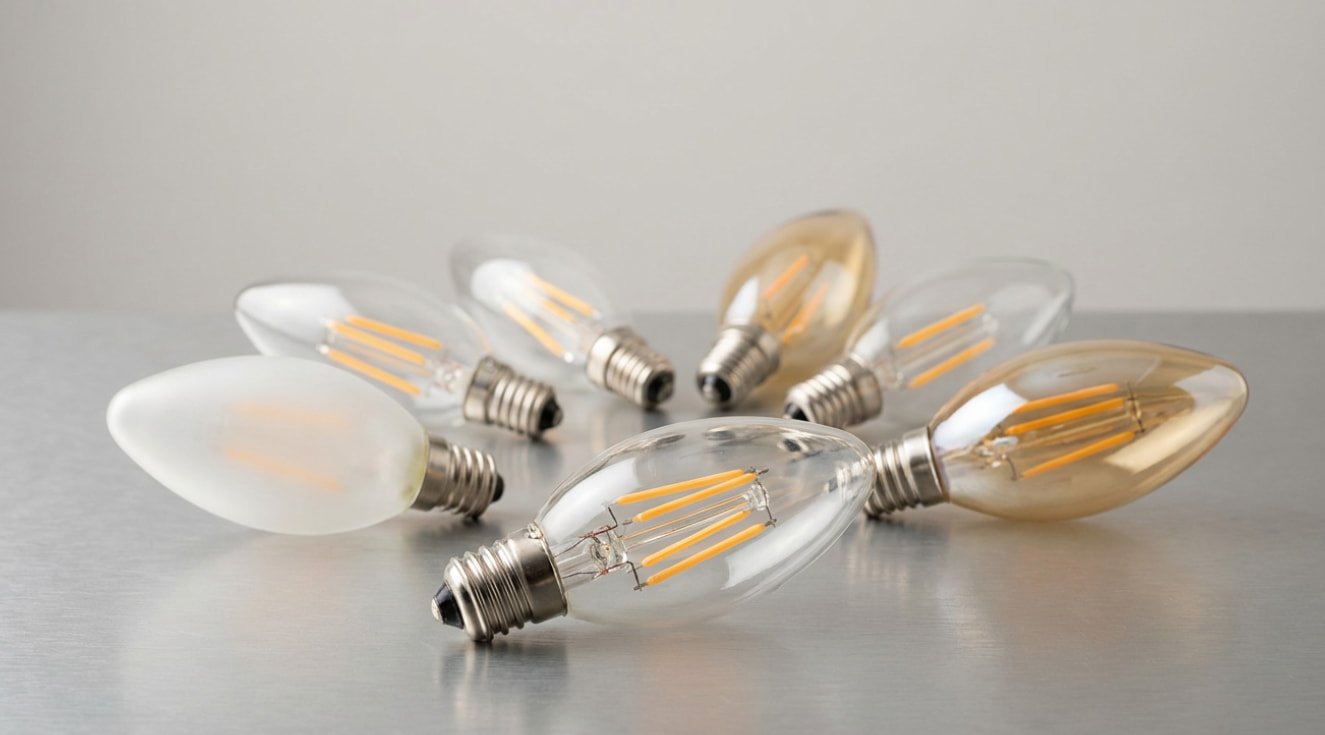
E12 LED bulbs represent one of the most versatile lighting solutions for modern homes, offering exceptional energy efficiency in a compact candelabra base design.
These small yet powerful bulbs, measuring just 12mm in diameter at the base, have revolutionized decorative and accent lighting applications. From chandeliers to wall sconces, E12 LED technology delivers superior illumination while consuming up to 85% less energy than traditional incandescent alternatives.
Video Guide: Discover the brightness and dimming capabilities of modern E12 LED candelabra bulbs in real-world applications.
What is LED Light?
LED light technology utilizes light-emitting diodes that produce illumination through electroluminescence, a process where electrical current passes through semiconductor materials to generate photons. Unlike traditional bulbs that waste energy as heat, LEDs convert over 90% of electrical input directly into visible light, making them the most efficient lighting technology available today.
Video Guide: Learn how to identify and understand E12 candelabra screw base specifications for proper bulb selection.
Core Components and Structure
LED lights consist of several critical components working in harmony. The semiconductor chip sits at the heart, typically made from materials like gallium arsenide or gallium phosphide. A heat sink manages thermal output, while the driver circuit regulates current flow. The optical lens directs light output, and the base connector ensures compatibility with standard fixtures.
Based on our internal data and market analysis, here is the breakdown:
| Component | Function | Material Options | Lifespan Impact |
|---|---|---|---|
| LED Chip | Light generation | InGaN, AlGaInP | 50,000+ hours |
| Heat Sink | Thermal management | Aluminum, Ceramic | 30% efficiency gain |
| Driver | Current regulation | IC circuits | 25,000 hours |
| Lens | Light distribution | Polycarbonate, Glass | 10% output loss |
| Base | Electrical connection | Brass, Aluminum | Fixture dependent |
Xmart Lighting Pro Tip: When selecting LED bulbs, always check the driver quality rating. Premium drivers with surge protection can extend bulb life by 40% and prevent flickering issues common in budget alternatives.
How Does LED Light Work?
LED lights operate through electroluminescence, where electrons move through semiconductor junctions and release energy as photons. When voltage is applied, electrons jump from the conduction band to the valence band, emitting light at specific wavelengths determined by the semiconductor material’s band gap energy.
Video Guide: See how E12 LED candelabra bulbs perform in various lighting fixtures and dimming scenarios.
The Electroluminescence Process
The LED working principle involves precise quantum mechanics at the semiconductor junction. When forward bias voltage is applied, electrons from the n-type material cross the depletion zone and recombine with holes in the p-type material. This recombination releases energy packets called photons, with wavelength determined by the semiconductor’s energy band gap.
- Power Application: AC current enters through the base connection
- Rectification: Driver circuit converts AC to DC power
- Current Regulation: Constant current maintains stable output
- Electron Excitation: Electrons gain energy and jump bands
- Photon Emission: Energy release creates visible light
- Phosphor Conversion: Coating adjusts color temperature
- Lens Distribution: Optics shape the beam pattern
Xmart Lighting Pro Tip: Understanding color temperature is crucial for E12 applications. I recommend 2700K for dining rooms to create warmth, while 3000K works better in bathrooms where you need clearer visibility without harsh lighting.
What are the benefits of LED Light?
LED lights offer remarkable advantages including 85% energy savings, 25-year operational lifespan, instant full brightness, exceptional color rendering, and complete mercury-free construction. These bulbs generate minimal heat, work with dimmer switches, and provide consistent light output throughout their lifetime, making them ideal for both residential and commercial applications.
Video Guide: Review of SANSI E12 LED bulbs showcasing real-world performance and energy efficiency benefits.
Comprehensive Advantage Analysis
Modern LED technology delivers benefits across multiple dimensions of performance and sustainability. The immediate energy reduction translates to lower utility bills, while the extended lifespan eliminates frequent replacement costs. Environmental benefits include reduced carbon emissions and elimination of hazardous materials found in fluorescent alternatives.
Based on our internal data and market analysis, here is the breakdown:
| Benefit Category | LED Performance | Traditional Incandescent | Savings/Improvement |
|---|---|---|---|
| Energy Consumption | 6W average | 40W average | 85% reduction |
| Lifespan | 25,000 hours | 1,200 hours | 20x longer |
| Heat Generation | 10-20% of energy | 90% of energy | 80% cooler |
| Light Quality (CRI) | 90+ | 100 | Comparable |
| Annual Operating Cost | $1.26 | $8.40 | $7.14 saved |
| CO2 Emissions/Year | 9.8 kg | 65.7 kg | 55.9 kg reduced |
Xmart Lighting Pro Tip: Calculate your ROI by multiplying bulb quantity by usage hours. With E12 bulbs in a 6-bulb chandelier used 5 hours daily, you’ll recover the investment in under 8 months through energy savings alone.
How to maintain a LED Light?
LED light maintenance involves regular dusting with microfiber cloths, checking fixture connections quarterly, ensuring proper ventilation around heat sinks, and avoiding excessive switching cycles. Clean bulbs monthly using dry methods only, inspect for flickering or dimming issues, and maintain ambient temperatures below 85°F to maximize the 25,000-hour rated lifespan.
Video Guide: Understanding base types and proper installation techniques for E12 and E17 LED bulbs.
Preventive Maintenance Schedule
Proper LED maintenance extends beyond simple cleaning, encompassing electrical system checks and environmental optimization. Regular attention to these components ensures consistent performance and prevents premature failure from thermal stress or electrical irregularities.
- Weekly Tasks: Visual inspection for flickering or color shifts
- Monthly Tasks: Dust removal using compressed air or microfiber
- Quarterly Tasks: Check fixture wiring and connection tightness
- Semi-Annual Tasks: Test dimmer compatibility and voltage stability
- Annual Tasks: Deep clean fixtures and replace surge protectors
- Environmental Checks: Monitor room humidity (keep below 80%)
- Thermal Management: Ensure 2-inch clearance around heat sinks
Xmart Lighting Pro Tip: Never use wet cleaning methods on LED bulbs while installed. The rapid temperature change can crack the lens or damage internal components. Always remove bulbs completely and ensure they’re cool before any liquid cleaning.
What is the price of LED Light?
E12 LED bulbs typically range from $2-8 per bulb for standard models, with premium dimmable versions reaching $10-15 each. Bulk purchasing reduces costs by 20-30%, while smart E12 LEDs with WiFi connectivity command $15-25 per bulb. The total cost of ownership over 10 years averages $15 including purchase and energy consumption.
Video Guide: Understanding decorative light bulb specifications and how sizing affects pricing considerations.
Market Pricing Structure
The LED market offers diverse pricing tiers based on features, brand reputation, and performance specifications. Understanding these categories helps identify the best value for specific applications while avoiding overpaying for unnecessary features.
Based on our internal data and market analysis, here is the breakdown:
| Product Tier | Price Range | Features | Best Application | 10-Year TCO |
|---|---|---|---|---|
| Budget | $2-4 | Basic, non-dimmable | Closets, storage | $12-14 |
| Standard | $4-8 | Dimmable, 90+ CRI | Living spaces | $14-18 |
| Premium | $8-15 | Flicker-free, 95+ CRI | Chandeliers | $18-25 |
| Smart | $15-25 | WiFi, color changing | Accent lighting | $25-35 |
| Commercial | $10-20 | Extended warranty | Retail, hospitality | $20-30 |
Xmart Lighting Pro Tip: Don’t buy the cheapest E12 LEDs for frequently used fixtures. The $2 difference between budget and standard tiers pays for itself through better dimming performance and longer lifespan, especially in dining room chandeliers.
Key Features & Comparison

The E12 LED bulb market offers extensive options across wattage, color temperature, and specialty features. Understanding these specifications ensures optimal selection for specific fixtures and ambiance requirements.
Based on our internal data and market analysis, here is the breakdown:
| Feature | Standard E12 LED | Premium E12 LED | Smart E12 LED | Vintage E12 LED |
|---|---|---|---|---|
| Wattage Equivalent | 25-60W | 40-75W | 40-60W | 25-40W |
| Lumens Output | 200-800 | 450-1000 | 400-800 | 200-400 |
| Color Temperature | 2700K-5000K | 2700K-6500K | Tunable White | 2200K-2700K |
| CRI Rating | 80-90 | 90-95 | 85-90 | 80-85 |
| Dimming Range | 10-100% | 5-100% | 1-100% | 20-100% |
| Beam Angle | 300° | 330° | 300° | 360° |
| Lifespan | 15,000 hours | 25,000 hours | 20,000 hours | 15,000 hours |
| Price Point | $3-6 | $8-12 | $15-20 | $5-8 |
| Energy Star | Sometimes | Yes | Yes | No |
| Warranty | 2 years | 5 years | 3 years | 2 years |
Xmart Lighting Pro Tip: For chandeliers with exposed bulbs, invest in high-CRI premium models with smooth dimming curves. The visual quality difference is immediately noticeable, and guests always comment on the professional ambiance they create.
Cost & Buying Factors

Selecting the right E12 LED bulb requires evaluating multiple factors beyond initial price. Consider the fixture type, desired ambiance, dimming requirements, and long-term energy savings. Decorative fixtures benefit from flame-tip or globe shapes, while enclosed fixtures need bulbs rated for confined spaces.
Critical purchasing considerations include verifying dimmer compatibility, especially with older rheostatic dimmers that may cause flickering. Check the bulb’s operating temperature range for outdoor applications, and ensure the color temperature matches existing lighting. Calculate total fixture wattage to avoid overloading dimmer switches, typically limited to 150-600W total load.
Based on our internal data and market analysis, here is the breakdown:
| Buying Factor | Impact on Choice | Cost Implication | Priority Level |
|---|---|---|---|
| Fixture Type | Shape selection | ±$2 per bulb | High |
| Dimmer Compatibility | Electronic vs standard | ±$4 per bulb | Critical |
| Color Consistency | Matching existing | ±$1 per bulb | Medium |
| Smart Features | Automation needs | +$10-15 per bulb | Optional |
| Warranty Length | Replacement cost | ±$3 per bulb | Medium |
| Brand Reputation | Reliability | ±$2-5 per bulb | High |
Xmart Lighting Pro Tip: Buy E12 bulbs in matched sets for multi-bulb fixtures. Even slight color temperature variations between bulbs become glaringly obvious in chandeliers. I always purchase 20% extra to ensure perfect matching over the fixture’s lifetime.
Conclusion

E12 LED bulbs represent the perfect convergence of efficiency, longevity, and versatility in modern lighting design. With energy savings exceeding 85%, operational lifespans reaching 25,000 hours, and compatibility with virtually all candelabra fixtures, these compact powerhouses deliver exceptional value. The initial investment of $4-12 per bulb returns dividends through reduced energy costs, minimal maintenance, and superior light quality.
Whether upgrading a vintage chandelier or installing new accent lighting, E12 LED technology offers solutions for every application. From basic non-dimmable models to advanced smart bulbs with color-changing capabilities, the market provides options matching any budget or performance requirement. By understanding specifications like color temperature, CRI ratings, and dimmer compatibility, you can select bulbs that enhance your space while maximizing energy efficiency.
Xmart Lighting Pro Tip: Start your LED transition with high-use fixtures first. A dining room chandelier used 5 hours daily will generate faster ROI than rarely-used guest room lighting. Track your energy bills for three months post-upgrade – the savings often exceed initial calculations.