IP65 vs IP67 vs IP68 LED Strip: Select by Exposure, Not by Number
Choose an LED strip construction by the water exposure it must withstand, not by selecting the highest IP number. Water jets, temporary immersion and continuous immersion are different conditions, and the rating applies only to the construction and assembly covered by the relevant evidence.
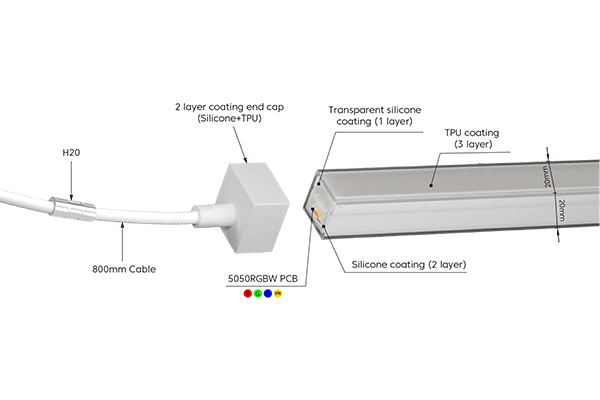
The strip body, cut end, connector, cable entry and power interface must all be considered.
What Do the Numbers in an IP Rating Mean?
An IP code describes the protection provided by an enclosure. In IP65, IP67 and IP68, the first digit “6” indicates the dust-protection classification. The second digit identifies the tested water-ingress condition.
| Rating | Water exposure represented | What buyers should not assume |
|---|---|---|
| IP65 | Protection against the specified water-jet test | Not intended as an immersion claim |
| IP67 | Protection under the specified temporary-immersion test | Not continuous or unlimited submersion |
| IP68 | Protection under continuous-immersion conditions agreed for the product | Not unlimited depth, duration or every underwater application |
Always confirm the exact standard edition, tested model, test configuration and report conditions.
Is IP68 Automatically Better Than IP65 for Every Installation?
No. The second digit identifies a test condition, not a universal quality ranking. A construction intended for immersion may not automatically carry evidence for a separate water-jet exposure unless that exposure is also covered by its testing and marking.
Match the exposure type.
Rain, directed jets, temporary flooding and continuous immersion are not the same requirement.
Match the complete assembly.
The product is only as useful as the tested strip, ends, connectors and cable entries used in the installation.
Match the evidence.
Verify the exact model and test conditions rather than relying on a generic IP icon.
Which Exposure Must the Installation Withstand?
| Installation condition | Main question before selection | Evidence to review |
|---|---|---|
| Indoor humidity or occasional splash | Can water reach the strip or connections directly? | Construction, installation instructions and applicable exposure test |
| Sheltered outdoor installation | Can wind-driven water reach the strip, ends or cable entry? | Complete sealed configuration and drainage design |
| Exposed rain or cleaning jets | What direction, pressure and frequency of water exposure are expected? | Applicable water-jet test for the exact assembly |
| Temporary flooding or immersion | What depth and duration may occur? | Temporary-immersion conditions and complete-sample evidence |
| Continuous submersion | What depth, duration, water type and temperature apply? | Product-specific IP68 conditions and application requirements |
| Chemical, saltwater or high-UV environment | Are water ingress and material degradation separate risks? | IP evidence plus separate material-resistance evidence |
This table supports initial selection only. Final suitability depends on the exact product, installation method, local requirements and model-specific documentation.
Which Parts Must Be Included in the Protection Claim?
A rating for the LED strip body does not automatically extend to an untested connector, field-cut end, extension cable or power supply.
Does Cutting the LED Strip Change Its Protection?
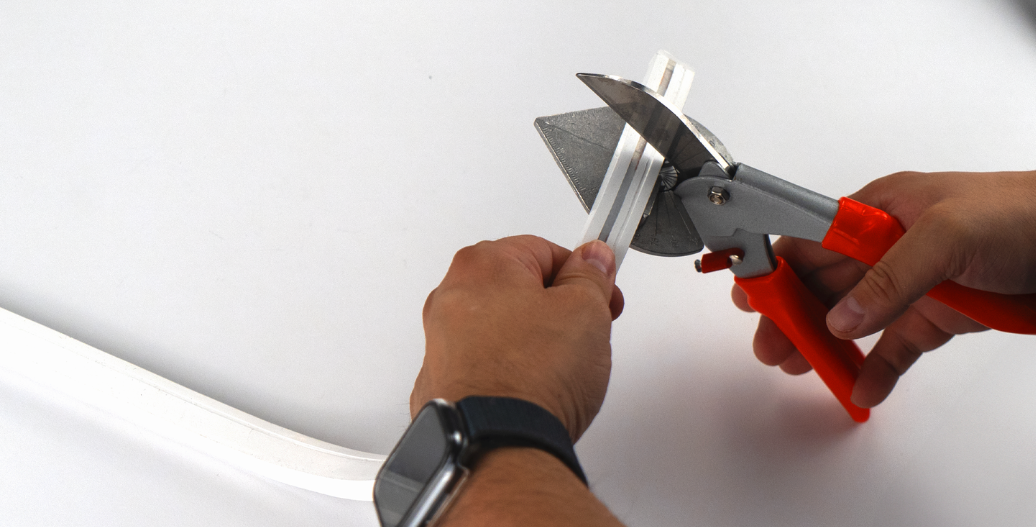
It can. Cutting exposes a new sealing boundary. The installer must use the approved end treatment, adhesive, cap, connector and curing process for the selected construction. The original rating should not be carried over automatically to a field-modified assembly.
Factory-Sealed Length
- Assembly method controlled before shipment
- End and cable entry can be identified in the evidence
- Appropriate when sealing repeatability is important
Field-Cut Length
- More installation flexibility
- Sealing depends on materials and workmanship
- May require project-specific instructions or verification
- Should not inherit an IP claim without supporting evidence
What Does an IP Rating Not Establish?
An IP code specifically measures ingress protection against solid particles and liquids (water). It is not a comprehensive durability certification.
An IP rating does not by itself establish:
Suitability for a specific wet-location electrical installation or compliance with every market’s safety requirements.
These questions require separate material, mechanical, environmental or safety evidence.
Why an IP Rating Does Not Prove UV or Chemical Resistance
What Should Buyers Request Before Approving an IP-Rated LED Strip?
A certificate image or IP logo is not enough if the buyer cannot identify the covered model and construction. Request specific documentation.
Example Water-Exposure Requirement for an LED Strip RFQ
The supplier should propose a construction only after these conditions are understood.
Copy this template into your procurement documents or emails to ensure accurate technical proposals.
Application: [indoor / sheltered outdoor / exposed outdoor / temporary immersion / continuous immersion]
Expected water exposure: [splash / rain / cleaning jet / flooding / immersion]
Exposure frequency: [occasional / regular / continuous]
Installation orientation: [horizontal / vertical / recessed / drainage details]
Required strip length: [factory-sealed or field-cut]
Connection method: [factory cable / soldered joint / solderless connector]
Cable-entry location: [describe]
Ambient temperature: [range]
Additional exposure: [UV / salt / chemicals / cleaning agents]
Required market documentation: [buyer to define]
Required evidence: [model-specific report / internal validation / order inspection]
How Can Xmart Confirm the Appropriate Construction?
Provide Xmart with the installation environment, expected water exposure, required length, cut and connection method, cable entry, temperature range and target market. Xmart can then review the available construction and identify which model-specific test or validation records apply.
Availability of IP65, IP67 or IP68 constructions varies by LED strip series and configuration. A rating published for one product must not be applied automatically to another series.
IP65, IP67 and IP68 LED Strip Questions
Common technical clarifications regarding water ingress protection.
Is IP67 always better than IP65?
Does IP68 mean unlimited underwater use?
Does the IP rating include the connector?
Can an IP65 LED strip be temporarily submerged?
Does IP68 prove resistance to chlorine or saltwater?
Can a field-cut LED strip retain the original IP rating?
Is an IP rating enough for a U.S. wet-location project?
Related Technical Resources
Describe the Exposure Before Requesting an IP Rating
Send Xmart the water source, exposure frequency, possible depth and duration, installation orientation, strip length, connection method, cable entry, temperature range and target market. This allows the proposed construction and available evidence to be reviewed against the real application.
Phone
+86 15874715712Vietnam Factory
Pho Yen City, Thai Nguyen Province, Vietnam