
12V vs 24V vs 36V vs 48V LED Strips
A practical voltage-selection guide for lighting brands, fixture manufacturers and commercial buyers comparing current, cut length, power-feed requirements and system compatibility.
Compare Voltage OptionsWhich LED Strip Voltage Should Buyers Choose?
Choose the LED strip voltage according to the required section length, power per meter, power-feed distance, cut length, driver and controller compatibility, fixture dimensions and validated end-of-run performance.
- 12V is often evaluated for shorter sections or systems already designed around 12V.
- 24V is widely used for general commercial and architectural LED strip systems.
- 36V and 48V are typically considered for purpose-designed extended-run products where reducing circuit current or intermediate feed points may benefit the installation.
A higher voltage does not automatically guarantee a specific run length, higher efficacy, lower LED temperature or better reliability.
What This Comparison Covers
Included
- • Conventional low-voltage LED strips
- • Single-color and non-addressable multichannel strips
- • Constant-voltage power systems
- • Purpose-designed 36V and 48V extended-run models
Not included
- • Tunnel and mining route lighting
- • Special mini-cut circuit designs
- • Addressable pixel strips
- • AC mains-voltage strips
Note: A special 24V mini-cut strip may have a shorter cut length than a conventional 12V strip. A regulated 48V long-run strip may perform very differently from a conventional 48V circuit. Always compare the identified product architecture rather than applying a general voltage rule to every LED strip category.
How Does Voltage Change Current?
For the same electrical power, increasing the operating voltage reduces the current required by the LED strip system.
| Voltage | Current per Meter |
|---|---|
| 12V | 0.80 A/m |
| 24V | 0.40 A/m |
| 36V | 0.27 A/m |
| 48V | 0.20 A/m |
At the same power, a higher-voltage system carries less current. Lower current can reduce conductor voltage drop and resistive loss when the PCB and wiring resistance are otherwise comparable.
However, this does not mean that a 48V strip automatically consumes less power or operates at a lower LED temperature. Total power, circuit design, PCB construction and installation conditions still matter.
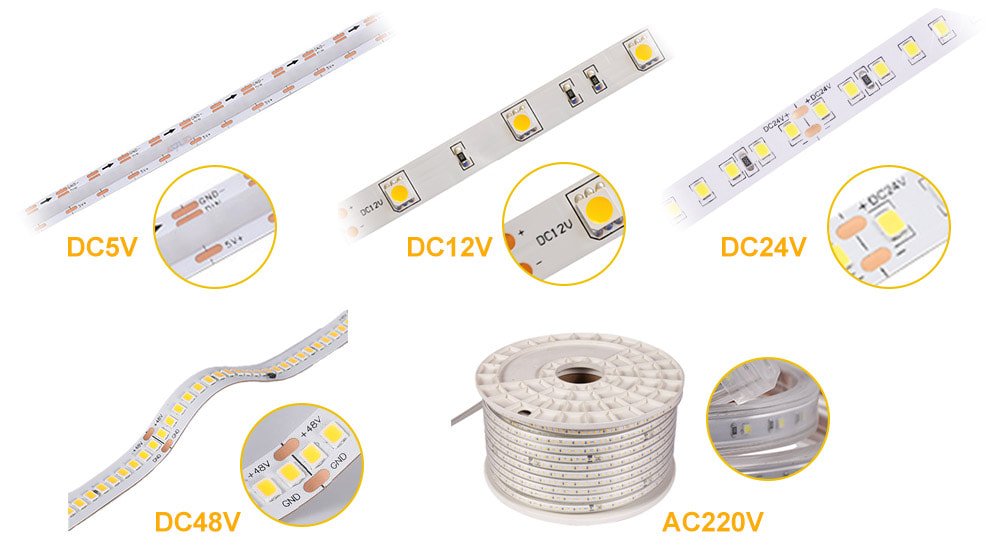
12V vs 24V vs 36V vs 48V LED Strip Comparison
| Buyer Consideration | 12V | 24V | 36V | 48V |
|---|---|---|---|---|
| Current at 9.6 W/m | 0.80 A/m | 0.40 A/m | 0.27 A/m | 0.20 A/m |
| Common system position | Short sections and existing 12V systems. | General commercial and architectural LED strip systems. | Purpose-designed extended-run systems requiring compatible 36V components. | Purpose-designed extended-run systems where reduced current or fewer feed points may be useful. |
| Cut-length tendency | Conventional circuits often use smaller electrical groups, which may support shorter cut units. | Conventional cut units may be longer than equivalent 12V circuits. | Cut length is strongly dependent on the selected circuit design. | May require longer circuit sections; confirm the exact model before fixture design. |
| Power-feed planning | More sensitive to conductor loss at the same power and PCB construction. | Lower current than 12V at the same power, but feed planning is still required. | May support extended runs when combined with a purpose-designed circuit. | May support longer validated runs, but voltage alone does not determine the limit. |
| Driver & controller compatibility | Confirm 12V constant-voltage driver and compatible controller. | Confirm 24V constant-voltage driver and controller. | Requires compatible 36V driver and control equipment; availability must be checked. | Requires compatible 48V driver and controller; channel current and voltage ratings must be checked. |
| Typical buyer starting point | Short finished sections, existing 12V platforms or applications prioritizing conventional short cut units. | General lighting brands, fixture manufacturers, commercial profiles and architectural lighting. | Extended linear systems where an approved 36V model and compatible components are available. | Extended-run commercial products where a validated 48V model can reduce current or simplify feed planning. |
|
Not determined by voltage alone:
Maximum run length
Light output
Luminous efficacy
Operating temperature
Lifetime
Color consistency
IP rating
Certification coverage
Product reliability
|
||||
These are selection tendencies, not universal product limits. The final specification must identify the exact model, watts per meter, PCB construction, cut length, feed method, operating environment and acceptable start-to-end variation.
Does a Lower Voltage Always Mean a Shorter Cut Length?
Not always.
In many conventional resistor-based LED strips, a lower operating voltage uses fewer LEDs in each electrical group, which can result in a shorter cut unit. This is why a conventional 12V strip may offer finer cutting resolution than a comparable 24V strip.
However, cut length is ultimately determined by circuit architecture—not by voltage alone.
Special mini-cut products, regulated circuits and other purpose-designed strips can use different electrical arrangements. Buyers should therefore confirm the actual cut mark and cut-unit length for the proposed model.
Procurement Tip
Do not design a fixture around an assumed cut length. Put the required cut length in the RFQ and ask the supplier to identify the matching model.
How Should Commercial Buyers Choose an LED Strip Voltage?
Follow this 5-step process to define the electrical requirements before requesting samples.
Check the Existing System
If the fixture, vehicle, driver or controller already operates at a fixed voltage, compatibility may determine the starting point.
Define the Finished Section Length
State the physical installed length and clarify whether it is one electrical run or several separately powered sections.
Define Power per Meter
Higher watts per meter increase current and conductor loss. Voltage should be compared using the same target power.
Define the Feed Arrangement
Confirm one-end, two-end, center-feed or multiple parallel branch requirements.
Validate the Proposed Model
Measure start and end voltage, input power, light-output variation and operating temperature under the intended installation conditions.
Voltage Selection Examples
Short Furniture Sections
Project Condition
- • Multiple short sections
- • Frequent corners
- • Short finished lengths
- • Limited space for unused cut segments
Selection Direction
A conventional 12V model may be evaluated when shorter cut units are important. A suitable 24V product may still work if its actual cut length matches the furniture dimensions.
Commercial Cove Lighting
Project Condition
- • Several-meter linear sections
- • Standard commercial driver system
- • Planned power-feed access
- • Conventional architectural profile
Selection Direction
24V is a practical starting point for many commercial cove systems. The installer must still divide the system into correctly powered electrical sections and verify end-of-run performance.
Extended Commercial Corridor
Project Condition
- • Long continuous visual line
- • Limited intermediate feed locations
- • Defined start-to-end light tolerance
- • Space for compatible drivers and controls
Selection Direction
Evaluate a purpose-designed 36V or 48V long-run model. The supplier must provide the tested configuration, power per meter, feed method, cable conditions and permitted light variation.
These examples identify a starting voltage for evaluation. They are not guaranteed maximum-run specifications.
Why Can’t Maximum Run Length Be Chosen by Voltage Alone?
Two LED strips with the same voltage can have very different usable run lengths.
The result depends on:
- Watts per meter
- PCB width and copper conductor design
- Circuit segmentation
- On-strip current regulation
- IP encapsulation
- One-end or two-end feed
- Driver and cable location
- Connector current rating
- Ambient temperature
- Aluminum profile
- Permitted voltage and light-output variation
The length that still lights up is not necessarily the length that remains within specification.
What Data Should Buyers Request Before Approving a Voltage?
- Exact LED strip model
- Rated voltage
- Nominal and measured watts per meter
- PCB width and relevant conductor specification
- Cut-unit length
- Maximum validated single-feed length
- One-end, two-end or center-feed condition
- Start and end voltage
- Start and end light-output variation
- Ambient and operating temperature
- Bare or IP-rated construction
- Required driver and controller
- Applicable certification coverage
- Test date and sample reference
A Quick Question
How should buyers verify a long-run LED strip?
Ask for model-specific electrical and optical data showing the tested length, power load, feed method, start and end voltage, light variation and temperature conditions.
How Does Xmart Recommend a Voltage for an OEM Project?
Xmart reviews the intended application, installed section length, watts per meter, cut-length requirement, power-feed access, control method, target market and acceptable end-of-run variation before proposing a voltage.
For general commercial products, 12V and 24V options may be compared first. For extended-run requirements, Xmart may evaluate purpose-designed 36V or 48V models.
The final model, supported length, production route and certification coverage are confirmed before sampling or order approval.
LED Strip Voltage Questions
Is 24V LED strip better than 12V?
Does 48V LED strip run four times farther than 12V?
Does a higher voltage make an LED strip brighter?
Does a higher voltage make an LED strip more efficient?
Can a 24V LED strip be connected to a 48V driver?
Why can a 48V LED strip have a longer cut length?
Which voltage is best for commercial LED strip lighting?
Are Tunnel & Mining LED Strips included in this comparison?
Need Help Selecting an LED Strip Voltage?
Send Xmart your installed section length, watts per meter, profile dimensions, cut-length requirement, power-feed plan, control method and target market. The engineering team can compare suitable voltage and model options for sampling.
Direct Contact
Pho Yen City, Thai Nguyen Province, Vietnam (Vietnam Factory)
Related Engineering Resources
Last reviewed: October 2025
Technical review: Xmart Engineering Team